Why Curtains Near a Space Heater Can Create a Serious Home Safety Risk
Minjin Park
·
Curtains near a space heater can overheat, block airflow, or catch fire if placed too close. Learn practical ways to use portable heaters more safely at home.
On a cold morning or chilly evening, a space heater can feel like the easiest fix.
You set it near the window where the draft is coming in. Maybe it sits beside the bed, next to the couch, or near a desk. The warm air starts blowing, the room feels better, and you get comfortable.
But there is one detail many people overlook: curtains.
Curtains are often right where people want to place a heater. They hang near windows. They move with air currents. They can brush against furniture. Some are long enough to touch the floor. Some are lightweight and flowy. Some are thick, heavy, and meant to block cold air.
That combination matters.
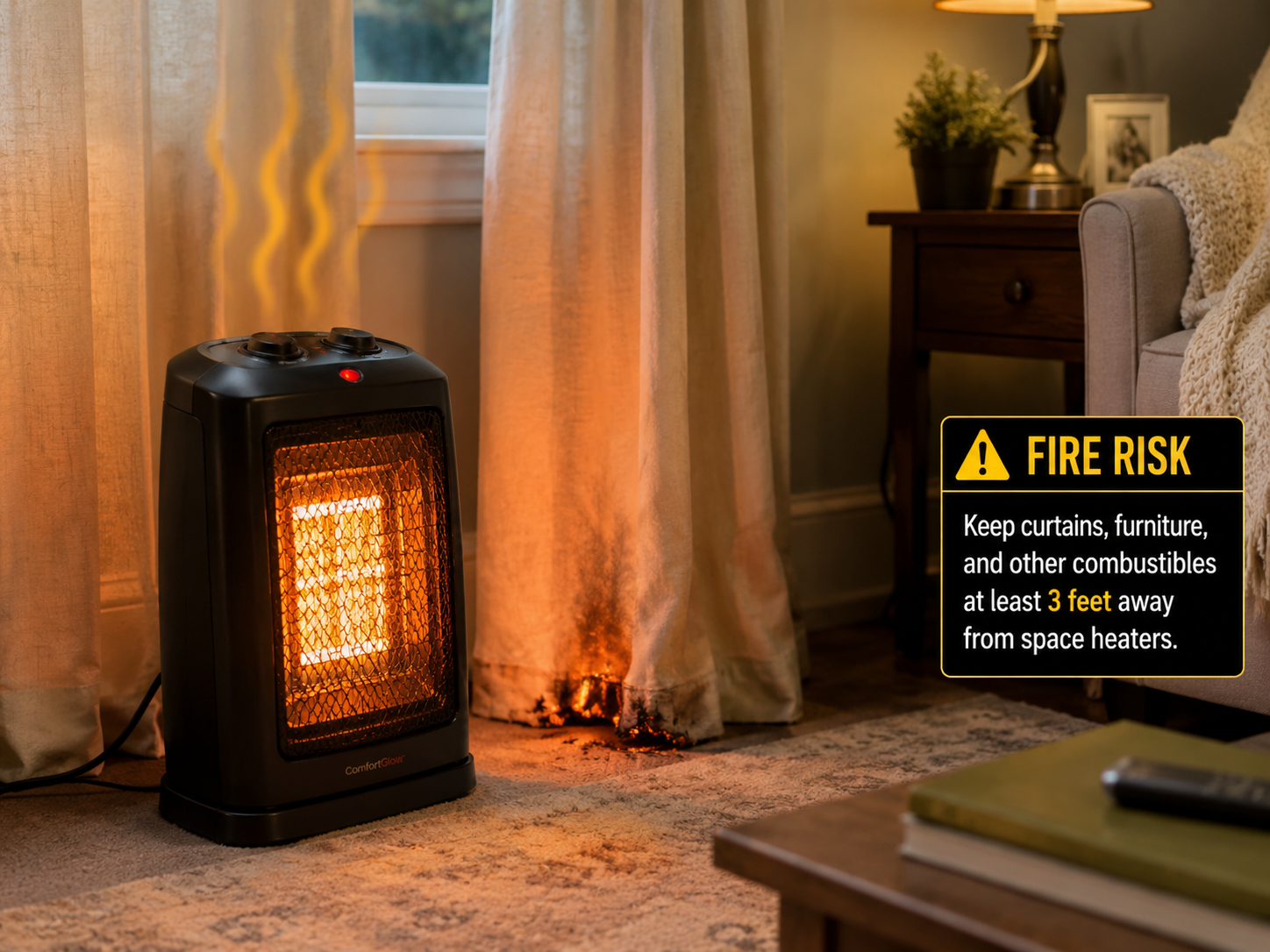
A space heater produces concentrated heat. Curtains are fabric. If they are too close, they can overheat, discolor, melt, scorch, smoke, or catch fire. Even if nothing dramatic happens right away, repeated heat exposure can weaken fabric and create a risky setup.
This does not mean you can never use a space heater in a room with curtains. Most homes have curtains somewhere. The key is distance, airflow, and supervision.
A heater should warm the room, not the curtains.
Why Curtains and Space Heaters Are a Bad Match
Curtains are made to hang, move, and cover an area. Space heaters are made to produce heat in a focused zone.
That creates a problem when the two are placed too close together.
The heater may blow warm air directly into the fabric. Radiant heat may build up against the curtain. A curtain panel may shift and fall closer than expected. A long curtain may rest near the heater without you noticing. If the heater is placed near a window, the curtain can trap heat between the fabric and the wall.
A small gap can disappear quickly if someone opens the curtain, closes it, bumps it, or if airflow moves it.
Unlike a table or wall, fabric does not stay perfectly still. That is why curtains require extra caution around any heat source.
The Main Accident: Fabric Overheating or Catching Fire
The most obvious concern is fire.
Curtains, drapes, sheers, and fabric panels can ignite if exposed to enough heat. Some materials burn faster than others. Lightweight synthetic curtains may melt or shrink. Cotton or linen curtains may scorch or catch. Heavy blackout curtains may trap heat and smolder before anyone notices.
The danger is not always instant flames. Sometimes the warning signs are smaller:
A hot fabric smell
Discoloration near the heater
A brown or yellow patch
A melted edge
Curling or stiff fabric
Smoke-like odor
A curtain that feels unusually warm
These are signs that the heater is too close.
If you ever notice fabric warming up, changing color, or smelling odd near a heater, turn the heater off and move it away before using it again.
Curtains Can Block Heater Airflow
A space heater needs clear space around it to work properly.
When curtains hang in front of the heater or too close to the intake or output area, airflow can become blocked. That can cause the heater to work harder, overheat, or shut off if it has a safety feature.
Blocked airflow can also make the room heat unevenly. Instead of warming open air, the heater may heat the curtain, wall, or window area. That wastes energy and increases risk at the same time.
A heater should not be tucked behind a curtain, half-covered by fabric, or placed where the curtain can blow across the front.
If warm air cannot leave the heater freely, the setup is not safe.
Window Areas Are Especially Tempting
People often place heaters near windows for a simple reason: windows feel cold.
If there is a draft, the instinct is to put the heater right where the cold air enters. But windows are also where curtains, blinds, cords, and fabric gather.
This makes window-side heater placement tricky.
A heater under a window may seem practical, but long curtains can hang directly above it. Even short curtains may move into the warm air stream. If the heater is on the floor, floor-length curtains can drape near or behind it.
In bedrooms, this is especially common. A heater may be placed beside the bed near the window, with curtains behind it and bedding nearby. That creates several soft materials close to heat.
A better choice is usually to place the heater on a hard, flat surface away from the window treatment, with open space around it.
“It Has Safety Features” Is Not Enough
Many modern space heaters include safety features such as automatic shutoff, tip-over protection, or overheat protection. These are helpful, but they are not permission to use the heater carelessly.
Safety features can reduce risk, but they do not remove it.
A tip-over switch may shut off the heater if it falls, but it may not help if a curtain slowly drapes near the heat. Overheat protection may turn the unit off if internal temperature rises too high, but nearby fabric can still become too warm before that happens.
Also, not every heater is equally reliable, and older heaters may not have current safety features.
Treat safety features as backup, not the main plan.
The main plan is still simple: keep the heater away from anything that can burn.
Common Curtain-Related Space Heater Mistakes
Placing the Heater Under Long Curtains
This is one of the most common risky setups.
A heater sits on the floor below a window, and long curtains hang above or behind it. At first, there may be a few inches of space. But curtains can shift. Someone may close them. A pet may brush against them. Warm air may move the fabric.
Long curtains and floor heaters need generous separation.
Letting Curtains Blow Toward the Heater
If a fan, open door, draft, or heater airflow moves the curtain, the distance can change constantly.
A curtain that seems safe when still may become unsafe when moving. Lightweight sheer curtains are especially easy to lift or pull into warm air currents.
Using a Heater Behind Furniture Near Curtains
Sometimes a heater is placed beside a couch, bed, or chair near a curtained window. This can create a tight pocket where heat builds up.
The heater may be too close to the curtain, furniture, blanket, pillow, or rug all at once.
Space heaters need breathing room. A crowded corner is not a good place.
Leaving the Heater On While Sleeping
Using a space heater while sleeping adds risk because no one is watching. If a curtain shifts, fabric overheats, or the heater malfunctions, you may not notice quickly.
For safer use, turn portable heaters off before sleeping or leaving the room.
While this is not specifically a curtain issue, it often happens in the same setup: the heater is placed by a window, but the outlet is far away, so someone runs a cord behind curtains or furniture.
That is not a safe arrangement. Plug the heater directly into a wall outlet when the manufacturer instructs it, and keep cords visible and away from heat.
How Far Should Curtains Be From a Space Heater?
A commonly recommended rule is to keep space heaters at least three feet away from anything that can burn. That includes curtains, bedding, furniture, paper, clothing, rugs, and holiday decorations.
Three feet is not just a random number. It gives fabric room to move without easily entering the heater’s heat zone.
For curtains, think about both the current position and the possible position.
Ask:
Could the curtain move closer if the window is opened?
Could someone close the curtain and cover the heater?
Could a pet or child pull the fabric?
Could the heater airflow push the curtain?
Could the curtain fall if the rod loosens?
Is the heater below the curtain or beside it?
If the answer is yes, move the heater.
Warning Signs Your Heater Is Too Close to Curtains
Pay attention to small clues. They often show up before anything serious happens.
The Curtain Feels Warm
Curtains should not feel warm from the heater. If they do, the heater is too close.
The Fabric Smells Hot
A warm fabric, plastic, dusty, or scorched smell is a warning. Turn off the heater and check the area.
The Curtain Moves When the Heater Runs
If the heater’s fan pushes the curtain, the curtain is in the wrong zone. It may not touch the heater now, but movement makes the setup unpredictable.
You See Discoloration
Brown, yellow, shiny, melted, or stiff areas near the heater mean the fabric has already been affected by heat.
The Heater Keeps Shutting Off
If the heater’s overheat protection keeps turning it off, airflow may be blocked or the unit may be too close to objects. Do not keep restarting it without fixing the setup.
The Area Around the Heater Feels Crowded
A heater should not be squeezed between curtains, furniture, blankets, and cords. If it looks cramped, it probably is.
Safer Ways to Use a Space Heater in a Room With Curtains
Place the Heater on a Hard, Flat Surface
A space heater should sit on a stable, level surface. Avoid placing it on beds, couches, rugs, thick carpet, or furniture unless the manufacturer specifically says that setup is allowed.
For most portable heaters, the floor is best — but only if it is flat, stable, and away from fabric.
Keep the Three-Foot Zone Clear
Before turning the heater on, look around it in every direction.
Move curtains, blankets, laundry, paper, pet beds, and furniture away. Do not focus only on the front of the heater. Heat can affect nearby objects on the sides and back too, depending on the design.
Tie Back Curtains Safely
If curtains are near the area, tie them back well away from the heater. Do not let the tied fabric hang close to warm air.
Make sure the tieback is secure. A loose tieback that slips later can create a problem.
Use the Heater in an Open Area
A heater works better and more safely when warm air can circulate. Place it where it can warm the room without blowing directly into fabric, furniture, or walls.
Avoid tight corners with curtains.
Turn It Off When Leaving the Room
Even if you are only stepping away for a few minutes, turn the heater off. A curtain can shift, a pet can move, or an object can fall while you are gone.
This is one of the simplest habits for preventing space heater accidents.
Turn It Off Before Sleeping
A space heater may feel comforting at bedtime, but sleeping removes your ability to watch it. Warm the room before bed, then turn the heater off before going to sleep.
If the room stays too cold, consider safer long-term solutions like better insulation, weatherstripping, heavier bedding, or a professionally checked heating system.
Bedroom Setups Need Extra Care
Bedrooms often combine several risk factors: curtains, bedding, rugs, clothing, books, chargers, and sleepy people.
A heater near a bed can end up close to sheets, comforters, throw blankets, pillows, robe belts, or curtains. A blanket can slip during the night. A curtain can move. A person can wake up groggy and knock something over.
If you use a heater in a bedroom, place it away from the bed and away from window treatments. Keep the floor clear around it. Do not run it while sleeping.
Also check where the cord goes. It should not run under rugs, across walkways, behind curtains, or under furniture where heat damage may go unnoticed.
Living Rooms Have Their Own Risks
In living rooms, heaters are often placed near couches, curtains, and entertainment areas.
This can be risky because people relax and stop paying attention. A throw blanket may slide off the couch. A newspaper may fall. A pet bed may be placed nearby. Curtains may hang behind the heater near a window.
Try placing the heater where it can be seen easily. If it is hidden behind furniture, it is easier to forget and harder to monitor.
A heater should not disappear into the background.
Kids, Pets, and Curtains Near Heaters
Children and pets make curtain safety even more important.
A child may pull a curtain while playing. A cat may climb it. A dog may brush against it. A toddler may move a blanket or toy near the heater. A pet bed may be dragged closer to warmth.
If you have children or pets, create a clear heater zone. Keep the heater out of high-traffic paths and away from anything that can be pulled, bumped, or knocked over.
Consider using physical barriers only if they are designed for heater safety and do not block airflow. Do not improvise with blankets, laundry baskets, or furniture pushed too close.
These questions take less than a minute and can prevent a bad setup.
What Not to Do
Do not place a heater under curtains.
Do not use a heater to “dry” curtains, clothes, towels, or blankets.
Do not tuck a heater behind furniture to hide it.
Do not run a heater while sleeping.
Do not leave a heater on when you leave the room.
Do not ignore hot smells, discoloration, or repeated shutoffs.
Do not use a damaged heater with a frayed cord, cracked housing, loose plug, or strange noises.
Do not assume a small heater is harmless just because it is compact.
Small heaters can still produce enough heat to start a fire if used carelessly.
A Better Way to Warm a Drafty Window Area
If the room feels cold because of a drafty window, placing a heater right next to the curtains is not the only solution.
Try safer options first:
Close curtains after the heater is off and away from them.
Use weatherstripping around drafty windows.
Add insulated curtains, but keep them away from heat sources.
Use draft stoppers at doors.
Wear warmer layers indoors.
Use blankets safely away from the heater.
Have persistent heating issues checked by a qualified professional.
The goal is to reduce the need for a risky heater position.
Final Thoughts: Keep Heat and Fabric Apart
A space heater can make a cold room more comfortable, but it needs clear space to operate safely. Curtains near a heater create a risk because fabric can move, trap heat, block airflow, scorch, melt, or catch fire.
The safest habit is simple: keep curtains and all other flammable items at least three feet away from the heater. Place the heater on a stable surface, keep airflow clear, plug it in properly, and turn it off when you leave the room or go to sleep.
You do not need to be nervous every time you use a heater. Just be intentional.
Before turning it on, look around. Are the curtains close? Could they move? Is the heater crowded?
If the answer gives you pause, move the heater first. A warmer room should still be a safer room.
Hi, I’m the creator and editor behind ZestyHabit. I research everyday safety, first aid, and practical wellness topics using official guidance and reliable public sources, then turn that information into clear, realistic steps for daily life.
My goal is to help readers make safer, better-informed choices at home and beyond.