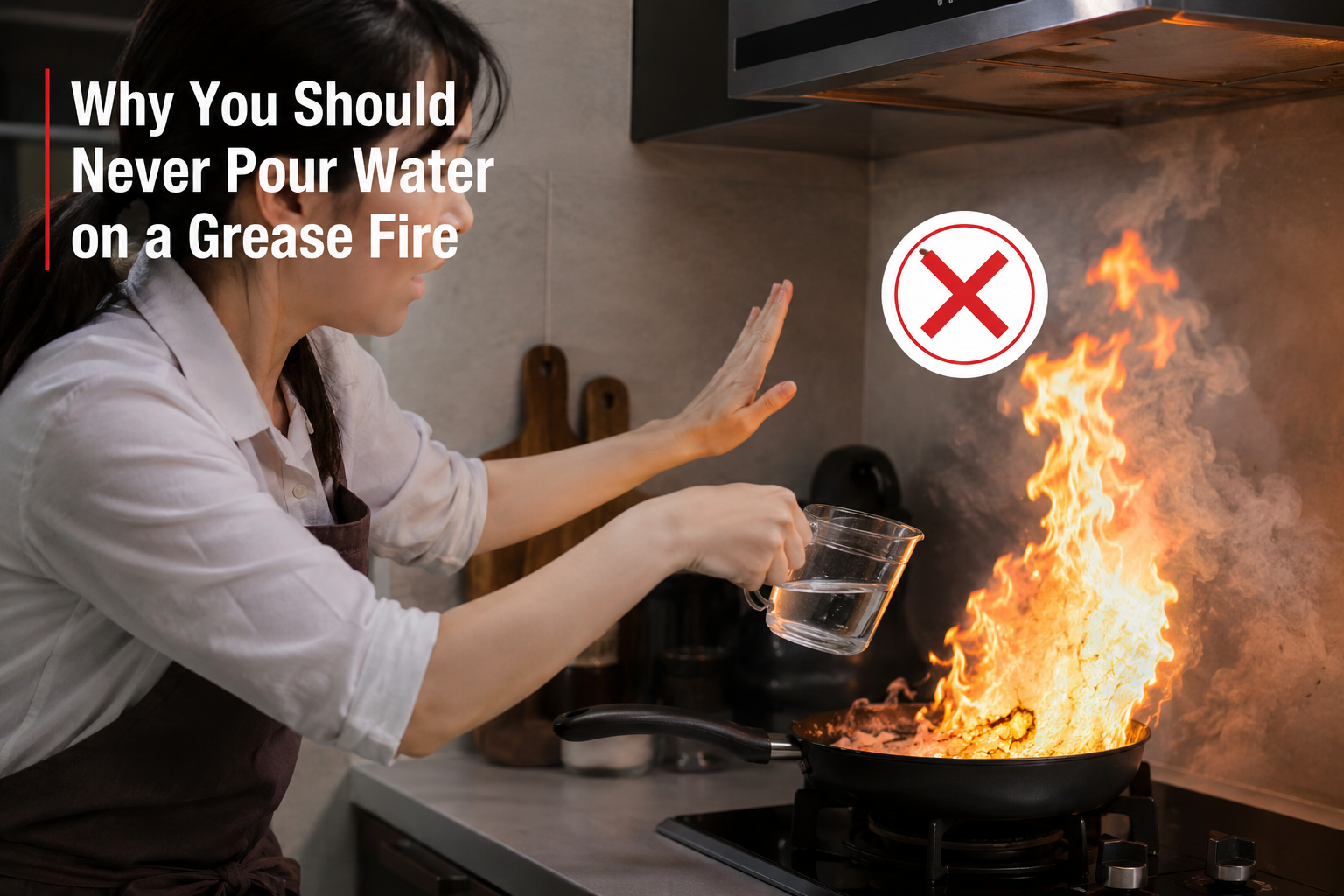
Pouring water on a grease fire can make flames spread fast. Learn why grease fires behave differently, what common mistakes to avoid, and simple kitchen habits that help reduce the risk.
When people see fire, the first thing that comes to mind is usually water.
That makes sense in many situations. A campfire? Water. A candle flame? Water may work. A small paper fire? Water can help. So when flames suddenly appear in a pan of hot oil, it is natural for someone to think, “I need to throw water on this.”
But with a grease fire, water is one of the worst things you can add.
A grease fire is different from many other small household fires because it involves hot cooking oil or fat. Oil and water do not mix, and hot oil behaves in a very specific, dangerous way when water hits it. Instead of cooling the fire safely, water can cause the burning oil to splash, burst upward, and spread flames across the stovetop, counter, floor, or nearby person.
You do not need to be a professional chef to benefit from this knowledge. Grease fires can happen in ordinary kitchens while frying bacon, cooking chicken, making fries, browning ground beef, or heating oil in a skillet. Most of the time, cooking with oil is completely manageable. The key is knowing how to prevent trouble and how not to make a small problem worse.
What Is a Grease Fire?
A grease fire happens when cooking oil, fat, or grease becomes hot enough to ignite. This can happen in a skillet, saucepan, deep fryer, wok, baking tray, or even on a stovetop surface where grease has collected.
Common sources include:
Cooking oil Butter or margarine Bacon grease Animal fat Deep-frying oil Greasy food residue Oil splatter around burners
A grease fire may begin with smoke, a sharp hot-oil smell, or oil that starts shimmering aggressively. If the oil continues heating, it may reach its smoke point and then its ignition point.
The moment flames appear, the situation changes. At that point, it is no longer just “hot oil.” It is burning fuel.
That is what makes a grease fire tricky. The oil itself is feeding the flames. Anything that spreads the oil can spread the fire.
Why Water Makes a Grease Fire Worse
Water and grease do not behave well together, even when there is no fire.
You have probably seen this while washing a greasy pan. Water beads up and rolls around because oil repels it. Oil floats on top of water because it is less dense. The two separate instead of blending.
Now imagine that same relationship when the oil is extremely hot and burning.
Water sinks below the oil
When you pour water into a pan of burning oil, the water does not simply sit on top and cool the surface. It is heavier than oil, so it sinks underneath.
That means the water drops below a layer of extremely hot grease.
The water turns into steam very quickly
Once the water sinks into the hot oil, it can turn into steam almost instantly. Steam takes up much more space than liquid water. That sudden expansion can force hot oil upward and outward.
This is the part people do not expect.
Instead of calming the flames, water can launch burning oil out of the pan.
Burning grease can splash across the kitchen
When hot oil sprays out, the fire can spread with it. Flames may jump onto the stovetop, nearby towels, cabinets, clothing, skin, or the floor.
This is why a small pan fire can become much more serious after someone throws water on it.
The danger is not just that water “doesn’t work.” The danger is that water can turn a contained fire into a spreading fire.
Why This Matters in Everyday Cooking
Grease fires are not limited to restaurants or deep-frying disasters. They can happen during normal home cooking.
You may be making breakfast and heating bacon grease. You may be shallow-frying chicken cutlets. You may be reheating oil to crisp leftovers. You may be roasting oily food in the oven. You may be cooking with a pan that still has grease from earlier.
Most kitchens have oil, paper towels, dish towels, wooden utensils, food packaging, and cabinets nearby. That is why a small flame in a pan deserves attention.
The goal is not to scare people away from cooking. It is to remove the one reaction that can make the situation much worse: reaching for water.
A calm, prepared kitchen is safer than a panicked one.
Common Ways Grease Fires Start
Grease fires often begin with small cooking habits that seem harmless at first.
Leaving oil heating unattended
This is one of the biggest causes. Oil can heat faster than expected, especially in a thin pan or on a high burner.
You may step away to answer the door, check your phone, wash vegetables, or grab something from another room. By the time you come back, the oil may be smoking heavily.
Hot oil should not be treated like boiling water. Water gives more obvious signs as it heats. Oil can look quiet for a while and then suddenly become dangerously hot.
Using heat that is too high
Many people turn the burner high to save time. That can be risky with oil.
High heat may be fine for a quick sear when you are standing right there, but it is not ideal for slowly heating oil while distracted. Oil can pass from warm to smoking to igniting quicker than people realize.
Medium or medium-high heat is often enough for many home cooking tasks.
Overfilling a pan with oil
Too much oil in a small pan creates more splash risk. If food is added too quickly or moisture hits the oil, bubbling can rise over the sides.
If oil spills onto a burner or hot surface, it can ignite.
Adding wet food to hot oil
Water trapped on food can cause splattering. Frozen food, freshly washed vegetables, damp potatoes, or wet meat can all make hot oil pop.
This does not mean food must be perfectly dry, but extra moisture should be reduced. Patting food with a paper towel before frying can make cooking calmer and safer.
Letting grease build up
Grease around burners, in drip pans, on the stovetop, or inside the oven can become fuel. A small flare-up may spread faster if old grease is sitting nearby.
Regular cleaning is not just about looks. It is part of fire prevention.
Warning Signs Before Oil Becomes Dangerous
A grease fire can feel sudden, but there are often warning signs first.
The oil begins to smoke
Smoke is a major signal that oil is too hot. Different oils have different smoke points, but visible smoke usually means it is time to lower or remove heat.
Do not ignore smoking oil because “the recipe said high heat.” Your pan, burner, and oil may behave differently from the recipe writer’s kitchen.
The smell becomes sharp or burnt
Hot oil has a smell. Overheated oil has a stronger, sharper smell. If it smells scorched or unpleasant, reduce the heat.
The oil looks unusually thin or shimmery
Oil often shimmers when it is hot enough for cooking. But if it looks aggressively rippled, extremely thin, or starts giving off smoke, it may be too hot.
Food is browning too fast
If food darkens quickly on the outside while staying undercooked inside, the heat may be too high. This can also increase smoking and splattering.
Splattering becomes intense
Some popping is normal when cooking with oil. But heavy splattering, especially when food is wet or the pan is crowded, is a sign to adjust.
What Not to Do During a Grease Fire
It is worth repeating the common mistakes because they often come from panic.
Do not pour water on it
Water can spread burning oil. This is the main rule.
Even a cup of water can make flames burst upward. A sink sprayer is also a bad idea. The force of spraying water can spread burning grease even more.
Do not carry the burning pan
It may seem logical to move the pan to the sink or outside. But carrying a flaming pan is risky.
Hot oil can spill onto your hands, arms, floor, clothing, or counters. A sudden movement can spread flames. Even if the fire looks small, the pan may be unstable and extremely hot.
Do not throw flour or baking powder on it
Some people confuse kitchen powders with fire-extinguishing materials. Flour can burn, and powdery ingredients can scatter into the air. This is not a reliable or safe method.
Baking soda is sometimes mentioned for very small grease fires, but relying on pantry ingredients can be risky because people may grab the wrong container or use too little. For everyday safety, prevention and proper equipment are much better.
Do not fan the flames
Waving a towel, opening a nearby window directly over the fire, or trying to blow on it can feed the flames with more oxygen or spread heat.
Do not keep cooking
If oil is smoking heavily or flames appear, do not try to “finish the food.” Turn your attention fully to safety.
Safer Ways to Reduce the Risk
This article is about general home safety awareness, not emergency training. But there are simple prevention habits every home cook can use.
Stay near the stove when heating oil
This one matters most.
If oil is heating, stay in the kitchen. If you need to leave, turn off the burner first. A few seconds of inconvenience is better than coming back to smoking oil.
Use the right pan size
Choose a pan with enough room for the oil and food. Crowding a small pan makes splattering more likely.
A deeper skillet or pot may be better for frying than a shallow pan.
Keep food dry before frying
Pat excess moisture from food when possible. Be especially careful with frozen items or washed vegetables.
Water hitting hot oil is what causes much of the popping and splattering people associate with frying.
Heat oil gradually
You do not always need the highest burner setting. Heating oil gradually gives you more control and more time to notice smoke or smell changes.
Keep the stovetop clear
Move dish towels, paper towels, oven mitts, cardboard packaging, plastic bags, and wooden utensils away from the burners.
A cluttered stovetop gives a small flame more things to reach.
Clean grease buildup
Wipe up oil splatter after the stove cools. Clean drip areas, burner surroundings, and oven spills regularly.
Grease residue can become fuel later.
Use a lid that fits the pan
Having a matching lid nearby can be helpful while cooking with oil. The lid should fit well and be easy to reach without leaning over the flames.
Do not store lids in a far cabinet where you would have to search while stressed.
Keep proper fire safety tools nearby
Many kitchens benefit from having a fire extinguisher rated for kitchen use. The important part is not just owning one, but knowing where it is and how to use it before you need it.
For grease and cooking fires, people often look for extinguishers labeled for Class B or Class K use, depending on the setting and product. Home kitchens commonly use multi-purpose extinguishers. Read the label and follow manufacturer guidance.
A fire blanket may also be useful in some homes, but again, it should be stored accessibly and used according to instructions.
How to Think About Small Pan Fires Calmly
The best time to think about a grease fire is before one happens.
If a small flame appears in a pan, the broad idea is to remove heat and oxygen without spreading the oil. Water does the opposite because it can splash the burning grease.
A fitting metal lid or baking sheet may help smother a small contained pan fire by cutting off oxygen, but only if it can be done safely without reaching over flames. Turning off the burner may remove the heat source. After that, the pan needs time to cool.
Do not peek too soon if something has been covered. Lifting a lid can let oxygen rush back in.
And if a fire is not small, is spreading, or you feel unsure, leave the area and call emergency services. That is not overreacting. It is what they are there for.
Again, this is not meant to replace local fire safety training or official instructions. It is a practical reminder: do not add water, do not move the pan, and do not take chances with spreading flames.
The Role of Cooking Oil Choice
Different oils tolerate heat differently. Some oils smoke at lower temperatures, while others can handle higher heat.
For example, oils used for high-heat cooking are usually chosen because they have higher smoke points. Oils with lower smoke points may start smoking sooner.
But oil choice is not a complete safety solution. Any cooking oil can become dangerous if overheated. Even a high smoke point oil can ignite if left on a hot burner long enough.
So instead of relying only on the type of oil, focus on habits:
Use the right amount. Watch the pan. Adjust the burner. Notice smoke early. Avoid distractions.
A good oil cannot make up for an unattended stove.
Why Deep Frying Needs Extra Attention
Deep frying can be done safely at home, but it requires more care than quick sautéing.
A pot of hot oil contains a lot of fuel. If it overheats, spills, or reacts with moisture, the result can be more serious than a small splash in a skillet.
Do not fill the pot too high
Oil rises when food is added. If the pot is too full, it may overflow.
A good rule is to leave plenty of space at the top of the pot. The exact amount depends on the pot and food, but crowding is never helpful.
Add food slowly
Dropping food from a height can splash oil. Add food gently, using tongs or a suitable tool.
Be careful with frozen food
Frozen food can carry ice crystals. Ice is water, and water in hot oil creates violent bubbling.
Follow package directions and avoid adding icy, wet food carelessly.
Use a thermometer if possible
Guessing oil temperature is difficult. A cooking thermometer gives better control and helps prevent overheating.
Oven Grease Fires Can Happen Too
Grease fires are not only stovetop events.
Oven fires can start when grease drips onto the bottom of the oven, spills from a roasting pan, or builds up over time. You may notice smoke first, especially when roasting fatty meat or reheating greasy food.
To reduce the risk:
Use a pan with sides for oily foods. Avoid overfilling trays. Clean spills after the oven cools. Do not ignore repeated oven smoking. Use foil only according to appliance instructions.
If something in the oven catches fire, keeping the door closed can help limit oxygen, and turning off the oven removes heat. Opening the door wide may feed the flames. If you are unsure or the fire continues, leave and call for help.
Teaching Family Members the Water Rule
One of the simplest ways to make your kitchen safer is to make sure everyone in the home knows the same rule:
Never put water on a grease fire.
This is especially important for teens, roommates, elderly family members, or anyone who cooks occasionally but may not know fire behavior.
You do not need to give a dramatic lecture. A simple explanation works:
“Oil and water don’t mix. If water hits burning oil, it can splash flames everywhere.”
That one sentence is memorable.
You can also show where the fire extinguisher is, keep a lid near the stove, and agree that nobody should carry a burning pan.
Everyday Prevention Checklist
Before cooking with oil:
Choose a pan with enough space. Move towels and packaging away from the stove. Dry wet food as much as practical. Keep a fitting lid nearby. Stay in the kitchen while oil heats.
While cooking:
Use moderate heat when possible. Watch for smoke. Turn heat down if oil smells burnt. Avoid crowding the pan. Add food gently.
After cooking:
Turn off the burner. Move the pan away from heat if safe. Let oil cool before handling. Dispose of oil properly. Wipe grease splatter after surfaces cool.
These habits are simple, but they reduce the chance of being surprised by overheating oil.
A Calm Way to Remember It
Kitchen safety advice can sometimes sound intense, but this rule is actually very simple.
Water is for many fires. Water is not for grease fires.
With grease, the goal is to avoid spreading the burning oil. That means no water, no carrying the pan, and no panicked splashing or fanning.
If you cook with oil often, keep your setup simple and predictable. Use a stable pan. Stay nearby. Keep clutter away from the stove. Watch for smoke. Know where your lid and extinguisher are. And make sure the people in your home know the same basic rule.
Final Thoughts: A Small Piece of Knowledge That Really Matters
A grease fire can start in an ordinary kitchen on an ordinary day. It does not mean someone is careless or a bad cook. Sometimes oil gets too hot, food splatters, or distractions happen.
What matters is knowing what not to do.
Pouring water on a grease fire can cause burning oil to splash and spread, turning a small contained flame into a much bigger problem. Once you understand that, the safer habits become easier to remember.
Stay near heating oil. Keep the stove area clear. Use moderate heat. Watch for smoke. Keep a proper lid and fire safety tools within reach. And above all, do not use water on burning grease.
It is a simple rule, but it is one of the most important kitchen safety habits a home cook can learn.
Hi, I’m the creator and editor behind ZestyHabit. I research everyday safety, first aid, and practical wellness topics using official guidance and reliable public sources, then turn that information into clear, realistic steps for daily life.
My goal is to help readers make safer, better-informed choices at home and beyond.