When Staying Inside After an Earthquake May Be Safer Than Rushing Outdoors
Minjin Park
·
After an earthquake, running outside can feel like the obvious move. But in some situations, staying inside a little longer may protect you from falling debris, broken glass, aftershocks, and street-level hazards.
When the floor moves under you, your body does not pause to read a safety manual.
It wants out.
That reaction is understandable. A building is supposed to feel solid. When it shakes, creaks, sways, or drops things from shelves, every nerve in your body may scream, “Leave now.”
But earthquakes are strange that way. The thing that feels safest in the moment is not always the safest move.
In many situations, rushing outside during or immediately after shaking can put you closer to falling glass, bricks, roof tiles, power lines, traffic, trees, signs, and pieces of damaged buildings. USGS guidance says that if you are indoors during an earthquake, you should stay there, drop, cover, and hold on, and avoid running outside while shaking or falling debris may still be a danger.
That does not mean you should always stay inside forever. It means there is a difference between getting out safely and bolting toward danger because panic is driving.
A few seconds of judgment can matter.
Why Doorways and Exits Can Be Dangerous
A lot of people picture safety as “outside, away from the building.”
In theory, yes, open space can be safer than standing next to a damaged structure. But getting there is the problem.
To reach the outdoors, you may have to cross rooms with broken glass, pass under light fixtures, go down stairs, move through a lobby, or step under an exterior wall where debris can fall. The path itself may be more dangerous than the place where you are already sheltered.
Doorways can also be chaotic. People rush at the same time. Someone falls. The door jams. Glass near the entrance breaks. A heavy sign, awning, chimney, or piece of facade drops outside.
This is especially true in apartment buildings, offices, schools, stores, and older buildings with decorative exterior features. The sidewalk right beside a building can become a hazard zone after shaking.
The CDC advises people indoors to protect themselves from falling debris and broken glass during shaking, then walk out carefully afterward while watching for things that could fall during aftershocks.
That word “carefully” is doing a lot of work.
During the Shaking: Inside Is Usually Where You Stay
If you are already inside when the earthquake begins, the general safety advice is not to sprint for the exit.
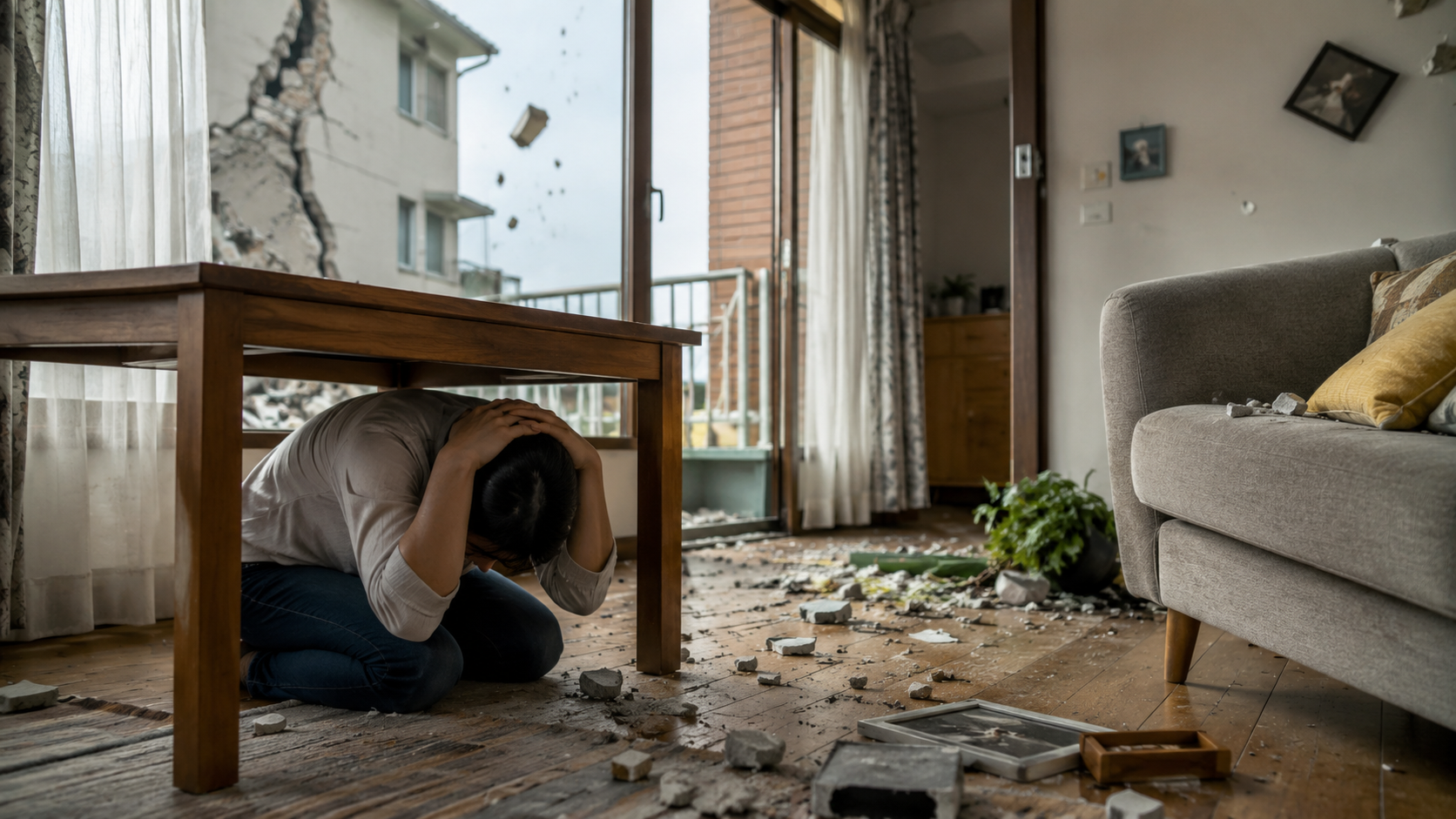
Drop to your hands and knees so you are less likely to be knocked over. Cover your head and neck. If a sturdy table or desk is close, get under it and hold on. If there is no shelter nearby, move as little as possible and protect your head and neck near an interior wall, away from windows, tall furniture, and anything that might fall.
This is not glamorous. Nobody looks cool under a table clutching a table leg.
But it is practical.
The danger during shaking is often not total building collapse. It is being hit by objects, glass, shelves, TVs, ceiling pieces, light fixtures, and furniture. OSHA notes that people moving even a short distance during earthquake shaking are more likely to be injured, and it recommends finding a safe place such as under a sturdy desk or against an interior wall away from windows and tall furniture.
So if you are inside and the shaking is active, the safer choice is often to stay low and protected rather than try to outrun the earthquake.
You cannot outrun a room that is already moving.
Right After the Shaking: Pause Before You Move
Once the shaking stops, there is often a weird silence.
Maybe alarms are going off. Maybe dishes are broken. Maybe someone is crying. Maybe your dog is acting personally betrayed by the planet.
This is the moment when many people jump up and rush outside.
Sometimes evacuation is the right move. But first, pause long enough to scan.
Are there broken windows near the exit? Do you smell gas? Is there smoke or fire? Are stairs damaged? Are shelves or ceiling pieces unstable? Are power lines down outside? Is the building making unusual cracking or shifting sounds?
A short pause is not the same as doing nothing. It is checking whether leaving is safer than staying.
The CDC recommends leaving a damaged building and not returning until authorities say it is safe, and it also warns that strange noises may mean a building is about to fall.
So the decision is not “inside good, outside bad.”
It is: “Where is the immediate danger right now?”
When Staying Inside May Be Safer for the Moment
There are several situations where staying inside briefly may be safer than rushing outside.
When the Shaking Has Not Fully Stopped
Aftershocks can follow the main quake, and sometimes what feels like “over” is only a short pause. If you are halfway down stairs or crossing a lobby when another jolt hits, you may be in a worse position than if you had stayed under cover.
Wait until shaking stops before moving, unless there is a direct threat such as fire.
When the Exit Route Is Full of Glass or Debris
If the hallway is covered in broken glass, ceiling material, fallen shelves, or loose furniture, charging through barefoot or in thin socks is asking for injury. Put on sturdy shoes if you can reach them safely. USGS specifically advises wearing sturdy shoes after an earthquake to avoid injury from broken glass and debris.
Small injuries matter in emergencies. A cut foot can make evacuation, cleanup, or helping someone else much harder.
When the Building Exterior Is the Bigger Hazard
The area just outside a building can be dangerous after an earthquake. Windows may break late. Bricks, tiles, signs, balconies, and air-conditioning units can fall. Chimneys can collapse. Power lines can come down.
If the only outdoor space available is a narrow sidewalk between buildings, staying inside until you can leave safely may be wiser.
When You Are in a High-Rise
Running down many flights of stairs immediately after shaking may not be safe if stairwells are crowded, damaged, dark, or filled with debris. Elevators should not be used after an earthquake because power failures or damage can trap people.
In a high-rise, you may need to shelter briefly, check conditions, listen for instructions, and then use stairs only when it is safe to evacuate.
When You Are Caring for Children, Older Adults, or Pets
Panic makes movement messier. If you are with a toddler, an older parent, someone with mobility issues, or pets, rushing can create more danger. A calmer exit, with shoes, glasses, medication, leash, or mobility aid if reachable, may be safer than a frantic dash.
This does not mean packing a suitcase. It means taking the few things that prevent immediate harm while leaving safely.
When You Should Leave the Building
There are also times when staying inside is not the safer choice.
Leave if there is fire, smoke, a strong gas smell, visible structural damage, major cracks, a partially collapsed wall or ceiling, flooding, or instructions from emergency officials to evacuate. Leave if you hear unusual shifting, cracking, or popping sounds that suggest the building may be unstable.
If you live near the coast and the shaking is strong or lasts long enough that standing is difficult, tsunami risk may be a concern. In that case, move to higher ground as soon as the shaking stops and it is safe to move. Do not wait for a perfect announcement if local guidance says strong shaking is a natural tsunami warning.
If you must leave, use stairs instead of elevators. Move carefully. Watch overhead hazards. Do not stand right next to the building once outside. Go to an open area away from buildings, trees, utility poles, and power lines. The CDC says that if you are outside during an earthquake, you should move to an open area away from trees, telephone poles, and buildings, and stay there.
Getting outside is only safer if you get to a safer outside place.
The doorway or sidewalk is not the finish line.
The Sidewalk Can Be More Dangerous Than the Living Room
They imagine outdoors as a wide empty field. But many homes, apartments, and offices open onto places that are not empty at all.
There may be brick walls, glass storefronts, tall fences, roof tiles, power lines, trees, streetlights, parked cars, traffic, and people running in different directions.
In cities, the sidewalk can be one of the worst places to stand right after shaking. Debris falls downward and outward. Glass does not politely wait until everyone has moved away. Even in suburban neighborhoods, chimneys, gutters, trees, and power lines can turn the front yard into a hazard.
So if you step outside, do not hover near the building to make phone calls or look back at the damage. Move to open space.
If there is no open space nearby, staying inside in a safer interior area may be the better temporary choice until you can move carefully.
What About Older Homes and Weak Buildings?
This is where the advice becomes less tidy.
If you are in a building that seems badly damaged, poorly maintained, or structurally unsafe, you may need to leave as soon as shaking stops. Older unreinforced masonry buildings, buildings with visible cracks, and structures that have already been weakened can be more dangerous during aftershocks.
But even then, running during active shaking can still be risky.
The practical approach is to protect yourself during the shaking, then evacuate carefully once movement stops if the building appears unsafe.
If you live in an earthquake-prone area and worry about your building, it is worth checking local retrofit programs, landlord responsibilities, and building safety information before an earthquake happens. That is not the kind of thing anyone wants to research at midnight after a jolt.
A little knowledge about your own building can reduce panic later.
The Myth of the Doorway
Many people grew up hearing, “Stand in a doorway during an earthquake.”
That advice has mostly fallen out of favor for modern homes and buildings. In many newer structures, doorways are not stronger than other parts of the building, and standing in one can leave you exposed to swinging doors, broken glass, and falling objects.
A sturdy table is usually a better option if one is close. If not, protect your head and neck and stay away from windows and heavy objects that can fall.
The “doorway” idea sticks around because it is simple and easy to remember. Unfortunately, not all memorable advice is good advice.
If your only nearby cover is a doorway and you cannot safely move elsewhere, use your judgment. But do not cross a room to get to a doorway when you could drop and cover where you are.
Aftershocks Change the Plan
Aftershocks are one reason immediate outdoor rushing can be dangerous.
The first quake may damage shelves, walls, windows, chimneys, and stairwells. The aftershock may be the thing that brings them down.
If you stay inside for the moment, do not relax completely. Stay aware of possible aftershocks. Move away from windows. Keep shoes on. Check for hazards. Have a path in mind if you need to leave.
If you go outside, do not stand under anything that could fall during an aftershock. Move to open ground and stay there until the situation is clearer.
Aftershocks make “safe” a moving target. What was fine two minutes ago may not be fine after the next jolt.
A Simple Room-by-Room Habit
Earthquake safety gets easier when you think about it before the floor starts moving.
In each room you use often, ask yourself: where would I drop, cover, and hold on?
In the bedroom, maybe it is beside the bed, away from windows, with a pillow over your head if you cannot get under furniture. In the kitchen, it may be away from cabinets and glass. In the living room, it may be under a sturdy table or beside an interior wall away from the TV and bookshelf.
Also notice what could fall.
Tall shelves. Mirrors. Wall art. Plants. Lamps. TVs. Heavy objects on high shelves. These are not just decorating choices in earthquake country; they are future projectiles.
Securing furniture, moving heavy items lower, and keeping shoes near the bed can make a real difference. It is not dramatic preparation. It is practical housekeeping with a safety bonus.
If You Are in Bed When It Happens
If an earthquake wakes you up, do not immediately jump up and run.
You may be half-asleep, disoriented, and surrounded by glass or fallen objects. Stay in bed if it is safer, cover your head and neck with a pillow, and wait for the shaking to stop. Then put on shoes before walking around if you can.
A pair of sturdy slip-on shoes near the bed is a small thing that can save your feet. Nobody wants to navigate broken glass barefoot at 3 a.m. while the house is dark and everyone is yelling.
Keep a flashlight nearby too. Not your phone only. A real flashlight. Phones are useful until they are under the bed, dead, or being used by someone else to call family.
If You Are in an Apartment Building
Apartment buildings add extra complications.
There are shared hallways, stairwells, elevators, neighbors, alarms, and sometimes no quick access to open space. During shaking, stay inside and protect yourself. Afterward, check your unit first. Look for fire, gas smells, water leaks, broken glass, and blocked exits.
Do not use the elevator.
If evacuation is needed, take the stairs carefully and watch for damaged railings, cracked steps, debris, or panicked crowds. Once outside, move away from the building. Do not gather under balconies or near the entrance.
If building management or emergency officials give instructions, follow them. If the building appears damaged, do not re-enter until it has been checked.
This can be inconvenient, especially if your medication, pet supplies, or wallet are still inside. But a damaged building is not a place to keep testing your luck.
If You Are in a Store, Office, or School
Public buildings can be especially chaotic.
Shelves fall. Ceiling tiles drop. People panic. Alarms sound. Employees may be trying to follow emergency procedures while customers are asking questions.
During shaking, get low and protect your head and neck. Move away from windows, tall shelves, displays, and heavy equipment if you can do so safely, but do not run across the building.
After shaking stops, follow staff or emergency instructions. If evacuation happens, leave calmly and avoid standing near exterior walls, glass, signs, or overhead fixtures.
In a store, resist the instinct to grab personal items scattered nearby if doing so puts you under unstable shelves or broken glass. Your purse matters. Your head matters more.
The Calm Decision: Stay, Check, Then Move If Needed
A useful way to remember it is this:
During shaking, stay where you are and protect yourself. After shaking, check for immediate dangers. Leave carefully if the building is unsafe or officials tell you to evacuate. If you go outside, move to open space away from things that can fall.
That sequence is much safer than “earthquake equals run.”
The goal is not to be brave or perfectly calm. Most people are not calm during an earthquake. The goal is to have a simple plan that can survive a scared brain.
A Few Things to Prepare Before You Ever Need Them
You do not need to turn your home into a bunker.
But a few small preparations help:
Keep sturdy shoes near the bed. Secure tall furniture and heavy objects. Know how to turn off gas if instructed or if you smell a leak. Keep a flashlight where you can find it. Have a family communication plan. Know your safest spots in each room. Learn your local tsunami guidance if you live near the coast.
The CDC recommends preparing emergency supplies and knowing what to do before, during, and after an earthquake, including safe spots and evacuation planning if a damaged area must be left.
Preparation does not make earthquakes convenient. Nothing does. It just gives you fewer decisions to make while your adrenaline is doing cartwheels.
The Point Is Not to Stay Inside No Matter What
It would be easy to misunderstand this topic, so let’s be clear.
Staying inside is often safer during shaking and sometimes safer immediately afterward. But if the building is damaged, burning, leaking gas, making alarming noises, or officially ordered to evacuate, you leave.
The safer choice depends on timing and surroundings.
What you want to avoid is the automatic rush outside before checking what is actually dangerous. In many earthquake injuries, the hazard is not the idea of being indoors. It is movement through falling objects, broken glass, unstable exits, and debris.
So take the pause. Protect your head. Put on shoes if you can. Look up, look around, and move with intention.
A Steadier Way to Think About Earthquake Safety
After an earthquake, “outside” can sound like safety. Sometimes it is. Other times, the path outside is filled with the very hazards you are trying to escape.
If you are indoors when shaking starts, drop, cover, and hold on. Do not run for the door while the building is moving. When the shaking stops, check your surroundings. If you need to leave, leave carefully and move to open space, not just the nearest sidewalk.
It is a small shift in thinking, but an important one.
Earthquake safety is not about making fearless decisions. It is about making slightly better decisions in a frightening moment.
And sometimes, for a few minutes, the safer place may be exactly where your panic is telling you not to stay.
Hi, I’m the creator and editor behind ZestyHabit. I research everyday safety, first aid, and practical wellness topics using official guidance and reliable public sources, then turn that information into clear, realistic steps for daily life.
My goal is to help readers make safer, better-informed choices at home and beyond.