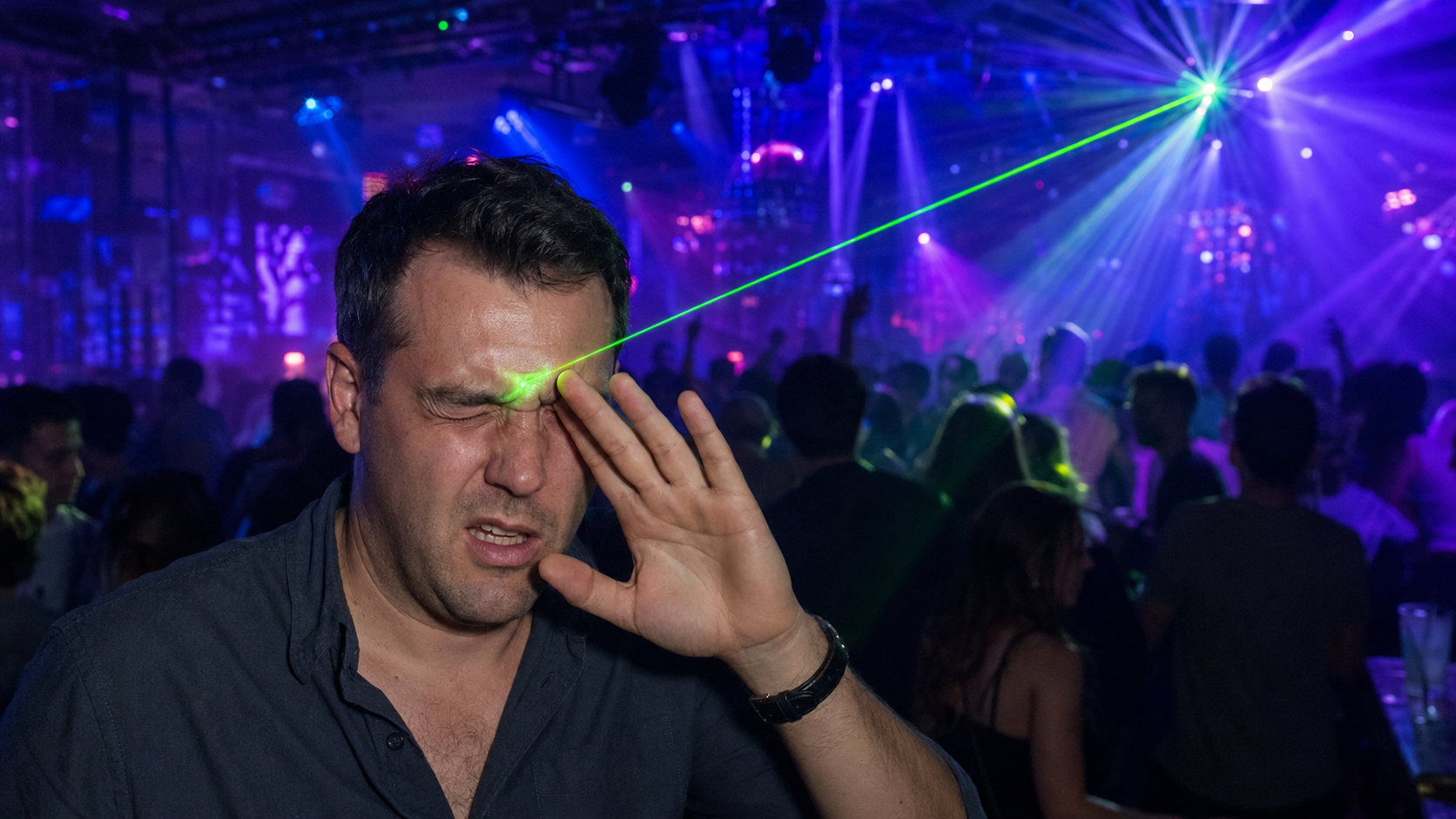
Can Laser Lights Damage Your Eyes? Symptoms, Risks, and What to Do After Exposure
Minjin Park
·
Laser lights are everywhere—from concert stages and nightclubs to presentation pointers, construction tools, children’s toys, and devices used to entertain pets. Because many of these products look harmless, it is easy to underestimate how concentrated laser light can be.
Unlike an ordinary flashlight, a laser produces a narrow, focused beam that can travel a long distance without spreading out very much. If that beam enters the eye, the eye’s own focusing system may concentrate the energy onto a tiny area of the retina. Depending on the laser’s power, wavelength, distance, and exposure time, the result may range from a temporary afterimage to permanent loss of central vision.
Fortunately, seeing a laser light does not automatically mean that your eyes have been damaged. Most accidental, momentary encounters with properly regulated, low-powered products do not cause permanent injury. However, direct exposure to an unknown or high-powered laser should never be dismissed—especially when vision changes follow.
The eye is designed to collect and focus light. Light entering through the cornea passes through the pupil and lens before reaching the retina, the light-sensitive tissue lining the back of the eye.
This focusing ability allows us to see clearly, but it also makes the retina vulnerable to concentrated laser energy. A narrow beam entering the pupil can be focused onto a much smaller retinal spot, increasing the amount of energy delivered to that tissue.
Laser exposure can damage the eye through several mechanisms:
Thermal injury: The tissue absorbs laser energy and heats rapidly, potentially creating a retinal burn.
Photochemical injury: Certain wavelengths can trigger chemical changes in retinal cells after sufficient exposure.
Mechanical injury: Extremely powerful or pulsed lasers may produce shock waves that physically disrupt tissue.
Indirect accident risk: Even without permanent eye damage, a bright laser can cause glare, flash blindness, distraction, or a startling reaction.
The retina has no pain receptors, so a retinal laser injury may occur without immediate pain. According to the U.S. Food and Drug Administration, vision problems may sometimes develop gradually and go unnoticed for hours or even days.
Are Concert and Nightclub Laser Lights Dangerous?
Professionally operated laser shows are supposed to be designed so that hazardous beams do not enter the audience’s eyes at unsafe exposure levels. Operators must account for beam power, scanning speed, distance, projection zones, and the possibility that a scanning system could malfunction.
Problems may arise when equipment is installed incorrectly, used by an untrained operator, modified, aimed too low, or operated without appropriate safety controls. A stationary beam is generally more concerning than one that sweeps rapidly across a room because it may expose the same retinal area for a longer time.
Haze and theatrical fog can make laser beams appear dramatic and highly visible. The visible beam in the air is usually light scattering from particles, while the concentrated beam itself continues along its path. Looking at the glowing path from the side is different from looking directly into the beam’s source.
If a laser at an event repeatedly enters your eyes, appears stationary on your face, or causes discomfort or visual disturbance, move away immediately and notify venue staff. Do not keep looking toward the projector to determine whether it is dangerous.
Laser Pointers and High-Powered Handheld Lasers
A compliant, low-powered laser pointer used responsibly presents far less risk than a powerful handheld laser deliberately aimed into someone’s eye. Unfortunately, labels and online product descriptions are not always reliable.
Some products sold as “pointers” are considerably more powerful than ordinary presentation devices. The FDA has specifically warned consumers about overpowered green, blue, and violet lasers available online. Brightness alone is not a dependable measure of power: a beam that looks dimmer is not necessarily safer.
The FDA recognizes several laser hazard classes. Class 1 products are generally considered nonhazardous during normal use, while Class 3B and Class 4 products can present an immediate eye hazard. Class 3B lasers, which may emit between 5 and 500 milliwatts, are too dangerous to be marketed in the United States as ordinary pointers or amusement products. More information is available in the FDA’s laser product classification guide.
Distance may reduce the amount of energy entering the eye because a real beam gradually spreads, but distance does not make every laser safe. Beam design, focusing, wavelength, power, atmospheric conditions, and optical aids all influence the risk.
Direct Beams Are Not the Only Concern
A laser does not necessarily have to come directly from the device to reach someone’s eye. Mirrors, polished metal, shiny decorations, glass, jewelry, and other reflective materials may redirect a beam.
A mirror-like reflection can retain much of the beam’s concentrated character and may still be hazardous. A diffuse reflection from a rough, matte surface typically scatters the light more widely and is less intense, although powerful industrial lasers can remain dangerous even after diffuse reflection.
Binoculars, telescopes, magnifying lenses, and other optical instruments can also increase the hazard by collecting additional laser energy. Never view an unknown laser through an optical aid.
Symptoms of Laser-Induced Eye Damage
Symptoms depend on which part of the eye was affected and how severe the exposure was. Possible warning signs include:
Blurred or reduced vision in one or both eyes
A dark, gray, bright, or blank spot near the center of vision
A persistent afterimage that does not fade normally
Straight lines appearing bent, wavy, or distorted
Difficulty reading or recognizing faces
Changes in color perception
Increased sensitivity to light
New floaters, flashes, or shadows
Eye discomfort or headache
A sudden difference between the vision in the two eyes
Damage to the macula—the central part of the retina responsible for detailed vision—may be especially noticeable when reading small print or looking directly at a person’s face.
Symptoms can be subtle. A person may not notice a small blind spot because the other eye compensates or the brain partially fills in missing information. Children may struggle to explain what has changed and may simply cover one eye, sit closer to screens, avoid reading, or complain that something looks “funny.”
Clinical reports have documented retinal burns, bleeding, macular holes, and permanent visual impairment after exposure to powerful handheld lasers. A medical review indexed by the National Library of Medicine describes handheld laser-related retinal injury as a growing public-health concern.
What to Do After a Laser Shines Into Your Eye
First, turn away from the beam and leave the exposure area. Do not look back toward the laser to test it, identify its color, or see whether it still affects your vision.
Next, check each eye separately in normal room lighting. You can briefly cover one eye and then the other to determine whether there is a clear difference. Do not repeatedly stare at bright lights, the sun, or the laser as a self-test.
Seek prompt medical advice if you notice persistent blurring, a central spot, distortion, reduced color vision, or any other new visual symptom. An ophthalmologist can examine the retina and may use retinal photography or optical coherence tomography to detect changes that cannot be seen from outside the eye.
A same-day eye examination is particularly important after a deliberate direct exposure, exposure to a high-powered or unknown laser, or any incident involving a child who cannot reliably describe their symptoms.
Go to an emergency department or emergency eye clinic immediately if there is sudden major vision loss, a curtain-like shadow, severe eye pain, new weakness or confusion, or if the exposure occurred alongside another physical injury. Do not drive yourself if your vision is impaired.
If possible, keep the product or photograph its label without operating it again. Information about the laser’s class, wavelength, and output power may help the medical team. Never delay care while trying to identify the device.
What Not to Do After Laser Exposure
Several common reactions can make the situation more confusing or delay appropriate evaluation.
Do not:
Rub or press on the affected eye.
Apply unprescribed eye drops, creams, or home remedies.
Cover the eye tightly with a pressure patch.
Keep testing your vision by looking at the beam.
Assume that no pain means no injury.
Wait several days when a new blind spot or distortion is present.
Attempt to repair, disassemble, or measure an unknown laser yourself.
Flushing the eye with water is useful after many chemical exposures, but it cannot remove laser energy or reverse retinal damage. Laser light does not remain trapped inside the eye. Rinsing is only necessary if another substance, such as smoke, dust, or a chemical, also entered the eye.
Can Laser Eye Damage Be Treated?
There is no single home treatment for laser-induced retinal injury. Management depends on the type and extent of the damage.
Some mild visual disturbances improve over time as inflammation settles and retinal tissue recovers. More serious injuries may leave a permanent blind spot or reduced central vision. Complications such as retinal bleeding, abnormal blood vessel growth, or a macular hole may require specialist treatment, medication, or surgery.
Research reviews note that treatment approaches vary because laser injuries can look different from patient to patient. Early assessment remains valuable even when there is no immediate procedure to reverse the damage. An ophthalmologist can document the injury, monitor recovery, identify complications, and recommend visual rehabilitation when necessary.
How to Prevent Laser Light Eye Injuries
The safest strategy is to control where the beam travels and who can access the device.
For everyday laser products:
Never point a laser at a person, animal, vehicle, aircraft, or reflective surface.
Do not give laser pointers to children as toys.
Choose products from reputable sellers with clear hazard labels.
Avoid unusually powerful products marketed for burning, popping balloons, or long-distance visibility.
Do not remove warning labels or modify the device.
Store lasers where children cannot reach them.
Use the lowest power appropriate for the legitimate task.
Never look into the aperture, even if the beam appears weak or the battery seems nearly empty.
Do not use binoculars or telescopes to view a laser beam.
For parties and performances, hire trained operators who use compliant equipment and understand audience-scanning requirements. Projectors should be securely mounted so that they cannot tip or be redirected by guests.
Workplaces using industrial, medical, or research lasers require more formal controls. These may include restricted areas, beam enclosures, interlocks, warning signs, training, and wavelength-specific protective eyewear. Ordinary sunglasses are not a substitute for certified laser safety glasses. Protective eyewear must be selected for the device’s wavelength and optical density.
Protecting Children From Laser Products
Children may intentionally stare into a beam, point it at friends, or use mirrors to create reflections without understanding the risk. A device that resembles a flashlight, toy weapon, or science gadget may appear harmless even when it contains a powerful laser.
The FDA recommends that children’s toy laser products remain within Class 1 emission limits. Parents should still supervise products that produce concentrated light and remove any device with missing labels, unclear instructions, or unexpectedly strong output.
If a child reports a spot in their vision after playing with a laser, take the complaint seriously. Ask them to describe what they see without encouraging repeated self-testing, and arrange an eye examination promptly.
The Bottom Line
Laser lights can damage the eyes, but the level of risk varies dramatically. Briefly seeing a properly controlled stage effect is not the same as staring into a high-powered handheld laser. The most concerning situations involve a direct beam, a stationary or prolonged exposure, an unknown device, optical magnification, or new visual symptoms afterward.
When in doubt, stop the exposure and pay attention to changes in vision. Retinal damage may be painless and invisible from the outside, so persistent blurring, distortion, blind spots, or color changes deserve prompt evaluation by an eye-care professional.
Have you ever experienced lingering spots, blurred vision, or discomfort after exposure to a laser pointer, concert light, or toy? Share what happened in the comments—your experience may help another reader recognize when it is time to seek medical care.
Hi, I’m the creator and editor behind ZestyHabit. I research everyday safety, first aid, and practical wellness topics using official guidance and reliable public sources, then turn that information into clear, realistic steps for daily life.
My goal is to help readers make safer, better-informed choices at home and beyond.