Eye Injury First Aid: What to Do—and What You Should Never Do
Minjin Park
·
Learn how to respond to chemical splashes, foreign objects, cuts, blunt trauma, and other eye injuries. Know when to rinse the eye, when not to touch it, and when to seek emergency care.
An eye injury can happen in seconds. Cleaning products may splash while you are working around the house, a piece of dust may blow into your eye, or a ball, branch, tool, or fragment may strike the eye unexpectedly. Some injuries cause immediate and obvious pain, while others appear minor at first but damage structures beneath the surface.
The correct first aid depends on what caused the injury. Rinsing is essential after a chemical splash or when a loose particle enters the eye, but it can be dangerous to manipulate an eye containing an embedded object. Pressing on a badly injured eye may also worsen internal damage.
When in doubt, treat changes in vision, severe pain, bleeding, and penetrating injuries as emergencies. Quick, careful action may help protect the person’s sight.
Emergency note: This article provides general first-aid information and does not replace an examination by an ophthalmologist or emergency medical professional. Call 911 in the United States for a severe injury, or use your local emergency number.
Do not assume that an injury is minor simply because there is little visible damage. The eye’s deeper structures, including the lens, retina, and optic nerve, may be injured without an obvious wound.
General Rules for Any Eye Injury
A few safety principles apply to nearly every eye emergency.
Wash your hands before helping if time and circumstances allow. Do not rub, squeeze, or press on the injured eye. Do not ask the person to “test” the eye repeatedly by touching it or forcing it open.
Avoid using medicated eye drops, redness-relief drops, ointments, or leftover prescription medicine unless a medical professional specifically recommends them. These products may interfere with examination or worsen certain injuries.
If vision is affected, the injured person should not drive. Arrange transportation or call emergency services.
The American Academy of Ophthalmology recommends urgent medical attention for significant eye injuries and warns against touching, rubbing, or applying pressure to an injured eye.
What to Do If a Chemical Gets in the Eye
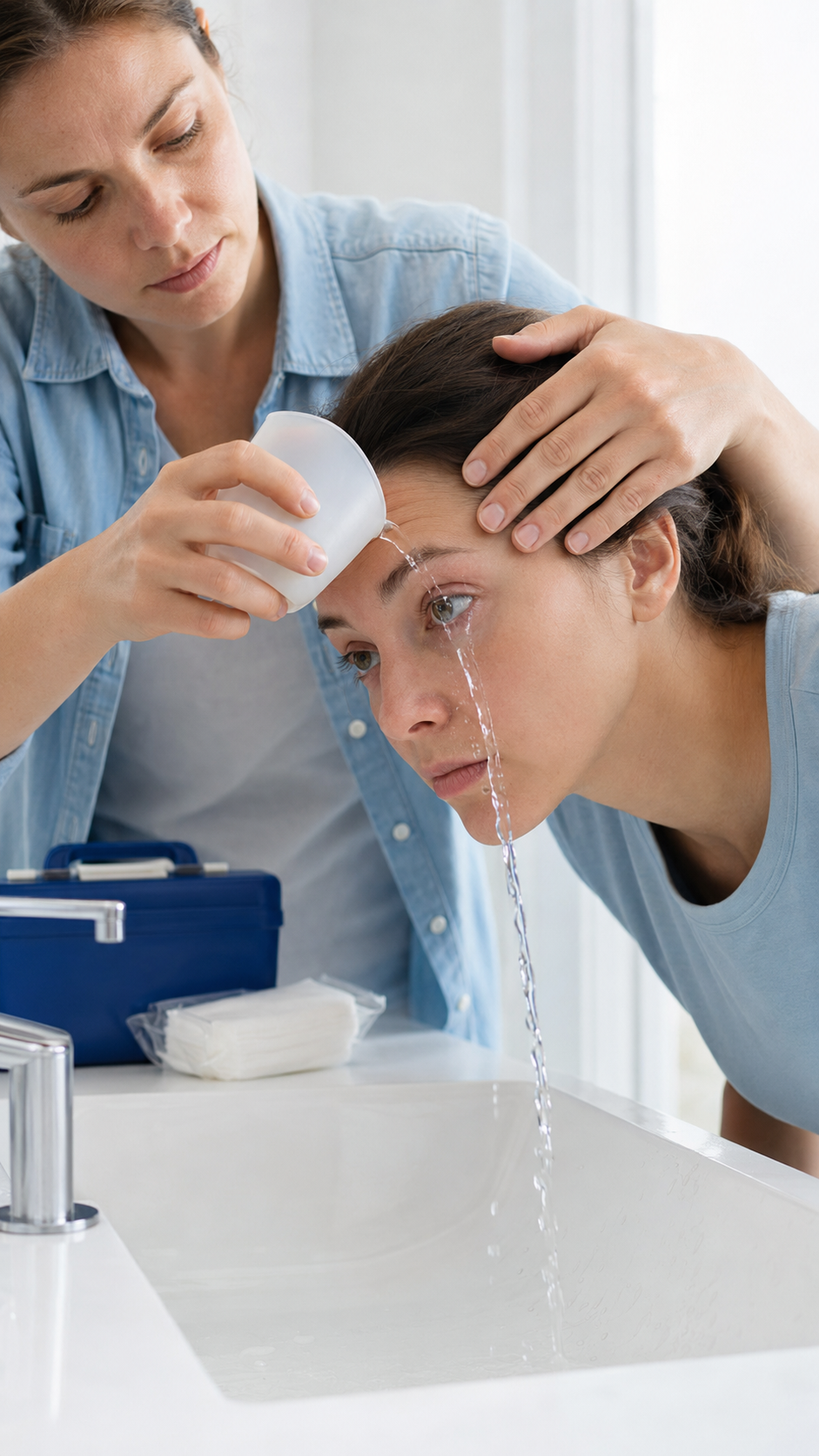
A chemical eye exposure requires immediate irrigation. Do not spend time searching online, calling a family member, or locating a special eyewash solution before beginning. Tap water is far better than delaying treatment.
Start rinsing immediately
Tilt the person’s head so the injured eye is lower and angled away from the unaffected eye. Hold the eyelids open and allow a gentle stream of clean, room-temperature water to flow over the eye.
Rinse for at least 15 to 20 minutes. Encourage the person to blink during irrigation so water reaches the eye’s surface and beneath the eyelids.
A shower may be the easiest option when both eyes or a large part of the face has been exposed. Keep the water pressure gentle. For a young child, wrapping the body in a towel can help control the arms while another adult carefully holds the eyelid open.
Remove contact lenses without delaying irrigation
Begin rinsing first. If contact lenses are present, remove them as soon as they can be taken out easily during irrigation. Do not delay flushing while struggling with a lens. Water may wash it out on its own.
Do not try to neutralize the chemical
Never put vinegar, baking soda, lemon juice, or another chemical into the eye to “cancel out” the first substance. A chemical reaction can produce additional heat or tissue damage.
Do not use milk, oil, or homemade solutions. Continue with clean water or sterile saline.
Get expert help after rinsing begins
Chemical burns can continue damaging the eye even when the person begins to feel better. Alkaline products—including some drain cleaners, oven cleaners, cement products, ammonia solutions, and industrial chemicals—can be particularly dangerous.
In the United States, call Poison Control at 1-800-222-1222 after irrigation has started, or use its online guidance. Poison Control recommends rinsing with plenty of room-temperature water for at least 15 to 20 minutes before obtaining further product-specific advice.
Bring the product container, label, or safety data information to the emergency department when doing so is safe. Do not delay transportation to search for it.
What to Do for Dust, Sand, or Another Loose Particle
Small particles often cause tearing, redness, and a gritty sensation. The eye may remove an eyelash or speck of dust naturally through blinking and tears.
Gently rinse the eye with clean water or sterile saline.
Blink several times during rinsing.
Seek medical care if the sensation remains.
Do not scrape the eye with a fingernail, tissue, cotton swab, or the corner of a towel. Never use tweezers on the surface of the eye.
A persistent feeling that something remains in the eye may actually be caused by a corneal abrasion. Seek prompt medical care if pain, redness, light sensitivity, excessive tearing, or blurry vision continues after rinsing.
Particles created by grinding, drilling, mowing, hammering, or cutting metal should not be treated as ordinary dust. They may strike at high speed and become embedded in the cornea or penetrate the eyeball. Obtain urgent professional evaluation even if the fragment appears extremely small.
What to Do If an Object Is Embedded in the Eye
An object stuck in or protruding from the eye is a medical emergency.
Do not remove it. Do not push it back in, wiggle it, shorten it, or rinse forcefully around it. Do not place a regular eye patch or bandage directly over the object.
Call 911 and keep the person as still and calm as possible. A rigid shield can help protect the eye from accidental contact. If no commercial eye shield is available, place a clean paper cup loosely over the injured eye and secure it to the surrounding area without pressing on the eye or object.
Do not give food or drink unless emergency professionals say it is safe, since surgery or sedation may be necessary. Prevent the person from rubbing or touching either eye while waiting for help.
The current MedlinePlus eye-emergency guidance advises leaving embedded objects in place, protecting the eye without pressure, and obtaining medical help immediately.
Do not rinse a visibly punctured eye. Do not press on it or attempt to examine the wound closely. Protect it with a rigid shield and call 911 or go directly to an emergency department.
A cut involving only the eyelid may also be more serious than it looks. The eyelid contains delicate structures that protect and drain the eye, and a deep eyelid cut may extend into the eyeball.
Place a clean dressing over an eyelid wound without pressing on the eye itself. If bleeding occurs, gentle pressure may be applied to the surrounding facial bone or eyelid tissue only when you are confident that the eyeball has not been injured. Significant eyelid cuts need prompt medical evaluation.
What to Do After a Blow to the Eye
Blunt injuries may be caused by a ball, fist, fall, airbag, door, or other object. A visible black eye does not reveal how much internal damage has occurred.
Place a cold compress gently over the closed eyelid and surrounding area. Do not press on the eyeball. Use a cloth-covered cold pack rather than applying ice directly to the skin.
Flashes of light, new floaters, or a dark curtain in the visual field
Significant swelling or an inability to open the eye
Loss of consciousness or confusion
Bleeding from the eye
Blood collecting in front of the iris may be a condition called hyphema. It requires urgent evaluation because it can raise pressure inside the eye and threaten vision. Do not treat visible blood inside the eye as an ordinary bruise.
What to Do for a Scratched Eye
A corneal abrasion is a scratch on the transparent front surface of the eye. It may result from a fingernail, branch, paper edge, contact lens, makeup brush, or small particle.
Symptoms can include sharp pain, tearing, redness, light sensitivity, blurry vision, and the persistent feeling that something is stuck in the eye.
Do not rub the eye or repeatedly pull the eyelids open. Remove contact lenses and do not wear them again until an eye-care professional says the injury has healed. Gentle rinsing may help if a loose particle caused the scratch, but it cannot repair the abrasion.
Do not patch the eye tightly unless a medical professional directs you to do so. Avoid numbing eye drops obtained from another person or left over from a previous examination. Repeated use can delay healing and cause serious corneal damage.
Because infection or deeper injury may resemble a simple scratch, contact an eye doctor promptly—especially when pain, light sensitivity, or vision changes are present.
Heat, Steam, and Ultraviolet Eye Injuries
Heat, hot liquid, steam, grease, and sparks can burn the eyelids and eye surface. Gently rinse a thermal injury with cool, clean water, but do not apply ice or frozen packs directly to the eye. Seek urgent care for persistent pain, reduced vision, blistering, or any significant facial burn.
Ultraviolet exposure from welding arcs, tanning equipment, or intense sunlight reflected from snow can cause photokeratitis, sometimes called “welder’s flash” or snow blindness. Symptoms—including pain, tearing, redness, gritty sensation, and light sensitivity—may not begin until several hours after exposure.
Move to a dark environment, remove contact lenses, avoid rubbing the eyes, and obtain medical advice. Never look at a welding arc without appropriate protective equipment.
Warning Signs That Require Emergency Care
Call 911 or seek immediate emergency treatment for:
Sudden loss or major reduction of vision
A penetrating or embedded object
A chemical burn with severe symptoms
Uncontrollable bleeding
A visibly deformed eye or pupil
Fluid leaking from the eye
Severe pain after trauma
Loss of consciousness or other signs of head injury
Eye injury accompanied by trouble breathing, seizure, or inability to awaken
Significant injury to both eyes
Prompt evaluation is also necessary when pain, redness, swelling, tearing, light sensitivity, or blurry vision persists after initial first aid. Eye injuries can change over several hours, so worsening symptoms should never be ignored.
Common Eye First Aid Mistakes to Avoid
One of the most damaging mistakes is rubbing the eye. Rubbing can drag a particle across the cornea or increase pressure on an already injured eyeball.
Other mistakes include:
Delaying irrigation after a chemical splash
Attempting to neutralize one chemical with another
Removing an embedded object
Using tweezers or cotton swabs on the eye
Applying pressure to stop bleeding from the eyeball
Using unprescribed antibiotic, steroid, or numbing drops
Wearing contact lenses after an injury
Assuming normal-looking vision means there is no damage
Allowing the injured person to drive
When the type or severity of an injury is uncertain, protecting the eye and obtaining professional care is safer than experimenting with home treatment.
How to Prevent Eye Injuries
Wear safety glasses or goggles appropriate for the activity when using power tools, mowing, handling chemicals, doing yardwork, or working around flying particles. Ordinary prescription glasses and sunglasses are not substitutes for certified protective eyewear.
Use sport-specific eye protection for activities involving balls, sticks, racquets, or physical contact. Store cleaning products and chemicals away from children, and point spray nozzles away from the face. Read product labels before opening containers and wash your hands after handling chemicals.
Eye emergencies are frightening, but a few simple rules make the correct response easier to remember: rinse chemical splashes immediately, flush only loose particles, never remove an embedded object, never press on a seriously injured eye, and seek urgent care for pain or vision changes. Have you ever had to deal with an eye injury at home, work, or during sports? What eye-safety habit do you think more people should know about? Share your experience and tips in the comments below.
Hi, I’m the creator and editor behind ZestyHabit. I research everyday safety, first aid, and practical wellness topics using official guidance and reliable public sources, then turn that information into clear, realistic steps for daily life.
My goal is to help readers make safer, better-informed choices at home and beyond.