Can Clenching Your Teeth During Exercise Cause Dental Damage?
Minjin Park
·
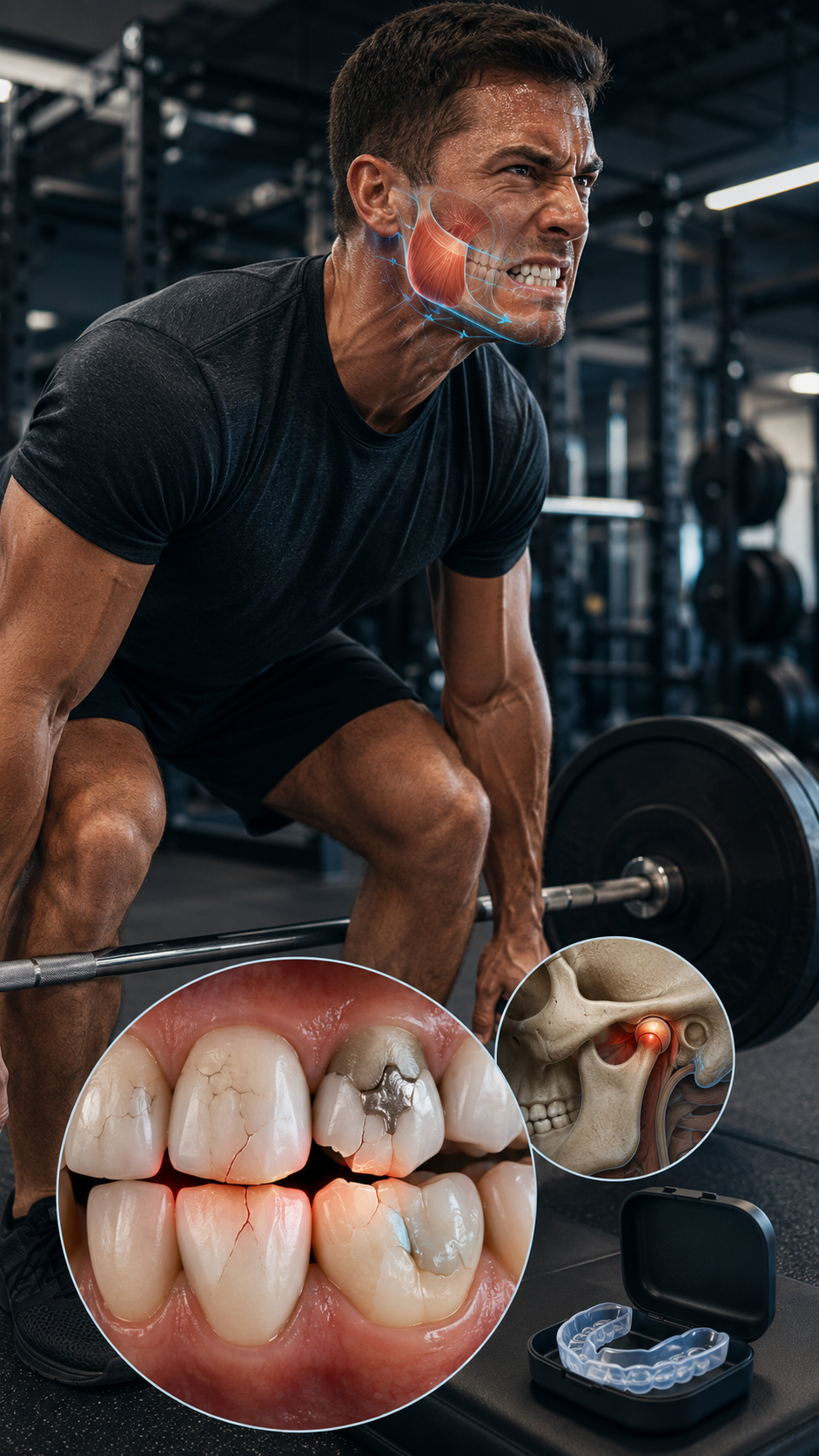
Picture the final repetition of a heavy squat. Your legs are shaking, your core is braced, and without consciously deciding to do it, you press your teeth together as hard as possible. The set ends, the weight returns to the rack, and only then do you notice that your jaw feels tight.
Clenching your teeth during intense exercise is common, particularly during weightlifting, CrossFit, sprinting, martial arts, and movements requiring maximum effort. Some athletes feel that tightening their jaw helps them generate more power or stabilize the rest of the body.
An occasional brief clench is unlikely to break healthy teeth immediately. Repeated, forceful clenching, however, may place substantial pressure on the teeth, fillings, crowns, jaw muscles, and temporomandibular joints. Over months or years, this habit can contribute to worn enamel, cracked teeth, temperature sensitivity, damaged restorations, headaches, and jaw pain.
Clenching is partly an instinctive response to physical effort. When people prepare to lift, push, pull, jump, or absorb impact, they tend to contract muscles throughout the body. The jaw may tighten along with the hands, shoulders, abdomen, and legs.
Researchers sometimes refer to this phenomenon as concurrent activation potentiation. Activating muscles that are not directly responsible for the movement—such as the jaw or hands—may temporarily influence force production elsewhere in the body.
A controlled study examining countermovement jumps found that deliberate jaw clenching was associated with changes consistent with this potentiation effect. The researchers suggested that some athletes might use clenching to gain a performance advantage. The study is indexed on PubMed.
That does not mean maximal clenching is required for a safe or effective workout. A small performance effect during a controlled test does not outweigh the potential dental consequences of grinding the teeth through every repetition.
Trying to stabilize a loose or poorly fitted mouthguard
Many people have no idea they are doing it until a training partner points it out or a dentist notices the evidence.
Exercise Clenching and Bruxism Are Related but Not Identical
Bruxism is repetitive jaw-muscle activity involving clenching, grinding, or thrusting the jaw. It may occur during sleep or while awake.
Exercise-related clenching is usually a form of awake jaw activity tied to effort. Some athletes deliberately bite down during a heavy movement, while others do it automatically. Unlike sleep bruxism, the behavior occurs during a situation in which the person can potentially notice and change it.
Not everyone who clenches during a workout has a medical bruxism disorder. The concern is the intensity, frequency, and accumulated exposure.
Someone who briefly touches their teeth together during one difficult repetition is in a different situation from someone who performs five strength sessions each week while forcefully grinding through every set. Existing dental conditions also matter. A tooth with a large filling, deep decay, old crack, or root canal may tolerate repeated force differently from an intact tooth.
How Much Pressure Can Teeth Handle?
Teeth are designed to withstand the forces of biting and chewing. Those forces are normally brief, distributed across food, and interrupted by periods when the jaw is relaxed.
Clenching is different because the upper and lower teeth press directly against each other without food cushioning the contact. The force may be maintained for several seconds and repeated through many sets.
Dental damage does not always happen as one dramatic fracture. Microscopic stress can accumulate gradually. A tiny enamel crack may remain painless for years before spreading into deeper layers. A filling may loosen, or a weakened cusp may eventually break while eating something that would not normally damage a healthy tooth.
The final bite on a piece of bread may appear to be the cause, even though years of clenching helped create the underlying weakness.
Possible Dental Problems Caused by Repeated Clenching
Enamel Wear
Enamel is the hard outer surface of a tooth. It cannot regenerate after being worn away.
Grinding can create flattened, shiny, or uneven biting surfaces. As enamel becomes thinner, the yellowish dentin underneath may become more visible. Teeth may appear shorter or develop sharp edges.
Enamel loss can also make teeth more sensitive to cold air, water, or sweet foods.
Cracked or Fractured Teeth
High bite forces can contribute to small craze lines, fractured cusps, or deeper vertical cracks. Teeth containing large fillings may be particularly vulnerable because less natural tooth structure remains to absorb the force.
The American Association of Endodontists identifies clenching and grinding as preventable contributors to cracked teeth. A crack may produce inconsistent pain while chewing, discomfort when bite pressure is released, or sensitivity to hot and cold temperatures.
Unlike a broken bone, a cracked tooth does not heal itself. Early evaluation improves the chance of preserving it.
Damaged Fillings, Crowns, and Veneers
Dental restorations are strong but not indestructible. Persistent clenching can chip ceramic, fracture a filling, loosen a crown, or damage the tooth supporting a restoration.
A damaged crown may not hurt immediately. Warning signs can include a rough edge, movement, an unusual taste, sensitivity, or a bite that suddenly feels different.
Dental implants cannot develop cavities, but excessive loading may still damage the crown, screw, or surrounding structures. Anyone with implants who frequently clenches should discuss protection with their dentist.
Gum and Supporting-Tissue Stress
Clenching alone is not generally considered a primary cause of gum disease. However, excessive forces may aggravate discomfort around a tooth that already has reduced bone support or inflammation.
If a tooth feels loose, changes position, or hurts under pressure, stop assuming the problem is simply muscle soreness and arrange a dental examination.
Jaw-Muscle Fatigue
The masseter and temporalis muscles generate biting force. Constantly tightening them during exercise can leave the jaw feeling tired, stiff, or tender.
Some people notice difficulty opening their mouth fully after training. Others experience pain that spreads toward the temples, ears, neck, or shoulders.
Temporomandibular Joint Symptoms
The temporomandibular joints, commonly called the TMJs, connect the lower jaw to the skull. Excessive muscle tension may contribute to pain around these joints, clicking, limited movement, or a feeling that the jaw is temporarily stuck.
Clicking without pain is not always a medical emergency, but new pain, locking, or difficulty eating deserves professional assessment.
What Research Has Found in Resistance Athletes
A 2023 study surveyed 602 hobby and competitive resistance-training participants about oral and facial problems during exercise. Approximately 34.6% reported some form of distress involving the mouth, teeth, or jaw while training.
Participants who had practiced resistance training for ten years or longer reported negative oral effects at more than twice the rate observed in those with less training history. The researchers concluded that longer participation was associated with more self-reported oral tissue trauma in their study population. The findings can be reviewed through PubMed.
This was a questionnaire-based study, so it cannot prove that lifting directly caused every reported problem. Diet, nighttime bruxism, existing dental work, and other behaviors could have contributed. It does, however, support the practical concern that years of repetitive clenching may have cumulative consequences.
Signs You May Be Clenching During Workouts
Watch for these clues:
Jaw tightness during or after a set
Teeth touching throughout most of the workout
Facial soreness after training
Temple headaches
New cold sensitivity
Pain when biting or releasing the bite
Small chips or rough tooth edges
Flattened chewing surfaces
Cracked fillings or crowns
Impressions along the tongue or inside the cheeks
Jaw clicking, stiffness, or reduced opening
A training partner noticing grinding sounds
Symptoms that are strongest in the morning may suggest that sleep bruxism is also occurring. Symptoms that appear mainly after lifting may be more closely connected to exercise technique or daytime clenching. Some people experience both.
How to Stop Clenching Your Teeth While Exercising
Create a “Teeth Apart” Cue
Before each set, consciously check your jaw. Allow a small space between the upper and lower teeth while keeping the lips relaxed.
A useful resting position is to place the tongue gently against the roof of the mouth behind the upper front teeth. Do not press hard. This position makes forceful clenching less automatic.
Use a simple cue such as “relax the jaw” when checking your stance, grip, and breathing.
Reset Between Repetitions and Sets
Even if your jaw tightens briefly during the hardest part of a movement, release it as soon as the effort passes. Do not remain clenched while resting, walking around the gym, or preparing equipment.
Lower the shoulders, soften the hands, take a calm breath, and allow the jaw muscles to relax between sets.
Review Your Breathing Technique
Holding the breath and clenching the jaw often occur together during heavy exercise. Breathing strategies vary according to the movement, load, and athlete’s experience, so there is no single rule appropriate for every lift.
Ask a qualified coach or physical therapist to review how you breathe and brace. The goal is to maintain safe trunk stability without using the teeth as part of the lifting equipment.
Anyone with heart, blood-pressure, pelvic-floor, or other medical concerns should ask a healthcare professional about breath-holding during heavy resistance exercise.
Reduce the Load Temporarily
If you can perform a movement only by grinding your teeth and straining every muscle in your face, the weight may be exceeding what you can currently control.
Reducing the load does not mean abandoning strength training. It can provide time to improve technique, breathing, and awareness before progressing again.
Stop Chewing Gum During Hard Exercise
Chewing gum adds repetitive jaw activity and may become a choking hazard during intense movement. It can also make it harder to recognize when the jaw is becoming fatigued.
Water is a safer option for managing dry mouth during most workouts.
Should You Wear a Mouthguard for Weightlifting?
A properly fitted mouthguard creates a protective layer between the teeth and may reduce the risk of dental injury. The American Dental Association includes weightlifting among the activities in which mouth protection may be considered and recommends properly fitted guards for sports with significant risk of dental or facial trauma. Its detailed guidance is available on the ADA mouthguard page.
However, different appliances serve different purposes.
An athletic mouthguard primarily protects against impact and distributes forces during sports. A bruxism appliance or occlusal splint is designed to protect teeth from grinding and may alter how the jaw muscles and joints are loaded. A nighttime appliance is not automatically appropriate for exercise, and a stock sports guard may not adequately manage chronic clenching.
A poorly fitted guard may:
Move during exercise
Interfere with breathing or speaking
Require continuous biting to keep it in place
Create uneven pressure
Irritate the gums
Worsen the clenching habit
Stock guards are generally the least retentive and may require the wearer to keep the mouth closed to hold them in place. Boil-and-bite guards can fit better when carefully molded, while custom guards made by a dentist usually provide the most precise fit.
If you have crowns, implants, braces, missing teeth, TMJ pain, or known bruxism, consult a dentist before selecting an appliance.
Contact Sports Require Additional Protection
Clenching is not the only dental risk during exercise. A ball, elbow, knee, bar, or fall can directly chip, dislodge, or knock out a tooth.
The ADA reports that mouthguard use lowers the risk of sports-related oral injury. One large study cited by the organization followed more than 70,000 college basketball players and found a dental injury rate of 0.12 per 1,000 exposures among players using custom-fitted guards, compared with 0.67 among those without them.
Wear the appropriate mouthguard during both competition and practice. Replace it if it tears, becomes loose, develops sharp edges, or no longer fits after dental treatment.
Clean it according to the manufacturer’s instructions, allow it to dry, and store it in a ventilated case. Do not share mouthguards.
When to Schedule a Dental Examination
Arrange an appointment if you have persistent jaw soreness, new sensitivity, visible wear, chipped enamel, damaged restorations, or recurring headaches associated with clenching.
A dentist can check:
Enamel wear patterns
Existing cracks
Fillings, crowns, veneers, and implants
Bite distribution
Jaw-muscle tenderness
TMJ movement
Gum and bone support
Whether an appliance is appropriate
Do not wait for constant pain. Cracked-tooth discomfort may come and go, and some cracks are difficult to see without specialized lighting, magnification, bite testing, or dental imaging.
What to Do If a Tooth Cracks During Exercise
Stop the workout immediately. Continuing to bite down may extend the crack or dislodge another piece.
Rinse gently with warm water. If a fragment has broken off, save it in a clean container and take it to the dentist. Apply a cold compress to the outside of the cheek if swelling develops.
Avoid chewing on the affected side and contact a dentist as soon as possible. Do not place aspirin directly on the tooth or gum because it can burn the tissue.
A badly cracked tooth, severe pain, facial swelling, uncontrolled bleeding, or major jaw injury requires urgent care. If the injury involves loss of consciousness, breathing difficulty, or suspected facial fracture, seek emergency medical treatment.
The Bottom Line
Clenching your teeth during a difficult repetition may feel powerful, but your teeth should not function as a lifting belt. Repeated force can gradually wear enamel, spread cracks, damage restorations, fatigue jaw muscles, and aggravate TMJ symptoms.
Learning to relax the jaw between efforts, improving breathing and lifting technique, reducing excessive loads, and obtaining appropriate dental protection can lower the risk. A properly fitted mouthguard may be useful, but it should match the sport, dental condition, and reason it is being worn.
Do you notice yourself clenching your teeth during heavy lifts, sprinting, or other intense exercise—and have you ever experienced jaw soreness or tooth sensitivity afterward? Share your experience and the technique that helped you relax your jaw in the comments so other athletes can learn from it.
Hi, I’m the creator and editor behind ZestyHabit. I research everyday safety, first aid, and practical wellness topics using official guidance and reliable public sources, then turn that information into clear, realistic steps for daily life.
My goal is to help readers make safer, better-informed choices at home and beyond.