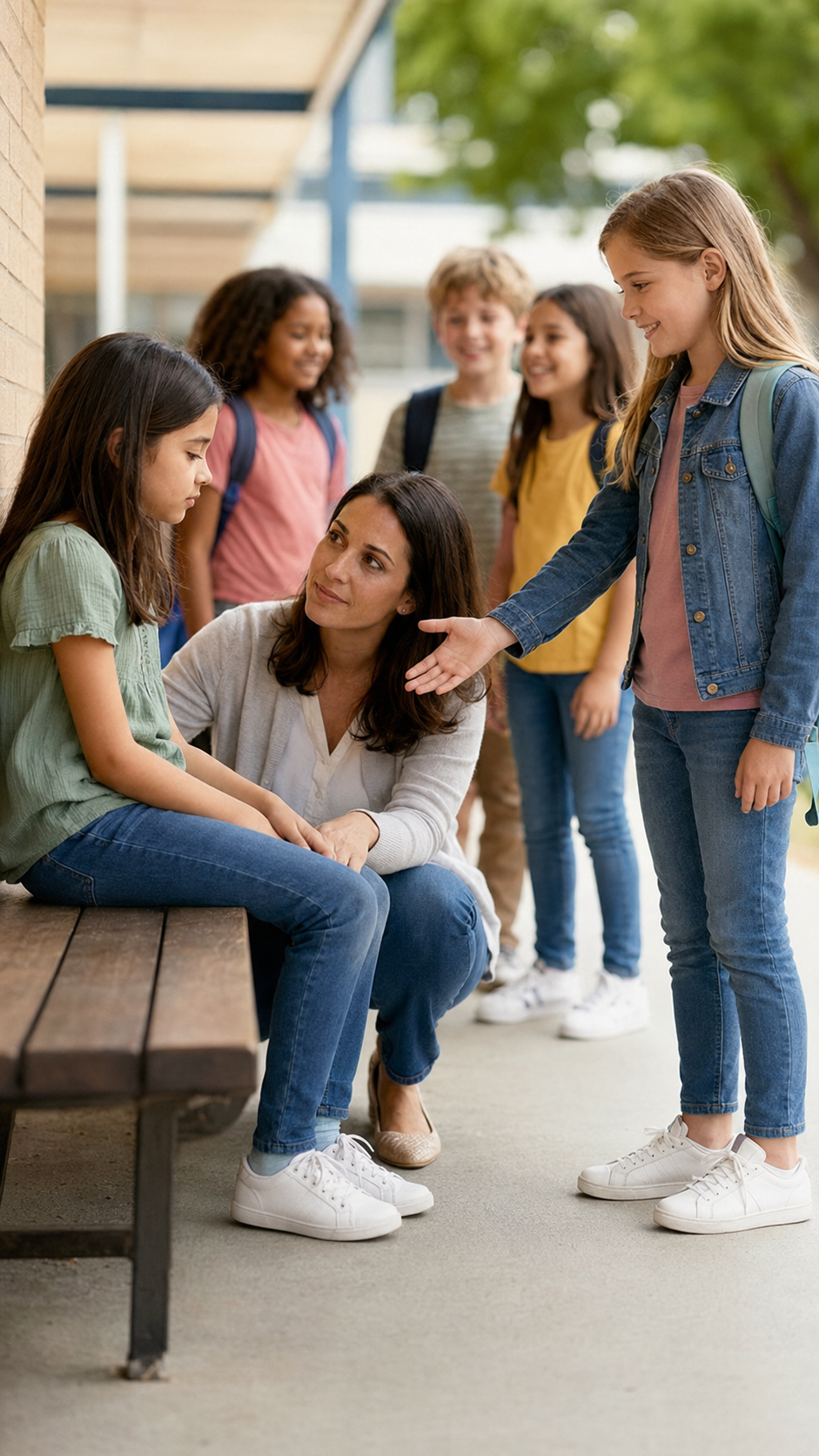
How to Help a Child Who Is Being Bullied and Excluded
Minjin Park
·
Finding out that your child is being bullied can bring up anger, fear, guilt, and an immediate urge to fix everything. When several children are involved—or when an entire group appears to be excluding your child—the situation can feel especially overwhelming.
Your child may be ignored at lunch, removed from group chats, mocked in front of classmates, deliberately left out of activities, or targeted with rumors. Because this type of bullying does not always leave a visible injury, adults may dismiss it as friendship trouble or normal conflict. But repeated social exclusion can be deeply painful and may affect a child’s confidence, education, sleep, and mental health.
Bullying is not rare. According to the CDC’s 2023 Youth Risk Behavior Survey, 19% of U.S. high school students reported being bullied on school property during the previous year, while 16% reported electronic bullying.
A calm, organized response from a trusted adult can make an enormous difference. Here is how parents and caregivers can help.
Not every disagreement between children is bullying. Friends may argue, say something insensitive, or temporarily choose different groups. These experiences still matter, but bullying usually involves three elements:
Unwanted aggressive or harmful behavior
A real or perceived imbalance of power
Repetition, or a strong possibility that the behavior will be repeated
This power difference may be physical, but it can also come from popularity, social status, access to embarrassing information, athletic ability, or the number of children involved. A child facing five classmates who control a larger friendship group may feel unable to defend themselves even if no one has threatened physical violence.
Group bullying often takes the form of relational aggression. Examples include repeatedly excluding a child, telling others not to speak to them, spreading rumors, humiliating them publicly, sharing private messages, or using friendship as a way to control their behavior.
The distinction matters because the solution to bullying is not simply telling both sides to apologize or “work it out.” A child who is being targeted may need protection, adult supervision, and a formal response from the school.
Watch for Signs Your Child May Be Struggling
Some children tell their parents immediately. Others stay silent because they are embarrassed, afraid of retaliation, or worried that adults will take away their phone or make the situation more visible.
The warning signs identified by StopBullying.gov include unexplained injuries, lost belongings, frequent headaches or stomachaches, changes in eating or sleep, falling grades, avoiding school, losing friends, and feeling helpless.
Asks to be driven to school instead of taking the bus
Avoids lunch, recess, sports, or after-school activities
Becomes unusually irritable after using their phone
Says that “everyone hates me” or “there’s no point going to school”
None of these signs proves that bullying is happening. They are reasons to start a gentle conversation.
Begin With a Calm, Private Conversation
Your first reaction matters. If you immediately threaten to confront the other children or call every parent involved, your child may regret telling you.
Choose a quiet moment and begin with what you have noticed:
“You’ve seemed worried about school lately, and I noticed you stopped sitting with your usual group. I’m not angry with you. I just want to understand what has been happening.”
Let your child tell the story in their own words. Try not to interrupt with questions that sound like blame, such as “Why didn’t you walk away?” or “What did you do to make them angry?”
Instead, ask:
Who was involved?
What happened before, during, and afterward?
How often has this happened?
Where does it usually happen?
Did anyone see it?
Has it happened online too?
Have you told an adult at school?
What would help you feel safer tomorrow?
Say clearly, “This is not your fault,” and “You did the right thing by telling me.” Avoid promising complete secrecy. Explain that you will involve only the people necessary to keep them safe and will talk with them before taking major steps whenever possible.
Check for Immediate Danger
Before deciding what to do next, determine whether your child is in immediate danger. Ask directly about threats, physical assaults, sexual harassment, stalking, extortion, weapons, and self-harm.
It is safe to ask a child whether they have thought about hurting themselves. Asking does not put the idea into their mind. If your child expresses suicidal thoughts, cannot stay safe, or is in immediate physical danger, treat the situation as an emergency.
In the United States, call 911 when someone is in immediate danger. A person experiencing suicidal thoughts or severe emotional distress can call or text 988 to reach the Suicide & Crisis Lifeline. StopBullying.gov provides additional emergency guidance. Outside the United States, contact your local emergency service or crisis line.
Create a Short-Term Safety Plan
Your child should not have to solve the bullying alone. Work together on a plan for the next school day.
Identify two or three adults your child can approach, such as a teacher, counselor, coach, bus driver, or school nurse. Choose safe places they can go during unstructured times. Bullying often happens in hallways, bathrooms, cafeterias, locker rooms, buses, and online spaces where supervision is limited.
A useful safety plan might include:
Walking between classes with a supportive peer
Checking in with a counselor each morning
Sitting near an adult on the bus
Having a designated place to eat lunch temporarily
Using a private phrase to tell a teacher that help is needed
Changing supervision in the locations where incidents occur
Whenever possible, the response should not punish or isolate the targeted child. Government guidance recommends asking the child what would help them feel safe and avoiding unnecessary changes that single them out. Moving the child who is being bullied to a different class or bus should not automatically be the first solution. The adults should first consider changes that address the behavior and improve supervision.
Document the Pattern
Keep a factual incident log. For each event, record:
Date, time, and location
Names of the children and adults involved
Exactly what was said or done
Witnesses
Injuries or damaged property
How the incident affected attendance, learning, or health
Who was notified and how they responded
Save emails, messages, usernames, links, photographs, and screenshots. Preserve the original material even if your child blocks the account afterward. Do not edit screenshots in a way that removes dates or surrounding context.
Documentation helps adults see a pattern that may not be obvious when each incident is considered separately. It also keeps school meetings focused on observable facts instead of competing opinions about personalities.
Report the Bullying to the School in Writing
Start with the teacher, counselor, or staff member closest to the situation, but put your concerns in an email. Include a concise description of the pattern, the effect on your child, any immediate safety concerns, and the specific help you are requesting.
For example:
“Since May 6, my child has reported four incidents involving the same group of students, including repeated exclusion, insults during lunch, and threatening messages in the class group chat. My child is now afraid to attend school. I would like a meeting to discuss immediate safety measures, supervision during lunch, preservation of relevant records, and the school’s process for investigating bullying.”
During the meeting, ask:
Who will investigate the report?
How will my child be protected during the investigation?
What supervision changes can begin immediately?
How will the school prevent retaliation?
Who will update us, and by what date?
When will the safety plan be reviewed?
The school may not be allowed to share another student’s disciplinary record. That does not mean it should refuse to explain what it is doing to protect your child.
Avoid demanding a face-to-face meeting between your child and the students involved. Forced mediation can be inappropriate when there is a power imbalance. An apology may eventually be helpful, but it is not a substitute for stopping the behavior.
Why a Formal Response Matters: A Real Case
A 2022 resolution involving Arizona’s Kyrene School District shows why repeated harassment must be treated as a pattern. The U.S. Department of Education’s Office for Civil Rights found that a student had experienced months of antisemitic harassment from numerous classmates at school and on social media, and that the district had not responded appropriately.
The district agreed to measures including support for the affected student, staff training, policy revisions, student education, and a school climate survey. The case involved discriminatory harassment rather than every form of bullying, but it illustrates an important principle: adults must examine the duration, group participation, online behavior, and accumulated impact—not treat each event as an unrelated joke. Details are available through the Department of Education’s OCR case announcements.
Handle Cyberbullying Without Punishing Your Child
Children sometimes avoid reporting online abuse because they fear losing access to their phone. Unless there is an immediate safety reason, do not make disclosure feel like a punishment.
Help your child save evidence, block abusive accounts, tighten privacy settings, and report the content through the platform. Do not respond angrily or forward humiliating material to more people. Federal cyberbullying guidance specifically recommends documenting dates and descriptions, preserving screenshots and messages, reporting the behavior, and blocking the responsible account.
Contact law enforcement when cyberbullying includes credible threats of violence, stalking, sexual images of a minor, extortion, or other potentially criminal behavior.
Help Your Child Rebuild Connection and Confidence
Stopping the bullying is only part of the recovery process. A child who has been rejected by a group may begin to believe that no one will accept them.
Help them find safe connections without suggesting that they need to become a different person. One genuine friendship can be more protective than trying to win back an entire group.
Consider clubs, sports, music, volunteering, faith communities, gaming groups with appropriate supervision, or other activities based on your child’s interests. The goal is not to keep them busy enough to forget what happened. It is to give them opportunities to experience competence, belonging, and relationships outside the bullying environment.
A pediatrician or licensed mental health professional may help if your child has persistent anxiety, depression, sleep problems, school refusal, panic symptoms, or a major change in eating. Counseling is not an admission that the targeted child caused the problem. It is additional support while adults work to restore safety.
Teach Responses Without Making the Child Responsible
Practice short, calm responses such as “Stop,” “That’s not okay,” or “I’m leaving now.” Your child can also rehearse walking toward a supervised area, contacting a trusted adult, or joining a supportive peer.
However, advice such as “be more confident” should never replace adult intervention. Assertiveness may help in some situations, but it cannot reliably overcome a coordinated group, threats, or a serious imbalance of power.
Do not encourage physical retaliation unless your child must act to escape immediate harm. Fighting back can escalate danger and may make it harder for adults to identify the original pattern.
Know When to Escalate the Complaint
If the school does not respond, follow the district’s written complaint process. Escalation may move from the teacher or counselor to the principal, superintendent, school board, and state education agency.
In the United States, bullying connected to race, color, national origin, sex, disability, or another legally protected characteristic may also qualify as discriminatory harassment under federal law. The Department of Education provides information on harassment, bullying, and retaliation and explains how to file a complaint with the Office for Civil Rights. State laws and reporting procedures vary, so review the rules where your child attends school.
What Your Child Needs Most
A child being targeted by a group needs more than advice to ignore it. They need to know that an adult believes them, will act carefully, and will continue checking in after the first meeting.
Keep asking how the plan is working. Watch for retaliation that appears more subtle than the original behavior. Celebrate your child’s courage in speaking up, while reminding them that what happened does not define their worth or future friendships.
Has your family ever dealt with bullying or repeated social exclusion, and what response from a teacher, parent, or school made the greatest difference? Share your experience in the comments—your insight may help another caregiver recognize the problem and support a child sooner.
Hi, I’m the creator and editor behind ZestyHabit. I research everyday safety, first aid, and practical wellness topics using official guidance and reliable public sources, then turn that information into clear, realistic steps for daily life.
My goal is to help readers make safer, better-informed choices at home and beyond.