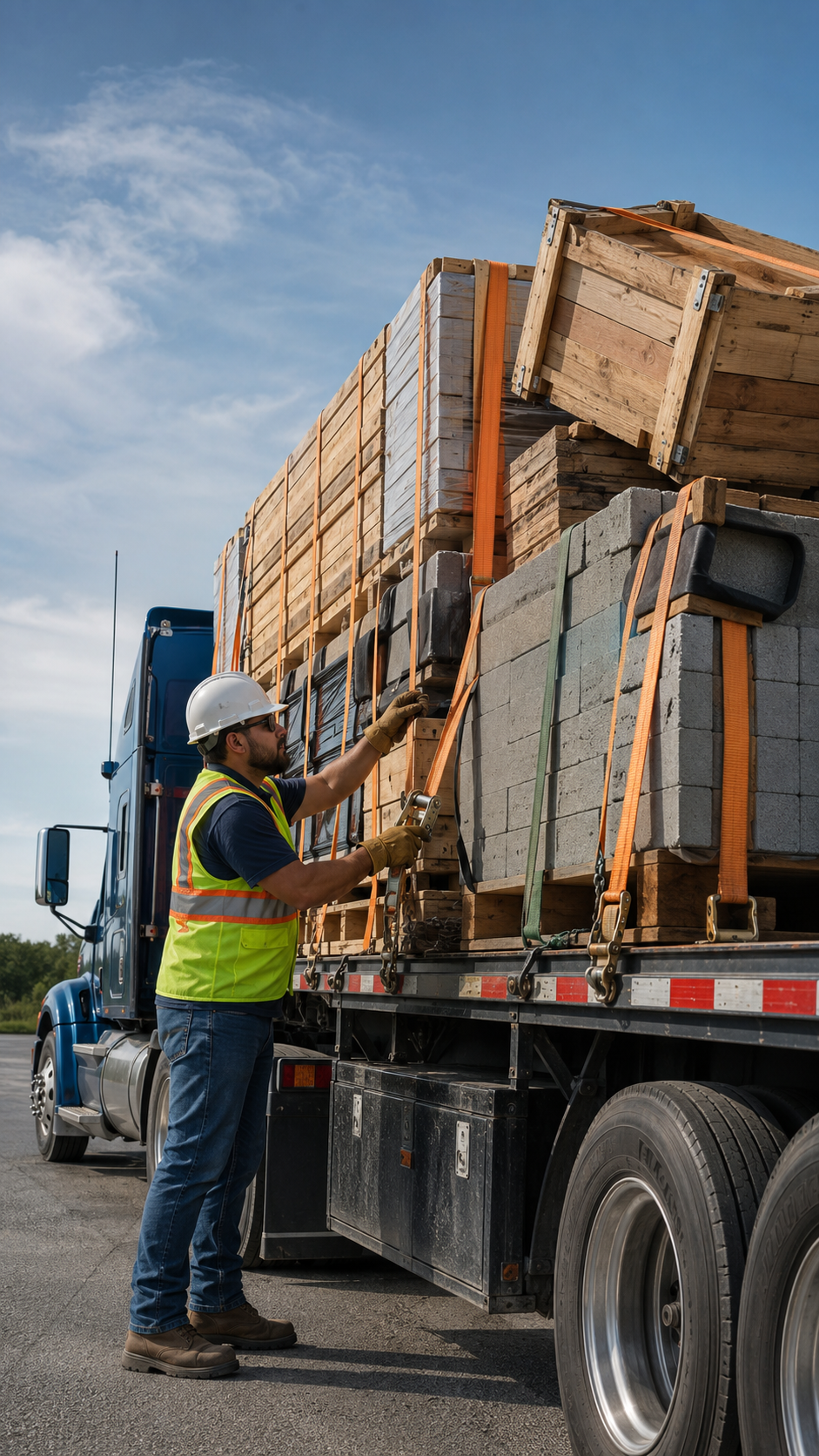
How to Prevent Truck Cargo From Falling: A Complete Load-Securement Guide
Minjin Park
·
A ladder resting in a pickup bed, a mattress tied down with thin rope, or a stack of building materials held by a single strap may look secure while the vehicle is parked. Once the truck begins moving, however, the load is exposed to braking, cornering, road vibration, crosswinds, and sudden bumps.
If even one object falls, the consequences can be devastating. A following driver may strike it, swerve into another lane, or lose control while trying to avoid it. Smaller materials can also injure pedestrians, damage vehicles, and create hazards that remain on the road long after the truck has left.
The National Highway Traffic Safety Administration reports that approximately 850 people are killed and almost 19,000 are injured each year in crashes involving objects on the road. It also notes that every state and the District of Columbia has laws addressing unsecured loads. NHTSA’s secure-load guidance makes the central rule simple: anything that could shift, spill, blow away, or fall must be properly restrained.
Preventing truck cargo from falling requires more than covering it with a tarp. Drivers must choose the right vehicle, distribute the weight correctly, use rated securement equipment, inspect every connection, and recheck the load during the trip.
Cargo does not need to slide dramatically to become dangerous. A small amount of movement can loosen a strap, change the load’s center of gravity, open a gap between stacked items, or place unexpected pressure on a tailgate.
Failure to retighten tie-downs after the load settles
An open, damaged, or improperly latched tailgate
Sudden braking or aggressive cornering
Using bungee cords as primary restraints
Exceeding the truck’s or trailer’s weight rating
A load can appear stable under gravity alone. The real test is what happens during an emergency stop or evasive maneuver.
Understand the Forces Acting on a Truck Load
When a truck accelerates, cargo tends to move backward. When the driver brakes, it moves forward. During a turn, it shifts sideways. A pothole or railroad crossing can also create vertical movement that lifts an object away from the truck bed.
Federal cargo-securement standards for commercial motor vehicles are designed around these predictable forces. Under 49 CFR §393.102, securement systems must satisfy performance criteria related to forward deceleration, rearward acceleration, lateral acceleration, and vertical movement.
Would every item remain attached if the truck braked hard, turned sharply, or struck a major bump?
If the answer is uncertain, the load is not ready for the road.
Step 1: Use the Right Vehicle for the Load
Cargo securement begins before anything is placed in the truck.
Check the vehicle’s payload capacity, gross vehicle weight rating, axle ratings, bed dimensions, and approved anchor points. If you are towing, verify the trailer rating, hitch capacity, coupler, safety chains, tires, brakes, and tongue-weight requirements.
Do not assume that an object is safe to transport simply because it physically fits. A small pickup can be overloaded by dense materials such as soil, gravel, bricks, concrete, tile, or scrap metal long before the bed appears full.
Oversized machinery, metal coils, logs, concrete pipe, vehicles, and other specialized commodities may require equipment and securement methods that a standard pickup or utility trailer cannot provide. Commercial operators should consult the applicable FMCSA commodity-specific rules rather than relying only on general tie-down practices.
If the load exceeds the vehicle’s capacity or cannot be attached to rated points, arrange professional transportation.
Step 2: Inspect the Truck, Trailer, and Anchor Points
A strong strap cannot compensate for a weak attachment point.
Before loading, inspect:
The truck bed and trailer deck
Tailgate latches and hinges
Sidewalls, racks, and stakes
D-rings, rails, chains, and anchor points
Trailer coupler and safety chains
Tires, wheels, lights, and brakes
Headboards, bulkheads, and front-end structures
Tarps and cargo nets
Ratchets, hooks, webbing, chains, and tensioners
Look for rust, cracks, bent hardware, torn stitching, heat damage, chemical deterioration, missing labels, and excessive wear. Remove defective equipment from service so it cannot be accidentally reused.
Never attach a tie-down to decorative trim, a lightweight bed rail, an unapproved bumper, or another component that was not designed to carry securement forces.
Step 3: Place Heavy Cargo Low and Keep the Load Balanced
Load placement affects both cargo security and vehicle handling.
Place heavier objects low in the bed and distribute weight from side to side. Keep the center of gravity as low as practical. Avoid building a tall stack when the same cargo could be arranged in a shorter, wider configuration.
Heavy cargo should be positioned so that axle and vehicle ratings are not exceeded. On a trailer, poor front-to-rear placement can create insufficient or excessive tongue weight, either of which may affect stability. Follow the trailer and tow-vehicle manufacturers’ instructions rather than estimating by appearance.
Cargo should be packed closely enough that individual pieces cannot gain momentum inside an empty space. Use suitable blocking, bracing, dunnage, or void fillers where necessary.
Do not rely on the truck cab, tailgate, or trailer wall to stop a heavy object unless that structure is specifically designed and strong enough to be part of the securement system.
Step 4: Prevent Round Objects From Rolling
Cylinders, pipes, barrels, reels, tanks, and logs need more than downward strap pressure. If they can roll, they must be blocked.
The FMCSA cargo-securement rules require cargo likely to roll to be restrained with chocks, wedges, cradles, or equivalent methods. The device used to prevent rolling must not be able to loosen unintentionally during transit.
Place the restraint firmly against the cargo and secure it to the vehicle when appropriate. A loose piece of wood placed near a pipe is not dependable blocking. Once the vehicle moves, the makeshift block may move with it.
Round cargo should also be restrained in the forward, rearward, sideways, and vertical directions. Blocking and tie-downs usually work together rather than replacing one another.
Step 5: Choose Rated Tie-Down Equipment
Cargo straps, chains, hooks, tensioners, and anchor points have working load limits, often abbreviated as WLL. The WLL describes the maximum load that a component is intended to handle in normal service.
The capacity of a securement assembly is determined by its weakest component. A high-capacity chain attached to a low-rated hook or anchor point does not retain the chain’s full rating.
For commercial motor vehicles, 49 CFR §393.106 requires the aggregate working load limit of the securement system to be at least one-half the weight of the article or group of articles being restrained. Depending on how a tie-down is routed and attached, only part of its marked WLL may count toward the aggregate total.
Drivers should know:
The weight of the cargo
The WLL of each strap or chain
The rating of hooks and tensioners
The capacity of each anchor point
Whether a direct or over-the-load tie-down is being used
The minimum number of tie-downs required
Do not use knots in synthetic webbing or chains. Knots can reduce strength, interfere with proper tension, and violate commercial securement requirements.
Ordinary elastic bungee cords are useful for holding a lightweight cover in place, but they should not be the primary restraint for furniture, appliances, lumber, machinery, or other substantial cargo.
Step 6: Use Enough Tie-Downs
A load may meet the total WLL requirement and still lack the required number or positioning of restraints.
For general commercial cargo that is not blocked against forward movement, FMCSA states that:
One tie-down is required for an article 5 feet or shorter and 1,100 pounds or less.
Two tie-downs are required if the article is 5 feet or shorter but weighs more than 1,100 pounds.
Two tie-downs are required if the article is longer than 5 feet but shorter than 10 feet, regardless of weight.
An article longer than 10 feet requires two tie-downs for the first 10 feet and an additional tie-down for every additional 10 feet or fraction.
These are minimum federal requirements for covered commercial operations, not a guarantee that every load is safe with exactly that number. The cargo’s shape, stability, surface, weight distribution, and applicable commodity-specific rules may require additional restraints.
Private pickup and trailer owners should check state law and use enough independently attached restraints to control movement in every direction.
Step 7: Protect Straps From Sharp Edges
A sharp corner can cut through a strap that initially appeared strong enough.
Use edge protectors where webbing contacts metal, stone, concrete, lumber, glass, machinery, or any surface capable of cutting or abrading it. Edge protection should withstand the pressure of the tightened restraint without crushing or slipping away.
FMCSA specifically requires edge protection when a tie-down is subject to abrasion or cutting. It must resist abrasion, cutting, and crushing.
Position ratchets and hooks where they will not strike the road, tires, cargo, or moving vehicle components. Secure loose strap tails so they cannot whip in the wind or become entangled.
Step 8: Secure Loose Materials Before Covering Them
A tarp is a cover, not necessarily a cargo restraint.
Leaves, trash, insulation, gravel, branches, packaging, and other lightweight material can blow out even when larger objects remain in place. Use a vehicle or container with sidewalls high and strong enough to contain the material. Close and latch the tailgate before installing a properly sized tarp or cargo net.
The cover should extend over the entire load and be fastened at multiple points. It must not flap excessively, obscure lights or license plates, drag on the road, or come loose at highway speed.
Large objects beneath the tarp still need their own rated restraints. A tarp thrown over a refrigerator or couch will not reliably keep it in the truck during sudden braking.
After securing the load, clean loose debris from the bumper, tailgate, trailer frame, steps, and roof. A single tool or piece of scrap left on a flat surface can become road debris.
Step 9: Perform a Walk-Around and Push Test
Before driving, walk around the entire vehicle.
Check that:
Every ratchet is locked
Hooks are fully engaged
Straps are tight and correctly routed
Chains are properly tensioned
Edge protectors remain in place
The tailgate and doors are latched
Loose strap ends are secured
The tarp or net cannot lift
Cargo does not block lights, reflectors, mirrors, or the license plate
Nothing extends dangerously beyond the vehicle
Required flags, lights, or permits are in place for overhanging loads
Push or pull each accessible object from several directions. If it rocks, rolls, slides, or tips, add blocking or another restraint.
Never assume the person who loaded the truck also secured it correctly. The driver should personally verify the condition of the load before entering a public road.
Step 10: Recheck the Load During the Trip
Vibration can compress cargo, settle stacked material, stretch webbing, and reduce tension.
Federal rules require many commercial truck drivers to inspect cargo and securement devices within the first 50 miles of a trip. Drivers must then reexamine the load after a change in duty status, after three hours, or after 150 miles—whichever occurs first. The complete requirements and limited exceptions are provided in 49 CFR §392.9.
Private drivers should follow the same basic habit even when the federal schedule does not apply. Stop in a safe parking area shortly after departure and recheck the load. Inspect again after rough roads, emergency braking, strong winds, or any sound suggesting movement.
Do not stop on a narrow shoulder unless there is an immediate safety emergency. Find a location where you can stand away from traffic while inspecting the vehicle.
A Real Accident That Changed Washington Law
In February 2004, Washington resident Maria Federici was critically injured when a piece of particle board fell from a trailer and crashed through her windshield. The accident left her blind and severely injured.
The object did not need to be unusually large or heavy to cause life-changing harm. Highway speed converted an ordinary piece of building material into a dangerous projectile.
Safe Driving Does Not Replace Proper Securement
Smooth driving reduces stress on the cargo, but it cannot fix an inadequate securement system.
When transporting a load:
Increase following distance.
Reduce speed on curves and rough roads.
Brake gradually when possible.
Avoid sudden lane changes.
Account for crosswinds and vehicle height.
Watch for low bridges and overhead obstructions.
Do not attempt to “outrun” a storm with a questionable load.
A correctly secured load should tolerate foreseeable driving forces, including the possibility of emergency braking. Driving slowly while depending on gravity is not a safe alternative.
What to Do If Cargo Shifts or Falls
If you notice movement, noise, a loose tarp, or a trailing strap, reduce speed smoothly and pull into a safe parking area. Do not make abrupt steering movements, and do not climb onto an unstable load.
Call 911 if the object is creating an immediate traffic danger.
Give the location, travel direction, lane, and description of the debris.
Do not walk into traffic to retrieve it.
Cooperate with law enforcement and remain at the scene when directed.
Attempting to remove cargo from a highway can result in a second, potentially fatal collision. Traffic control and debris recovery should be handled by authorities equipped to protect the scene.
Make Load Security a Routine, Not a Guess
Preventing truck cargo from falling is a repeatable process: choose the right vehicle, inspect the equipment, load heavy objects low, block anything that can roll, use rated restraints, protect tie-downs from sharp edges, cover loose material, and recheck everything during the trip. Commercial drivers must also follow all applicable federal, state, local, and commodity-specific regulations.
Have you ever seen cargo fall from a pickup, trailer, or commercial truck—or found a load that had loosened during a trip? Which securement mistake do you think drivers overlook most often? Share your experience or practical loading tips in the comments so other readers can keep dangerous debris off the road.
Hi, I’m the creator and editor behind ZestyHabit. I research everyday safety, first aid, and practical wellness topics using official guidance and reliable public sources, then turn that information into clear, realistic steps for daily life.
My goal is to help readers make safer, better-informed choices at home and beyond.