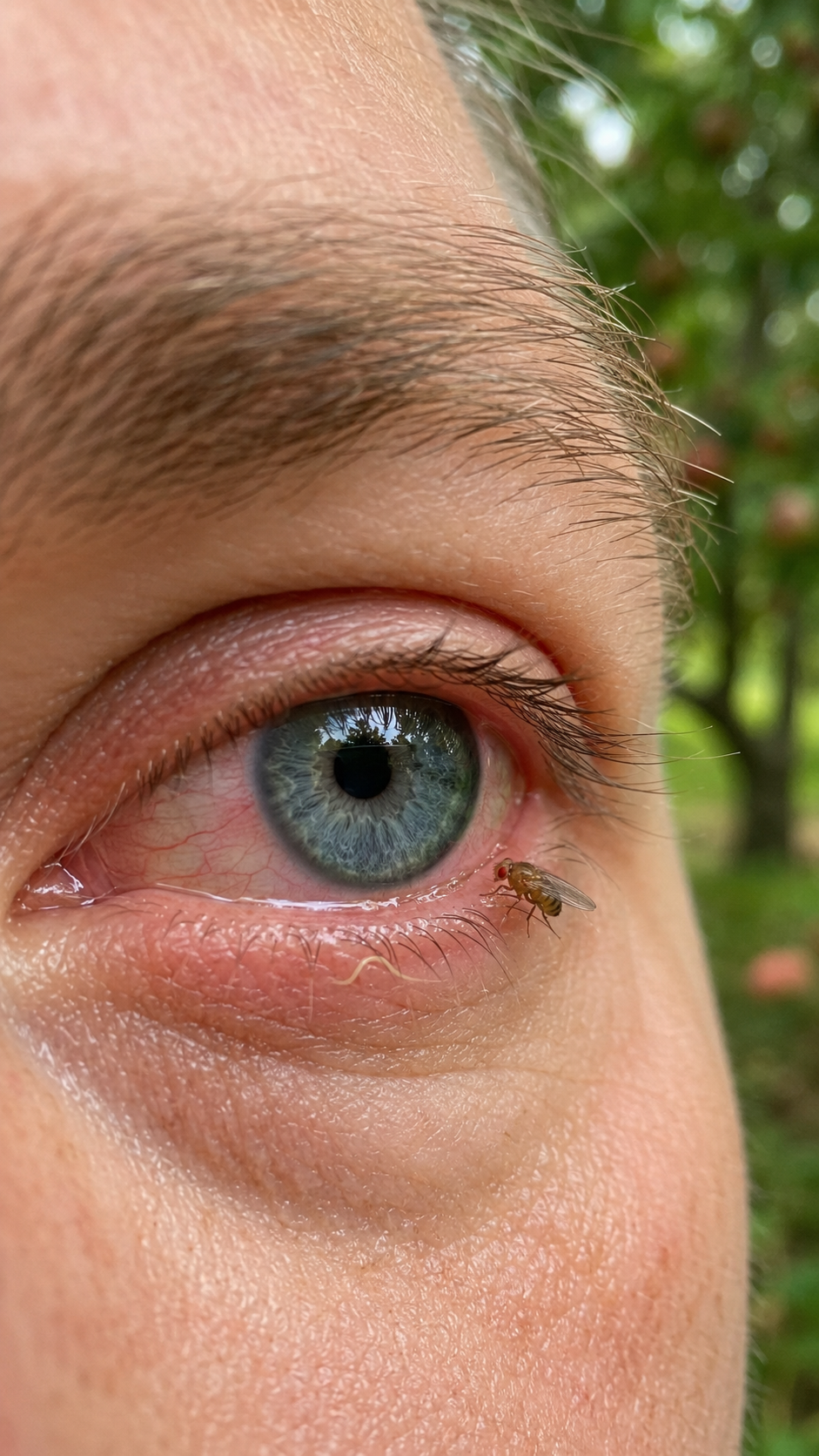
Oriental Eyeworm Infection: How Tear-Feeding Fruit Flies Transmit Thelazia callipaeda
Minjin Park
·
A tiny fly lands near your eye while you are hiking, gardening, or spending time in the countryside. You brush it away and forget about it. Several weeks later, one eye becomes itchy and watery. It feels as though an eyelash is trapped beneath the lid, but no amount of blinking makes the sensation disappear.
In rare cases, the problem may not be dust, pollen, or an eyelash. It may be an Oriental eyeworm called Thelazia callipaeda.
The idea of a worm living on the surface of the eye sounds like something from a horror film, but human thelaziasis is a documented parasitic disease. The parasite is transmitted by certain small flies that feed on tears. Dogs, cats, foxes, and other mammals are its usual hosts, while humans become infected accidentally.
Fortunately, the condition is uncommon and usually treatable when recognized. However, delayed diagnosis can allow continuing inflammation and, in more serious cases, damage to the cornea.
Understanding the transmission route is especially important because the “fruit flies” involved are not necessarily the ordinary kitchen flies hovering around overripe bananas.
Thelazia callipaeda is a small parasitic roundworm, or nematode, commonly known as the Oriental eyeworm. According to the Centers for Disease Control and Prevention, most zoonotic human infections involving the genus Thelazia are caused by T. callipaeda. Other species, including T. californiensis and T. gulosa, can also infect people in certain regions.
Adult worms live primarily in the conjunctival sac—the space between the eyelids and the surface of the eye. They may also be found around the tear ducts and underneath the eyelids.
The worms are thin, pale, and threadlike. Adult T. callipaeda worms can reach approximately one to two centimeters in length, making them large enough to be seen moving across the eye during an examination.
Historically, the parasite was associated with eastern and southeastern Asia, including South Korea, China, Japan, India, Thailand, and Indonesia. It later became established in parts of Europe. More recently, infections in animals have been documented in the United States, showing that its geographic range is not fixed.
Are Ordinary Kitchen Fruit Flies Responsible?
This is where many headlines become misleading.
The vectors of T. callipaeda belong to the fruit fly family Drosophilidae, but they are specialized tear-feeding flies, particularly species in the genus Phortica. The CDC identifies Phortica variegata and Phortica okadai as important intermediate hosts.
Unlike familiar kitchen fruit flies that gather around fermenting produce, these flies are attracted to the tears and eye secretions of animals and, occasionally, humans. They are sometimes described as lacrimophagous, meaning “tear-feeding.”
Therefore, finding fruit flies in your kitchen does not mean that your family is at immediate risk of Oriental eyeworm infection. The parasite’s life cycle requires:
An infected animal or person carrying reproductive worms
A suitable fly that feeds on that host’s tears
Development of the parasite inside the fly
The infected fly feeding around another host’s eye
The infection does not normally result from eating fruit, swallowing a fly, touching a dog, or having ordinary household flies nearby.
How Does the Parasite Reach the Human Eye?
The life cycle is unusual because the fly does not merely carry worms on its legs.
Adult female worms living in an infected animal’s eye release first-stage larvae into its tears. When a suitable fly feeds on those tears, it ingests the larvae.
Inside the fly, the larvae develop and molt. After approximately two to three weeks, they become infective third-stage larvae and migrate toward the fly’s mouthparts.
When that fly later feeds on the tears of another animal—or a person—the infective larvae enter the conjunctival sac. They continue developing and can become adults after approximately one month.
This means the fly must already be biologically infected. A fly cannot normally pick up a larva from one eye and immediately transmit an infectious worm to someone else a few seconds later. Development inside the vector is an essential stage of the cycle.
Humans are accidental hosts. Dogs, cats, foxes, rabbits, and other wild or domestic mammals are much more important in maintaining the parasite’s natural transmission cycle.
Who Is Most at Risk?
Human infection remains rare, but exposure may be more likely among people who:
Spend significant time in forests, orchards, farms, or rural areas
Historically, some reports have involved children and older adults living in rural communities. This may partly reflect greater exposure to infected animals and tear-feeding flies, as well as difficulty recognizing or describing the early symptoms.
Cases in Europe have frequently appeared during warmer months. A report in the CDC’s Emerging Infectious Diseases journal noted that human cases in Italy and France occurred during summer, overlapping with the vector’s active season. Exact seasonal risk varies by region and climate.
Early Symptoms of Oriental Eyeworm Infection
Symptoms can be mild at first and easily mistaken for more common eye conditions.
Possible early signs include:
A persistent foreign-body sensation
Itching or irritation in one eye
Excessive tearing
Redness of the conjunctiva
Mild swelling
Increased blinking
Stringy or unusual discharge
A sensation of movement under the eyelid
A visible white thread moving across the eye
Most reported human cases affect one eye, although infection of both eyes is possible.
A person may initially assume that the symptoms are caused by seasonal allergies, dry eye, a scratched cornea, bacterial conjunctivitis, or a trapped eyelash. Standard eye drops may temporarily soothe irritation without eliminating the parasite.
Any persistent foreign-body sensation deserves medical evaluation, especially when the person has recently spent time outdoors in a region where Thelazia occurs.
Why Can Thelaziasis Become Dangerous?
The main danger comes from continuing mechanical irritation and inflammation.
The worm’s movement and textured outer surface can irritate delicate eye tissues. According to the CDC, heavier infections can cause conjunctivitis, swelling, light sensitivity, excessive tearing, and corneal ulceration.
Potential complications include:
Severe conjunctival inflammation
Keratitis, or inflammation of the cornea
Corneal abrasions or ulcers
Secondary bacterial infection
Increasing pain and sensitivity to light
Blurred vision
Corneal scarring in severe or delayed cases
This does not mean every infection leads to permanent eye damage. Many patients recover quickly after the worms are completely removed. The risk increases when the condition is mistaken for ordinary conjunctivitis and the parasite remains in the eye.
Seek urgent eye care for severe pain, sudden vision changes, marked light sensitivity, a cloudy area on the cornea, significant swelling, pus-like discharge, or any visible moving organism.
A Verified Human Case from Spain
One documented case illustrates both the strange presentation and the value of proper diagnosis.
In 2011, a 17-year-old girl from Cáceres, Spain, sought medical care after experiencing a foreign-body sensation in her left eye for three weeks. She had spent part of the summer in the countryside.
An ophthalmic examination found two thin worms in the conjunctival fornix. The larger specimen was a 17-millimeter adult female, identified as T. callipaeda through morphological examination and molecular testing.
The worms were removed with forceps, and the patient’s symptoms resolved. A follow-up examination two weeks later was normal. The case was published in the CDC journal Emerging Infectious Diseases.
This report demonstrates that the condition can resemble an ordinary piece of debris in the eye for weeks. It also shows that recovery can be straightforward when the parasite is found and completely removed.
How Is Oriental Eyeworm Infection Diagnosed?
Diagnosis usually begins with a careful eye examination, often using a slit lamp. The clinician may gently inspect the upper and lower conjunctival fornices because worms can hide beneath the eyelids.
In many cases, diagnosis occurs when a moving worm is directly observed and removed. The specimen can then be identified using its physical characteristics. Molecular testing, such as PCR and genetic sequencing, may be used to confirm the exact species.
Routine blood tests may be normal because the parasite is localized in the eye. Stool testing is generally not useful because this is not an intestinal worm.
Doctors may also check for:
Corneal abrasions or ulceration
Secondary bacterial infection
Retained worms or larvae
Inflammation of deeper eye structures
Reduced visual acuity
A follow-up examination can be important because more than one worm may be present.
How Is Thelaziasis Treated?
Mechanical removal of the worms by an eye-care professional is the central treatment in most human cases. A clinician may use topical anesthetic and fine forceps, followed by careful inspection or irrigation of the conjunctival sac.
Depending on the number of worms, species, location, and clinical findings, a doctor may consider additional antiparasitic treatment. Antibiotic or anti-inflammatory eye medication may be prescribed when there is secondary infection or significant inflammation.
Treatment must be individualized. Veterinary dewormers, household chemicals, skin insect repellents, essential oils, and over-the-counter pesticides must never be placed in the eye.
Do not attempt to pull out a suspected worm with tweezers at home. The object may be attached tissue, mucus, a suture, or another structure. Uncontrolled removal can scratch the cornea, leave part of an organism behind, or push it farther beneath the eyelid.
If you see something moving, avoid rubbing the eye and seek same-day ophthalmic care.
Are Pets a Direct Source of Infection?
An infected dog or cat cannot normally transmit T. callipaeda directly to a person through touching, licking, fur, or shared bedding. The suitable tear-feeding fly is required for the parasite to develop into its infectious stage.
However, infected pets can help maintain the local life cycle. A fly may pick up larvae while feeding on a pet’s tears, develop the infectious stage, and later feed on another host.
Pet owners should arrange a veterinary examination if a dog or cat develops:
Persistent watery eyes
Redness or squinting
Frequent pawing at the face
Unexplained eye discharge
A raised third eyelid
Visible threadlike movement around the eye
In 2024, CDC researchers reported locally acquired T. callipaeda infections in dogs and cats from parts of the northeastern United States. The report documented confirmed animal cases in New York, New Jersey, and Connecticut, while emphasizing that no related human cases had been reported from that area at the time. This finding signals a need for awareness, not panic.
How to Reduce the Risk of Infection
No preventive method can guarantee protection, and research has not established ordinary insect repellent as a reliable way to stop Phortica transmission. Practical exposure-reduction measures include:
Wear wraparound glasses or sunglasses in areas with persistent face-seeking flies.
Consider a fine-mesh head net during prolonged work in heavily infested woodland or orchard environments.
Move away or go indoors if small flies repeatedly approach your eyes.
Avoid rubbing your eyes with unwashed hands.
Keep pets’ veterinary examinations and parasite-control plans up to date.
Have unexplained eye problems in pets evaluated promptly.
Seek care when one-sided eye irritation persists after rural or outdoor exposure.
Tell the eye doctor about recent travel, outdoor activity, and contact with animals.
Controlling ordinary kitchen fruit flies is worthwhile for food hygiene, but it should not be presented as a proven defense against Oriental eyeworm infection. The relevant vectors have a specialized tear-feeding behavior and are commonly associated with outdoor environments and animal hosts.
What to Do After a Fly Lands on Your Eye
A single fly landing near your eye is not a reason to assume that you have been infected. Most flies are not suitable vectors, and even a suitable species must be carrying mature infective larvae.
Move away from the flies, wash your hands, and avoid rubbing the eye. If the eye is irritated, gentle rinsing with sterile saline or clean running water may help remove ordinary debris. Do not apply disinfectant, repellent, or soap to the eye.
Monitor for persistent symptoms over the following days and weeks. Arrange an eye examination if irritation continues, repeatedly returns, affects only one eye, or is accompanied by unusual movement beneath the eyelid.
The Bottom Line
Oriental eyeworm infection is real, but it is rare and frequently misunderstood. Thelazia callipaeda is transmitted by specialized tear-feeding drosophilid flies, particularly Phortica species—not simply by any fruit fly found near food. The parasite usually causes tearing, redness, itching, and a persistent foreign-body sensation, but untreated infection can progress to keratitis or corneal ulceration. Prompt examination, professional removal, and follow-up generally lead to a good outcome.
Had you heard of tear-feeding flies or Oriental eyeworm infection before reading this article, and which warning sign surprised you the most? Share your thoughts or experiences with unusual eye irritation in the comments so other readers can become more aware of this rare but important condition.
Hi, I’m the creator and editor behind ZestyHabit. I research everyday safety, first aid, and practical wellness topics using official guidance and reliable public sources, then turn that information into clear, realistic steps for daily life.
My goal is to help readers make safer, better-informed choices at home and beyond.