
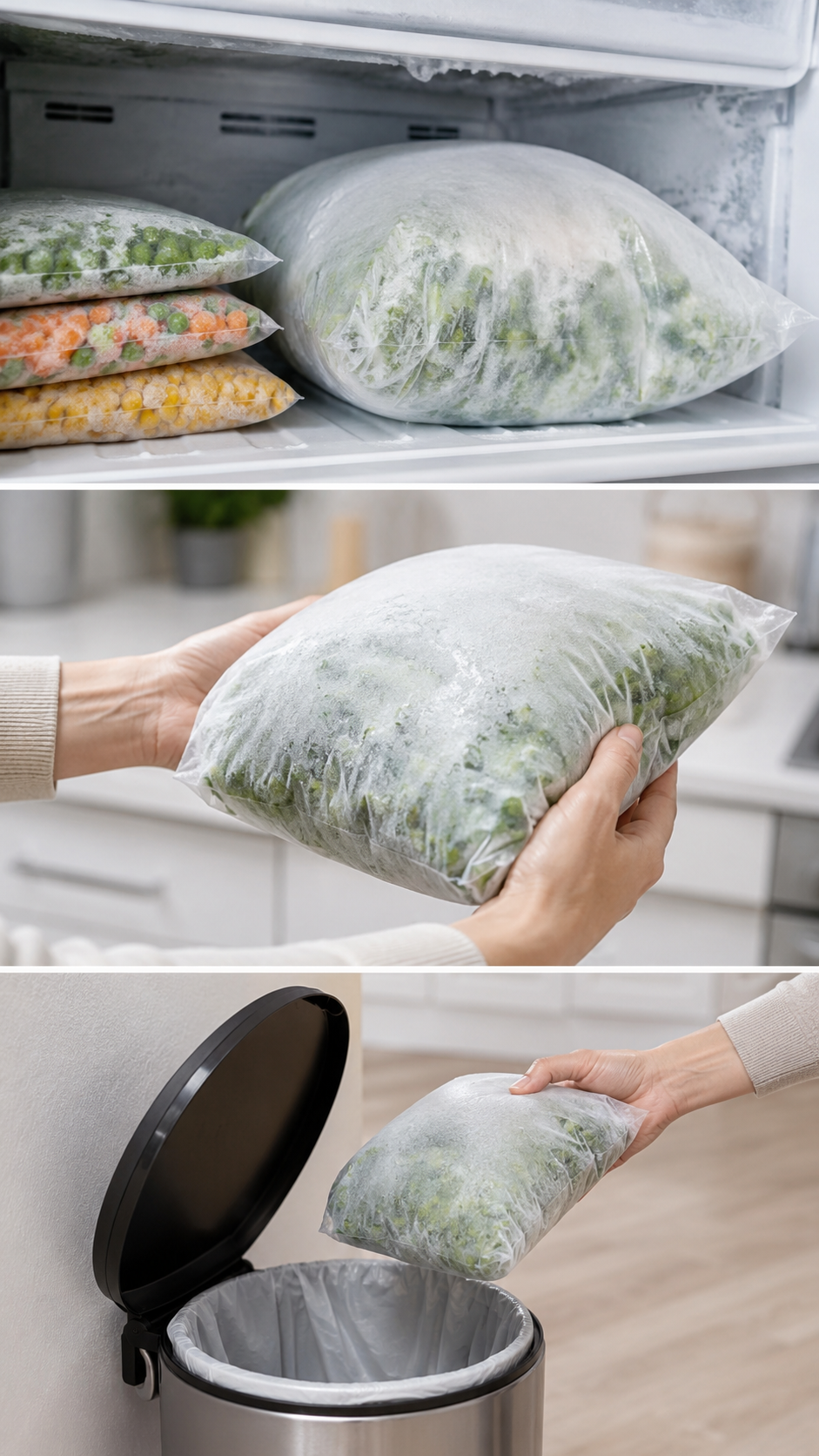

Is a swollen frozen food bag safe? Learn why packaging expands, which warning signs suggest spoilage or thawing, and when frozen food should be discarded.
Suggested URL slug: swollen-frozen-food-bag-safety
You open the freezer and notice that a bag of vegetables, chicken, dumplings, or another frozen food looks strangely inflated. It may feel tight like a balloon, have rounded sides, or appear noticeably larger than it did when you bought it.
Does a swollen frozen food bag always mean the food has spoiled?
Not necessarily. Some frozen packages contain trapped air, extra headspace, or protective gases from the manufacturing process. Food and liquid also expand as they freeze, which can make flexible packaging look fuller. However, unexplained swelling can also accompany temperature abuse, a damaged seal, thawing and refreezing, or gas production related to spoilage.
The condition of the package is only one part of the assessment. The safest decision depends on what the packaging normally looks like, whether the food remained continuously frozen, and whether there are additional warning signs such as leaks, broken seals, stains, unusual odors, or evidence of thawing.
When the package is severely swollen, leaking, spurts when opened, or has an unknown temperature history, do not taste the food. Return it to the retailer or discard it.
Why Do Frozen Food Bags Sometimes Swell?
A swollen bag can have several explanations, ranging from normal packaging characteristics to serious storage problems.
Air was trapped during packaging
Many frozen foods are not vacuum-sealed. A bag of vegetables, fries, fruit, or dumplings may contain air around the product. The air prevents pieces from being tightly crushed and makes the bag easier to fill and seal.
If all bags of the same product have a similar appearance and the package has looked that way since purchase, the puffiness may be normal.
The food expanded as it froze
Water expands when it freezes. Foods with a high water content can therefore take up slightly more space after becoming solid.
This is especially noticeable in liquid or semi-liquid products such as:
- Soups
- Sauces
- Smoothie mixtures
- Purees
- Prepared meals with gravy
- Homemade freezer bags filled too close to the seal
Commercial packages are designed with expansion in mind, but homemade packaging may bulge when insufficient headspace is left.
Temperature or altitude changed the air pressure
A sealed flexible package can look more inflated after changes in temperature or atmospheric pressure. Air inside the package contracts and expands as conditions change.
This type of swelling does not automatically indicate spoilage, but it should still be evaluated alongside the food’s storage history and the condition of the seal.
The product partially thawed and refroze
When frozen food warms, ice melts and moisture moves around inside the package. If the food later refreezes, it may form a solid block, large ice crystals, distorted packaging, or frozen liquid around the seams.
Partial thawing can also create time for microorganisms to grow if the food becomes too warm for too long. Refreezing does not reverse microbial growth or destroy toxins that may already have formed.
Microorganisms produced gas
Some bacteria and yeasts can produce gases while breaking down food. In a sealed package, that gas may cause swelling.
Microbial activity is greatly slowed when food remains solidly frozen at 0°F (-18°C). Therefore, gas production is less likely to begin while a product is continuously frozen. A swollen package may indicate that contamination or temperature abuse occurred before the product was frozen or during a period of thawing.
Packaging alone cannot identify the organism involved. Do not assume that a normal smell proves the food is safe.
Is a Swollen Frozen Food Bag Always Unsafe?
No single packaging feature can answer every case.
A mildly puffy bag may be normal if:
- It has looked the same since purchase
- Identical products on the shelf have similar packaging
- The manufacturer intentionally leaves headspace
- The seal is completely intact
- The food is solidly frozen
- There are no leaks, stains, or unusual odors
- You know the freezer remained at 0°F
- The product is not involved in a recall
Concern is much higher when the bag has changed over time. A package that was once flat and has gradually become tight or balloon-like deserves more caution than one that was already puffy at the store.
If you cannot determine why the package expanded, contact the manufacturer using the information printed on the label. Provide the product name, lot code, expiration or best-by date, and a photograph of the package.
Do not open a severely swollen package merely to investigate it.
Warning Signs That Mean the Food May Need to Be Discarded
A swollen bag becomes more suspicious when other abnormalities are present.
The seal is split or separating
A failed seam can allow microorganisms, moisture, and freezer air to enter. It can also let food leak out and contaminate nearby items.
The FDA advises consumers not to buy sealed packages that are torn, leaking, punctured, or coming apart at the seams. (FDA guidance for damaged food packages)
Liquid or food stains appear outside the package
Stains on a cardboard box or dried residue around a bag may show that the food melted, leaked, and froze again. This is particularly concerning with meat, poultry, seafood, dairy products, and prepared meals.
Raw juices can contaminate other freezer contents even if the original food is eventually cooked.
There are large ice crystals inside
A few small crystals are common in frozen food. Thick frost, large crystals, or a solid icy block may indicate prolonged storage, poor sealing, or temperature fluctuations.
Large crystals do not automatically prove that food is unsafe, but they are evidence that the product’s condition has changed. Combine this clue with temperature records and the rest of the package inspection.
The bag is unusually tight
A bag that feels pressurized or dramatically more inflated than identical packages may contain gas. Avoid squeezing, puncturing, or placing your face close to it.
The food spurts, foams, or releases strong pressure
If a package releases liquid, foam, or unusual pressure when opened, stop handling it and do not taste the contents. The FDA advises against eating food from containers that spurt liquid or foam or otherwise appear abnormal. (FDA food-tampering guidance)
A gentle release of air from some tightly sealed packages can be normal, but forceful expulsion combined with swelling, odor, or discoloration is a reason for disposal.
The food has an unusual color, odor, or texture
After safe thawing, discard food with mold, slime, an offensive odor, unexpected discoloration, or an unusual texture that is not explained by ordinary freezer damage.
Remember that dangerous food does not always look or smell spoiled. Sensory checks can confirm that food is bad, but they cannot prove that it is safe.
The temperature history is unknown
Perhaps the freezer door was left open, the power failed while you were away, or a delivery sat outside for several hours. If you cannot verify how warm the food became or how long it remained warm, discarding a swollen perishable product is the safer choice.
How to Tell Whether Frozen Food Thawed and Refroze
Look for a combination of clues rather than relying on a single sign.
Possible evidence includes:
- Food pieces frozen into one solid mass
- Large ice crystals throughout the bag
- Ice gathered at the bottom of the package
- A warped bag or box
- Dried food stains on the exterior
- A water line inside a container
- Misshapen ice cream or frozen desserts
- Meat juices frozen outside the inner wrapper
- Damaged labels or cardboard from moisture
- Food that feels soft rather than solid
Some products naturally freeze together, and frost can develop during long storage without a safety failure. A freezer thermometer provides better information than appearance alone.
Keep the freezer at 0°F (-18°C) or below. If an outage or equipment failure occurs, check each item separately with a food thermometer whenever possible.
The 40°F and Ice-Crystal Rule
According to USDA guidance, partially thawed frozen food may generally be refrozen or cooked if it still contains ice crystals or has remained at 40°F (4°C) or below.
Perishable food that has been warmer than 40°F for more than two hours should be discarded. This includes meat, poultry, seafood, dairy-based meals, casseroles, and many other prepared foods. (USDA emergency freezer guidance)
Refreezing food that remains within the safe temperature range may reduce quality. The food can become dry, watery, or mushy because additional ice crystals damage its structure.
If you do not know the temperature or duration, do not taste the food to test it. The USDA emphasizes that appearance and odor cannot reliably determine whether mishandled food is safe.
What About Freezer Burn?
Freezer burn is not the same as spoilage.
It occurs when moisture escapes from food and freezes elsewhere in the package. Affected areas may look:
- Dry
- Pale
- Grayish or brown
- Tough
- Shriveled
- Covered with frost
Freezer-burned food may have a stale flavor or poor texture, but freezer burn itself does not make food unsafe. The FDA describes it as a food-quality issue rather than a safety problem. (FDA freezer-safety guidance)
However, freezer burn caused by a hole or broken seal should prompt a closer inspection. The packaging damage may have exposed the product to contamination or temperature changes.
Special Caution With Vacuum-Packed Frozen Seafood
Vacuum packaging removes most oxygen and can extend quality, but frozen fish in reduced-oxygen packaging requires careful handling.
Certain strains of Clostridium botulinum can create toxin in low-oxygen conditions if fish is stored or thawed improperly. Frozen vacuum-packed seafood should carry directions to keep it frozen and either thaw it under refrigeration immediately before use or remove it from the package before thawing.
Follow the exact instructions printed on the label. Do not leave vacuum-packed fish thawing on the counter or store it thawed in a sealed package longer than directed. (FDA reduced-oxygen seafood guidance)
A swollen vacuum package is not a home test for botulism, and a flat package does not guarantee safety. Temperature control and correct thawing are what matter.
If a vacuum package that was originally tight has become loose or inflated, contact the manufacturer or discard the product when its history is uncertain.
What to Do With a Swollen Package at the Grocery Store
Do not buy a frozen product if its packaging is:
- Open or torn
- Leaking
- Punctured
- Separating at the seams
- Heavily stained
- Covered with excessive frost
- Soft or partially thawed
- Unusually swollen compared with identical products
- Clearly thawed and refrozen
Tell a store employee so the product can be removed and inspected. Do not simply push a suspicious package to the back of the freezer case.
Check products near the bottom of the package as well. Leaks from meat or prepared meals may freeze against the shelf and be difficult to notice.
When shopping, choose frozen foods near the end of the trip. Transport them home promptly in an insulated bag during hot weather.
What to Do If a Delivery Arrives Swollen or Warm
Open deliveries containing frozen food as soon as they arrive.
The USDA recommends that perishable mail-order food arrive frozen, partially frozen with visible ice crystals, or at least refrigerator-cold—below 40°F as measured with a food thermometer. If it arrives above 40°F, do not eat or taste it; contact the company. (USDA mail-order food safety)
Take photographs of:
- The outer shipping box
- The swollen package
- Leaking areas
- Melted cooling materials
- The thermometer reading
- Lot numbers and date codes
Keep the food isolated from other groceries while contacting the seller. Follow the company’s return or disposal instructions, but do not place warm perishable food back in the freezer to “save” it.
Check for Recalls Before Using a Suspicious Product
A swollen bag may have nothing to do with a recall, but checking is sensible when commercially packaged food looks abnormal.
Search the FDA or USDA recall database using the:
- Brand name
- Product name
- Package size
- UPC
- Lot or batch number
- Production date
- Best-by date
- Establishment number on meat or poultry products
Do not eat a recalled product even if the package looks normal. Follow the recall notice, which may instruct consumers to return the product or dispose of it in a specific way.
How to Dispose of a Questionable Frozen Package
If the package is severely swollen, leaking, or under pressure, avoid opening it.
- Keep children and pets away.
- Place the unopened package inside a second sturdy bag.
- Seal the outer bag.
- Follow recall or manufacturer instructions if applicable.
- Otherwise, place it in a secure trash container.
- Do not feed the food to pets or wildlife.
- Wash your hands afterward.
- Clean and sanitize any freezer surface exposed to leakage.
If raw meat or seafood juices leaked onto other foods, discard any unprotected items they touched. Intact containers can be washed and sanitized before being returned to storage.
Can Cooking Make a Swollen Frozen Product Safe?
Cooking is not a reliable solution for food that may have been spoiled or held at unsafe temperatures.
Proper cooking kills many microorganisms, but it may not eliminate all toxins produced during improper storage. Cooking also cannot correct chemical contamination, damaged packaging, or an unknown recall hazard.
Do not try to reduce waste by cooking a suspicious product “extra well.” When the food has multiple warning signs or an uncertain history, throwing it away is the safer decision.
How to Prevent Packaging Problems in a Home Freezer
A few storage habits make abnormalities easier to detect and reduce the chance of damage:
- Maintain the freezer at 0°F or below.
- Use an appliance thermometer.
- Do not overfill flexible bags.
- Leave appropriate headspace in liquids and sauces.
- Use packaging designed for freezer storage.
- Press excess air from homemade freezer bags.
- Protect bags from sharp bones and package corners.
- Keep raw meat below ready-to-eat food.
- Label homemade packages with the date and contents.
- Rotate older food to the front.
- Inspect the freezer after a power outage.
- Avoid repeatedly opening the door during an outage.
- Follow commercial cooking, storage, and thawing directions.
During a power outage, a closed full freezer can maintain its temperature for approximately 48 hours, while a half-full freezer may stay cold for about 24 hours. These are estimates, so actual food temperature remains the deciding factor.
Frequently Asked Questions
Why is my unopened bag of frozen vegetables puffy?
It may contain normal trapped air or packaging headspace. Compare it with identical packages and check the seal, temperature, ice crystals, and purchase condition. If it has become progressively swollen or has other warning signs, contact the manufacturer or discard it.
Is a bag full of ice crystals unsafe?
Not automatically. Ice crystals can result from moisture loss or temperature fluctuation. If the food stayed at 40°F or below, it may still be safe, although its quality can decline.
Can I taste a small amount to check?
No. Harmful contamination may not create a noticeable flavor, and even a small taste can cause illness. Use time, temperature, packaging condition, and recall information instead.
Should I puncture a swollen bag?
No. Puncturing it may spray contaminated liquid and destroys evidence that could help a retailer or manufacturer evaluate the problem.
Can I return a swollen frozen product?
Most retailers will replace or refund an abnormal product. Keep the package isolated, photograph it, and contact the store before transporting a leaking or severely swollen item.
Final Thoughts
A slightly puffy frozen-food bag is not always proof of spoilage, but a package that suddenly inflates, leaks, separates at the seams, or shows signs of thawing deserves caution. Check the seal, compare it with normal packages, review the food’s temperature history, and never taste a questionable product. When several warning signs appear—or you simply cannot verify that the food stayed safely frozen—throwing it away is worth more than risking foodborne illness. Have you ever found a ballooned frozen-food bag in your freezer? Tell us what the product was and how you handled it in the comments below.

Hi, I’m the creator and editor behind ZestyHabit. I research everyday safety, first aid, and practical wellness topics using official guidance and reliable public sources, then turn that information into clear, realistic steps for daily life.
My goal is to help readers make safer, better-informed choices at home and beyond.


