
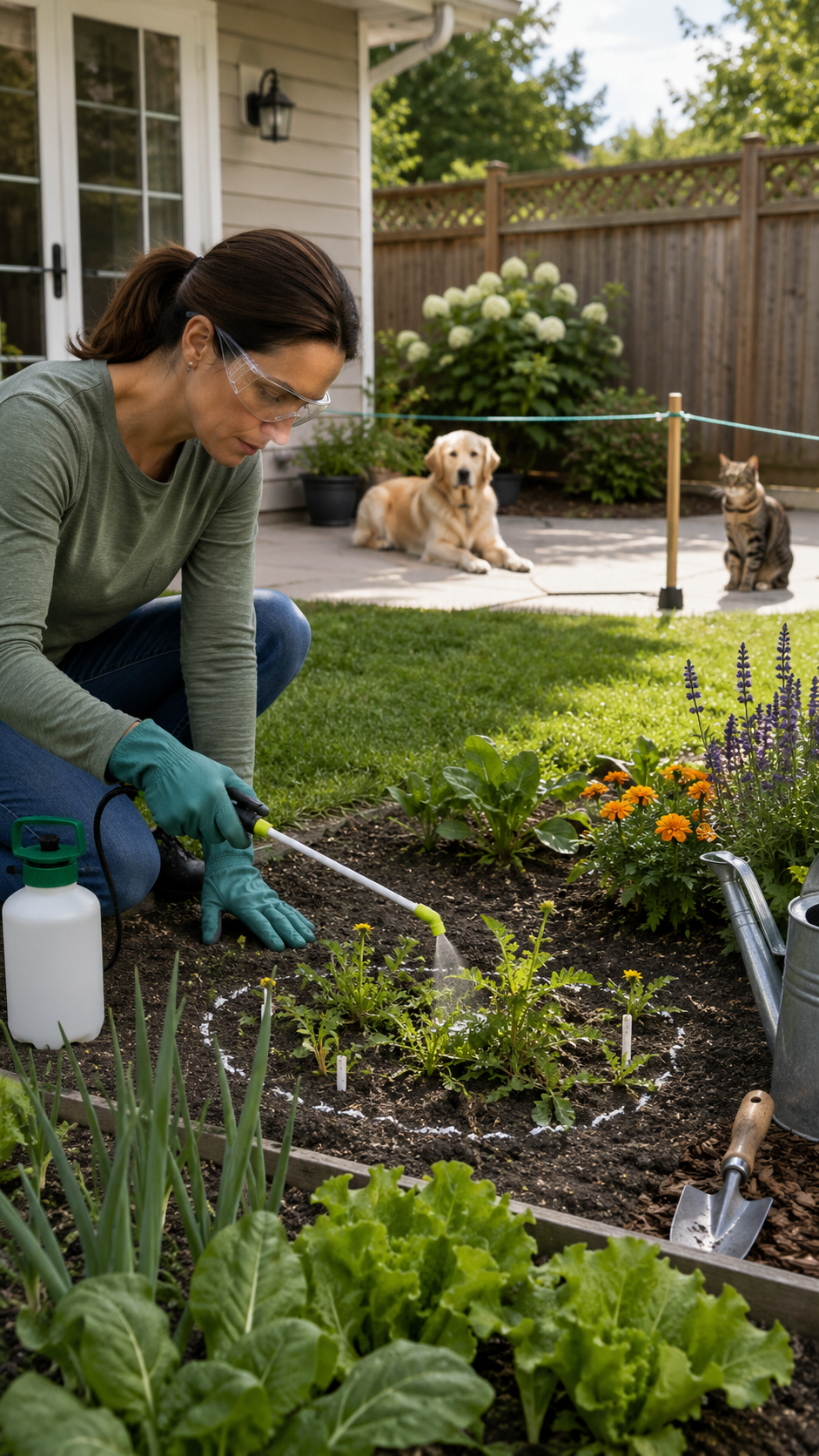

Learn how to use garden herbicides safely, prevent accidental exposure, protect pets, and handle, store, and dispose of weed killers correctly.
Suggested URL slug: garden-herbicide-safety-pets-exposure
A bottle of weed killer can make garden maintenance much easier, but it deserves the same care as any other pesticide. A quick spray on the driveway or lawn may seem harmless, yet accidental splashes, drifting mist, spills, and improper storage can expose people, pets, desirable plants, and nearby waterways.
Herbicides also vary considerably. A ready-to-use spot treatment is not the same as a concentrated product that must be diluted, and a lawn treatment may contain several active ingredients. For that reason, there is no single waiting period, protective outfit, or first-aid response that applies to every weed killer.
The safest approach is simple: use the product only when necessary, read its label before every application, and prepare for mistakes before opening the container. This garden herbicide safety guide explains how to reduce exposure, protect pets, respond to an accident, and use weed-control products more responsibly.
Important: This article provides general safety information. The product label and advice from medical, veterinary, or poison-control professionals should take priority in an actual exposure.
Why the Herbicide Label Matters
The small print on a herbicide container is not just a set of gardening suggestions. In the United States, using a registered pesticide in a way that conflicts with its labeling can violate federal law. More importantly, the label contains product-specific information that a general article cannot provide.
Before using a garden herbicide, look for:
- Approved plants, weeds, and application sites
- Mixing and application rates
- Required personal protective equipment
- Restrictions related to wind, rain, and temperature
- Instructions for keeping people and pets away
- First-aid directions
- Environmental warnings
- Storage and disposal requirements
- Restrictions for vegetable gardens and edible crops
The EPA advises users to apply pesticides only for purposes listed on the label and never to assume that twice the amount will produce twice the benefit. Overapplication can increase exposure, damage plants, and allow more chemical to move away from the intended area. Its consumer pesticide-safety guidance also recommends mixing only the amount needed for the immediate job.
Keep the label attached to the original container. If an accident occurs, medical or veterinary professionals may need the product name, active ingredients, EPA registration number, concentration, and first-aid instructions.
Consider Whether Herbicide Is Necessary
Good weed management does not always begin with a sprayer. For a few weeds, pulling, digging, hoeing, mulching, or cutting flower heads before seeds develop may be enough. Improving lawn density can also make it harder for new weeds to establish.
First, identify the weed and determine why it is thriving. Repeated outbreaks may point to compacted soil, excessive irrigation, poor drainage, bare ground, or mowing at an unsuitable height. Addressing the underlying condition can reduce the need for repeated chemical treatment.
When an herbicide is appropriate, a targeted application is generally easier to control than spraying an entire yard. Choose a product labeled for the specific weed and location, and use the lowest labeled rate that will do the job. “More” is not a safety margin.
Prepare the Area Before You Spray
A few minutes of preparation can prevent most routine accidents.
Move children and pets indoors or to an untreated part of the property. Pick up balls, pet toys, bedding, food bowls, and water dishes. Cover or relocate outdoor furniture and anything else likely to be touched or chewed later.
Check the weather as well. Do not spray when wind could carry droplets toward people, neighboring properties, open windows, vegetable beds, ponds, or ornamental plants. Follow the product’s limits for wind, temperature, rainfall, and irrigation rather than relying on a general weather rule.
Wear every item of personal protective equipment specified on the label. Depending on the product, that may include chemical-resistant gloves, long sleeves, long pants, closed shoes, eye protection, or other equipment. Ordinary fabric or leather gloves may absorb liquid and can be difficult to decontaminate, so do not substitute them when the label calls for chemical-resistant material.
If dilution is required, mix the product outdoors or in a well-ventilated location. Use dedicated measuring equipment—never a kitchen spoon or cup that could later come into contact with food. Keep the container below eye level while pouring, and stand on a stable surface where a spill can be contained.
Never combine herbicides with fertilizers, detergents, vinegar, or other pesticides unless the label specifically permits that mixture. Unapproved combinations may behave unpredictably or expose you to multiple chemicals at once.
How Accidental Herbicide Exposure Happens
People can be exposed to weed killers in four main ways:
- Skin contact: Splashes during mixing, leaking sprayers, wet vegetation, and contaminated gloves or clothing
- Eye contact: Spray blown back into the face or liquid splashing while a concentrate is poured
- Inhalation: Breathing spray mist, dust, or vapor, particularly in poorly ventilated areas
- Ingestion: Contaminated hands, products transferred to drink bottles, or food and beverages left near the mixing area
The effects depend on the product, dose, route of exposure, and the person’s health. Possible warning signs include irritation, burning, headache, dizziness, nausea, vomiting, coughing, weakness, confusion, or breathing difficulty. These symptoms are not specific to herbicides, so the product label and professional advice are essential.
What to Do After Human Exposure
Act promptly, but do not improvise a home remedy.
For skin exposure: Remove contaminated clothing and rinse the affected skin with plenty of water. Wash skin and hair thoroughly with soap and water unless the label gives different directions. Contaminated clothing should be discarded or washed separately from household laundry.
For eye exposure: Hold the eye open and rinse gently with clean running water for at least 15 minutes. Do not add eye drops, neutralizing chemicals, or medication to the rinse water unless a medical professional instructs you to do so.
For inhalation: Move to fresh air without entering an unsafe cloud of spray or vapor yourself. Loosen tight clothing and seek urgent help if the exposed person is having trouble breathing.
For ingestion: Do not induce vomiting unless the product label or a medical professional specifically tells you to. Some formulations can cause additional injury when vomited. Do not give food, drink, or medication to an unconscious person.
The EPA recommends checking the product’s first-aid directions and obtaining emergency assistance immediately if someone is unconscious, experiencing convulsions, or having difficulty breathing. Keep the container or label available when contacting medical professionals or local poison-control services. More detailed instructions are available in the EPA’s pesticide exposure first-aid guidance.
Why Garden Herbicides Can Be Risky for Pets
Dogs and cats explore treated areas differently from people. A dog may walk through wet vegetation and later lick its paws. A cat may groom contaminated fur. Pets may also eat treated grass, drink from a puddle, investigate a spill, or chew a poorly stored container.
Exposure may occur through ingestion, skin absorption, or inhalation. Risk depends on the ingredients, concentration, amount, and species involved. A substance that produces limited irritation in one animal may cause a more serious reaction in another.
Possible signs of pesticide exposure in pets include:
- Excessive drooling
- Vomiting or diarrhea
- Loss of appetite
- Unusual tiredness or weakness
- Irritated skin or eyes
- Unsteady walking
- Muscle tremors or seizures
- Changes in breathing
- Collapse or loss of consciousness
These signs can have many causes, but suspected herbicide exposure should not be ignored.
Remove pets from the application area before opening, mixing, or spraying the product. Keep their toys, bowls, and bedding away too. After treatment, follow the label’s exact reentry instructions. “Wait until dry” appears on many labels, but it is not a universal rule.
Granular products may have to be watered into the soil, and pets may need to stay away until the granules have dissolved and the surface has dried. The National Pesticide Information Center advises keeping pets away for the label-specified period or until a spray has dried completely, whichever is longer. Its pet pesticide safety fact sheet also notes that residues can remain after drying, so pets should still be discouraged from licking or eating treated plants.
If you suspect exposure, move the animal away from the source and prevent further licking or grooming. Contact a veterinarian or animal poison-control professional promptly and provide the product label. Do not make the pet vomit or give milk, oil, salt, charcoal, or human medication unless a veterinary professional directs you to do so. Breathing difficulty, tremors, seizures, bleeding, collapse, or unconsciousness requires immediate veterinary attention.
Applying Herbicide Correctly
During application, keep the nozzle close to the target and use the spray pattern recommended on the label. Avoid spraying above shoulder height, walking backward into a treated area, or positioning yourself where even a light breeze can blow mist toward your face.
Do not eat, drink, smoke, or touch your phone with contaminated gloves. If the sprayer clogs, do not blow through the nozzle with your mouth. Stop, depressurize the equipment as directed, and clean it using the manufacturer’s instructions.
Protect more than the weeds you intend to treat. Herbicide drift can injure flowers, trees, shrubs, and neighboring gardens. Runoff can carry residues toward storm drains and surface water. Keep applications away from wells, ponds, streams, gutters, and drainage channels, and never spray immediately before heavy rain unless the label explicitly allows the expected conditions.
For edible gardens, use only a product whose label names the crop or application site. A herbicide labeled for lawns or ornamental beds should not automatically be used around vegetables, herbs, or fruit trees. Observe any planting, harvest, or preharvest interval printed on the label.
When the work is finished, wash your hands and any exposed skin before eating or drinking. Change out of application clothing and wash it separately if the label instructs you to do so. Clean equipment only as directed, taking care that rinse water does not enter a sink, street drain, septic system, or waterway.
What to Do About a Spill
Keep people and animals away from the area, put on the label-required protective equipment, and stop the leak only if you can do so without exposing yourself. Do not hose the spill into the ground or a drain.
For a small liquid spill, the label or safety data sheet may direct you to contain it with an absorbent material such as clay-based litter or another suitable absorbent. Collect the waste in an appropriate container and follow the product’s disposal instructions. Large spills, spills near water, or releases you cannot safely contain require assistance from local emergency or environmental authorities.
Avoid mixing cleanup materials with household chemicals. Trying to “neutralize” a spill with bleach, ammonia, acid, or another cleaner can produce heat, splashing, or hazardous fumes.
Safe Storage and Disposal
Store herbicides in their original, tightly closed containers with readable labels. Place them in a locked, dry, ventilated location that children and pets cannot reach, away from food, animal feed, medicine, seeds, and ignition sources.
Never pour weed killer into a beverage bottle, food jar, or unmarked sprayer. A familiar container can turn a preventable storage mistake into an ingestion emergency.
Use or dispose of leftover products according to the label and local regulations. The EPA says pesticide containers should not be reused and unwanted pesticide should never be poured into a sink, toilet, sewer, or street drain. Ask your local waste authority whether it offers household hazardous-waste collection. See the EPA’s pesticide disposal guidance for additional information.
Are “Natural” Weed Killers Automatically Safer?
No. “Natural,” “organic,” and “homemade” do not mean harmless.
Concentrated vinegar-based weed killers can irritate or burn skin and eyes. Essential-oil products may irritate people or animals, while repeated salt applications can damage soil and nearby plants. Homemade mixtures also lack the standardized use, first-aid, and disposal instructions found on registered product labels.
Evaluate every weed-control option by its ingredients, concentration, application method, and potential exposure—not by the marketing language on the front of the bottle.
Final Garden Herbicide Safety Checklist
Before treating weeds, ask yourself:
- Have I identified the weed and considered nonchemical control?
- Is this product labeled for the plant and location?
- Have I read the complete label today?
- Am I wearing the required protective equipment?
- Are children, pets, toys, and bowls out of the area?
- Are the wind and rain conditions suitable?
- Can I prevent drift and runoff?
- Do I know the reentry time?
- Is clean water available in case of a splash?
- Do I have a safe plan for storage, cleanup, and disposal?
Herbicides can be useful garden tools, but careful preparation matters more than speed. Use the smallest appropriate treatment, respect the label, and keep people, animals, and waterways outside the exposure path. Have you ever dealt with herbicide drift, a leaking sprayer, or a pet entering a recently treated yard? Share what happened—and the precautions you now take—in the comments so other gardeners can learn from your experience.

Hi, I’m the creator and editor behind ZestyHabit. I research everyday safety, first aid, and practical wellness topics using official guidance and reliable public sources, then turn that information into clear, realistic steps for daily life.
My goal is to help readers make safer, better-informed choices at home and beyond.


[…] guide explains how to use garden herbicides more safely, what to do after accidental exposure, and how to protect dogs, cats, children, […]