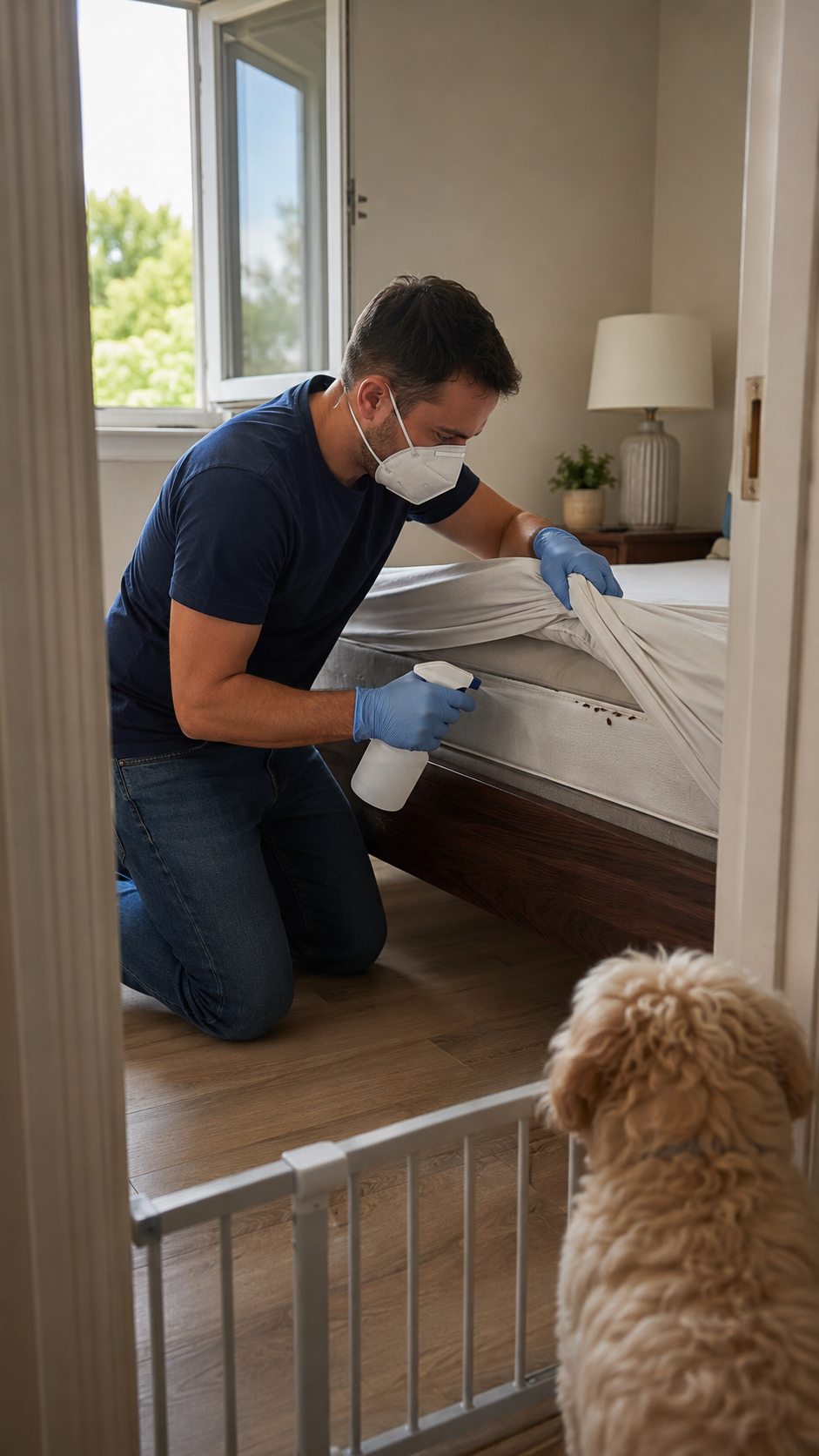
Bed Bug Pesticide Safety: Accidental Exposure, Pet Risks, and Proper Use
Minjin Park
·
Learn how to use bed bug pesticides safely, prevent accidental exposure, protect pets, recognize poisoning symptoms, and combine treatments for better control.
Discovering bed bugs can make anyone feel desperate. The bites, lost sleep, and fear of the infestation spreading often create pressure to spray every visible surface immediately. Unfortunately, using more pesticide than the label allows—or combining several products without a plan—can expose people and pets without eliminating the insects.
Bed bugs hide deep inside cracks, furniture joints, baseboards, mattress seams, and wall openings. Many populations are also resistant to commonly used insecticides. Spraying the same area repeatedly may increase exposure while leaving hidden bugs and eggs untouched.
Safe and effective control usually requires an integrated approach: confirming that the pest is actually a bed bug, reducing clutter, laundering or heat-treating appropriate items, vacuuming, monitoring, using encasements, and applying a properly registered pesticide only where its label permits.
This guide explains how to choose and use bed bug pesticides more safely, how to protect cats, dogs, birds, fish, and other pets, and what to do if accidental exposure occurs.
Bites alone cannot confirm a bed bug infestation. Mosquitoes, fleas, mites, allergic reactions, and other conditions can cause similar marks.
Before applying pesticide, look for more specific evidence:
Live reddish-brown insects
Pale eggs or shed skins
Dark fecal spots on mattress seams
Rust-colored blood marks on bedding
Bugs hiding around headboards, bed frames, and furniture joints
If possible, collect a specimen in a sealed container or clear tape and have it identified by a pest management professional or local Cooperative Extension office.
Treating the wrong pest wastes money and creates unnecessary chemical exposure. It may also delay the correct response while the actual problem becomes worse.
The Pesticide Label Is a Safety Document
A pesticide label is not merely a suggestion. It tells you where the product may legally be applied, which pests it controls, how much to use, what protective equipment is required, how long people and animals must remain away, and what to do after an exposure.
Before buying a product, confirm that:
It is registered with the EPA.
Bed bugs are specifically listed on the label.
Indoor residential use is permitted.
The intended application site is allowed.
You can follow all ventilation and reentry instructions.
The package is intact and includes a complete readable label.
The EPA provides a searchable tool for finding registered bed bug pesticide products. Registration does not mean a pesticide is harmless. It means the EPA has evaluated the product for its labeled uses, assuming the user follows all directions and precautions.
Never use an agricultural, garden, or outdoor pesticide inside a home unless indoor use appears on the label. Outdoor products may contain different concentrations, solvents, or application instructions that make indoor exposure more dangerous.
More Pesticide Is Not More Effective
One of the most common mistakes is assuming that doubling the amount will double the result. Excessive application may leave heavy residues, increase inhalation and skin exposure, damage furniture, and put pets at risk.
Repeated spraying can also contribute to insecticide resistance. If bed bugs survive an improperly targeted application, spraying the same chemical again may accomplish little.
Do not:
Apply more than the labeled amount
Spray more often than permitted
Mix different pesticides together
Add household chemicals to a pesticide
Pour pesticide into an unlabeled spray bottle
Use a concentrate without the exact labeled dilution
Treat mattresses or bedding unless the label specifically permits it
Spray clothing that will contact skin unless expressly allowed
Apply any household bed bug pesticide directly to a person or pet
Bed bug pesticides are intended for particular surfaces and locations—not for treating bites, skin, hair, animal fur, or pet bedding unless the label explicitly says otherwise.
Prepare the Room Before Applying Pesticide
Good preparation reduces accidental exposure and allows the product to reach appropriate hiding places.
Before treatment:
Read the entire label, including first-aid instructions.
Remove all people and pets as directed.
Remove pet bowls, toys, beds, litter boxes, and chew items.
Cover or remove food, dishes, utensils, and food-preparation equipment.
Store medications, toothbrushes, cosmetics, and children’s items away from the treatment area.
Remove or protect aquariums according to the label.
Put on every piece of protective equipment specified.
Plan how the room will be ventilated and when reentry is permitted.
Do not improvise protective gear. If the label calls for chemical-resistant gloves, ordinary winter gloves or thin fabric gloves are not substitutes. A basic dust mask is also not a replacement for a respirator when one is specifically required.
If you cannot meet the label’s protective requirements, do not use the product. Hire an appropriately licensed pest management professional instead.
Apply Only to Labeled Locations
Bed bugs usually hide rather than remain on exposed surfaces. Broadly coating floors, walls, mattresses, and furniture may increase human and animal contact without reaching the infestation.
Depending on the product label, appropriate treatment sites may include:
Cracks and crevices
Baseboard edges
Bed-frame joints
Gaps around furniture hardware
Specific mattress seams
Areas behind headboards
Voids or other protected hiding spaces
A product labeled only for cracks and crevices should not be sprayed across an entire carpet or mattress. Similarly, a mattress treatment may permit application to seams and folds but prohibit spraying the sleeping surface.
Let the label define both the target and the amount. Avoid creating puddles, dripping surfaces, or visible layers of residue unless that exact application is required.
Why Foggers and “Bug Bombs” Need Extra Caution
Total-release foggers fill an area with aerosolized pesticide. Although some are labeled for bed bugs, they are generally not effective as a stand-alone solution because the pesticide may not penetrate the deep cracks and crevices where bed bugs hide.
Foggers also introduce inhalation and fire hazards. The EPA’s fogger guidance warns that using too many can create flammable vapor concentrations and lead to fire or explosion. Occupants may also become ill if they return before the labeled reentry time.
If a fogger is used:
Confirm that bed bugs are listed on its label.
Use only the number permitted for the room’s volume.
Remove everyone, including all pets.
Eliminate ignition sources exactly as directed.
Do not use it in a closet, cabinet, or other small enclosed space unless expressly allowed.
Stay out for the complete labeled period.
Ventilate the area as instructed before normal occupancy resumes.
Never activate several foggers because an infestation seems severe. A larger amount does not compensate for the product’s inability to reach hidden bugs.
How to Protect Pets During Treatment
Animals can be exposed by breathing aerosol, walking over wet residue, licking treated surfaces, chewing contaminated objects, grooming pesticide from their fur, or drinking from an uncovered bowl or aquarium.
Before applying any bed bug pesticide, remove:
Dogs and cats
Birds
Reptiles and amphibians
Rabbits, rodents, and other small mammals
Pet bedding and carriers
Food and water bowls
Toys, scratching posts, and chew items
Litter boxes
The National Pesticide Information Center’s pet guidance recommends keeping pets away for the period specified on the label or until sprayed pesticide has dried completely, whichever is longer. The area should also be adequately ventilated before animals return.
Do not assume that a dry surface is automatically harmless. Some products are designed to leave residual pesticide behind. Prevent pets from licking, chewing, sleeping directly on, or repeatedly contacting treated surfaces.
Special Risks for Cats, Birds, and Fish
Cats may be particularly sensitive to certain insecticides, including some pyrethroids. They can also ingest residue while grooming their paws and fur.
Possible signs of insecticide poisoning in a pet include:
Excessive drooling
Vomiting or diarrhea
Paw flicking or skin twitching
Tremors
Agitation or unusual depression
Weakness
Loss of coordination
Difficulty breathing
Seizures
Birds have sensitive respiratory systems and should not remain near aerosol, mist, dust, or fumes. Fish and aquatic animals may be highly vulnerable to small amounts of pesticide entering their water. Covering an aquarium may not be sufficient for every application, especially when a fogger is used. Follow the product label and consult a veterinarian or pesticide specialist about safe relocation.
Never apply a household bed bug product to an animal. Bed bugs do not normally live on pets in the same way fleas do, and a room pesticide is not an appropriate flea or tick treatment.
What to Do If a Pet Is Exposed
Move the animal away from the treated area without exposing yourself. Prevent it from licking its fur, paws, or contaminated objects.
Contact a veterinarian or veterinary poison service immediately if the animal swallowed pesticide, has visible residue on its body, or develops any concerning symptom. Do not wait for tremors or seizures to begin.
Have the following information available:
Product name
Active ingredient
EPA registration number
Approximate amount involved
Time of exposure
Animal’s species, age, and weight
Current symptoms
Route of exposure, such as skin, inhalation, or ingestion
Do not induce vomiting or give milk, oil, salt, charcoal, or other home remedies unless a veterinarian specifically directs you. The correct response depends on the chemical and its formulation.
If pesticide is on the fur or skin, call a veterinarian for product-specific instructions. In some cases, gentle washing may be advised, but solvents or aggressive scrubbing can worsen exposure.
Human Symptoms of Pesticide Exposure
Symptoms vary according to the active ingredient, solvent, dose, and route of exposure. Possible warning signs include:
Burning or watering eyes
Skin redness, tingling, or irritation
Coughing or throat irritation
Headache or dizziness
Nausea, vomiting, or abdominal pain
Excessive sweating or salivation
Muscle twitching, tremors, or weakness
Confusion
Difficulty breathing
Convulsions or loss of consciousness
A mild odor does not prove that exposure is safe, and a strong odor does not necessarily indicate the most toxic product. Odor should never replace label precautions or exposure assessment.
Remove contaminated clothing and rinse the affected area with plenty of water. Wash the skin and hair thoroughly with soap and water. Wash contaminated clothing separately from other laundry or discard it if directed by the label.
Pesticide in the Eyes
Immediately hold the eyelids open and rinse gently with clean running water for at least 15 minutes. Remove contact lenses if the product label instructs you to do so or if they come out easily. Do not put eye drops, chemicals, or neutralizing solutions into the eyes.
Pesticide Inhalation
Move to fresh air immediately. Do not enter a heavily contaminated room without the protective equipment required for rescue. If someone remains inside and the space is unsafe to enter, contact emergency services.
Pesticide Swallowed
Do not induce vomiting unless the product label or a medical professional explicitly tells you to do so. Some formulations contain petroleum-based solvents that can enter the lungs during vomiting and cause additional injury.
Contact a poison control service or healthcare professional promptly, keeping the product container and label nearby. Call emergency services immediately if the person is unconscious, having trouble breathing, convulsing, or rapidly worsening.
Cleaning Up After Treatment
Do not automatically wash every treated surface. Cleaning too soon may remove a residual pesticide and reduce effectiveness, while spreading it with a wet cloth may increase contamination. Follow the label or pest professional’s directions about which surfaces to clean and when.
Food-contact surfaces, children’s play areas, and accidentally contaminated objects may require special cleaning. Use disposable gloves or other protective equipment if the label calls for it.
Never pour leftover pesticide into a sink, toilet, storm drain, yard, or street gutter. Keep it in its original labeled container and follow local household hazardous-waste rules and label directions for disposal.
Store remaining pesticide:
In its original container
With the complete label attached
Tightly closed
Away from food, medicine, and animal feed
In a locked location inaccessible to children and pets
Away from heat and ignition sources
Combine Pesticides With Non-Chemical Control
Pesticides are usually more effective when combined with integrated pest management. The EPA’s bed bug IPM guidance recommends combining appropriate chemical and non-chemical strategies.
Useful measures may include:
Drying suitable bedding and clothing on high heat
Vacuuming seams, cracks, and furniture joints
Sealing vacuum contents before disposal
Installing bed bug-proof mattress and box-spring encasements
Reducing clutter
Using interceptor traps under furniture legs
Moving beds away from walls
Preventing bedding from touching the floor
Monitoring repeatedly for surviving bugs and newly hatched eggs
Use only pesticide-labeled desiccant products. Pool-grade or food-grade diatomaceous earth should not be substituted for a registered bed bug pesticide because inhaling the dust can damage the lungs.
When to Hire a Professional
Professional help is advisable when the infestation is widespread, repeatedly returns, involves several apartments, or cannot be controlled without applying large amounts of pesticide.
Ask the company:
Whether it is properly licensed
How much bed bug experience its technicians have
Which products will be used
What preparation is required
How pets and vulnerable residents will be protected
When occupants may safely return
Whether follow-up inspections are included
How non-chemical methods fit into the treatment plan
Tell the professional about children, pregnancy, asthma, allergies, elderly residents, aquariums, birds, reptiles, and other pets before treatment begins.
Final Thoughts
Safe bed bug control is a planned process, not a single heavy spray. Confirm the pest, choose an EPA-registered product labeled for bed bugs, apply it only where permitted, and combine it with cleaning, heat, monitoring, encasements, and other non-chemical measures. Removing people and pets, respecting reentry times, and preserving the product label can prevent many accidental exposures.
Have you dealt with bed bugs in a home with cats, dogs, birds, fish, or other pets? Which combination of professional treatment, heat, encasements, monitoring, or carefully labeled pesticide use worked best for you? Share your experience in the comments below—your practical advice may help another reader approach the problem more safely.
Hi, I’m the creator and editor behind ZestyHabit. I research everyday safety, first aid, and practical wellness topics using official guidance and reliable public sources, then turn that information into clear, realistic steps for daily life.
My goal is to help readers make safer, better-informed choices at home and beyond.