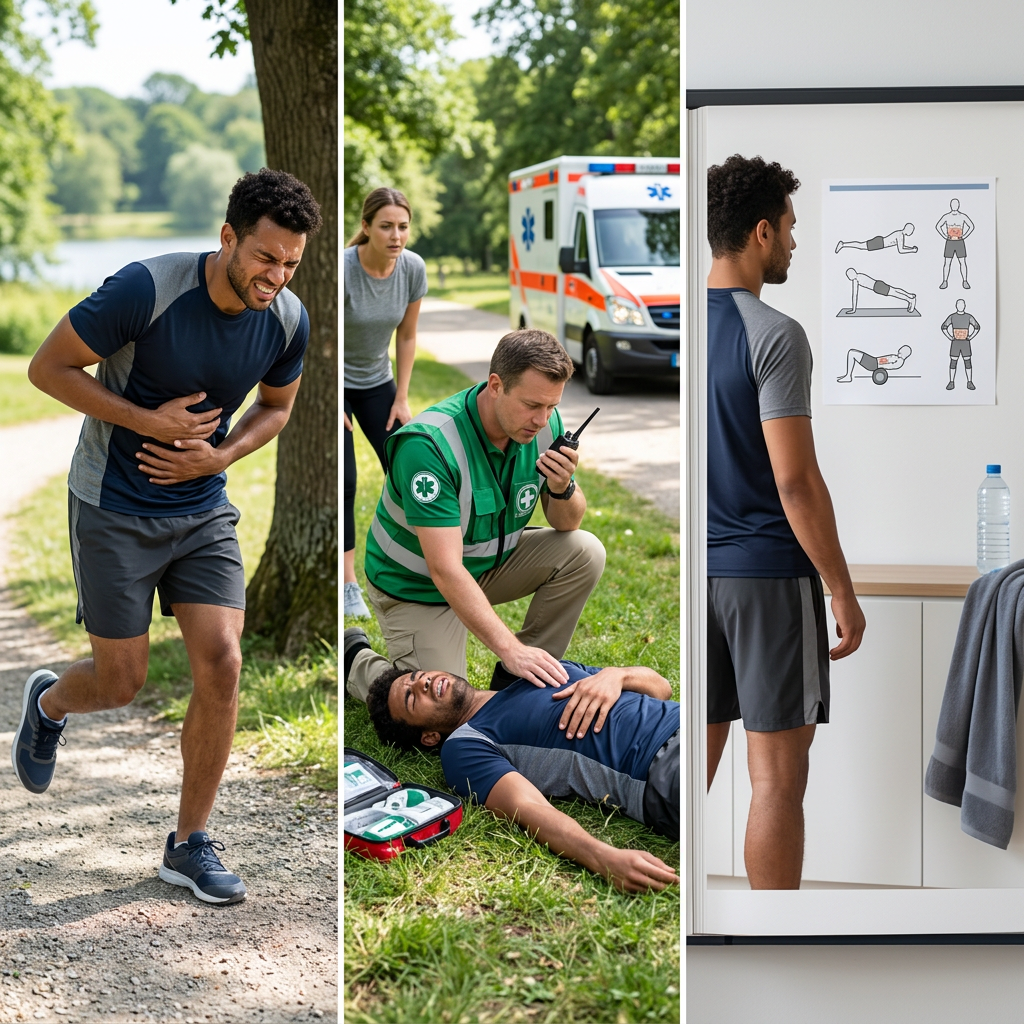
Spleen Injury During Exercise: Early Warning Signs, Emergency Response, and Prevention
Minjin Park
·
A hard tackle, an awkward fall, or a bicycle handlebar striking the upper abdomen may leave an athlete sore and shaken. In many cases, the injury is a bruise or muscle strain. Occasionally, however, the impact damages the spleen—an organ that contains a rich blood supply and can bleed dangerously when torn.
A spleen injury is easy to underestimate because the skin may look normal, the athlete may initially remain alert, and the pain may not seem severe enough to justify stopping. Some people even finish a practice or game before their condition worsens.
That delay can be dangerous. A ruptured spleen may cause life-threatening internal bleeding, and rupture does not always happen immediately after the original injury. Anyone who develops suspicious symptoms after a blow to the left ribs or abdomen needs prompt medical evaluation rather than home observation.
This article explains how spleen injuries happen during exercise, the early warning signs athletes and coaches should recognize, what to do in an emergency, and how to reduce the risk.
The spleen is located in the upper-left part of the abdomen, behind the lower ribs and near the stomach. It is approximately the size of a fist in a healthy adult.
The organ filters blood, helps remove old or damaged blood cells, and contributes to immune function. Although a person can live without a spleen, losing it reduces some of the body’s ability to fight certain infections. For that reason, modern trauma care often attempts to preserve the spleen whenever it is safe to do so.
Its position beneath the left rib cage provides some protection. However, the spleen is also filled with blood and relatively fragile. A strong impact can bruise it, create a collection of blood beneath its outer covering, or cause a tear that allows blood to leak into the abdominal cavity.
How Exercise and Sports Can Injure the Spleen
Most sports-related spleen injuries result from blunt abdominal trauma. The skin may remain intact even though an internal organ has been damaged.
Common mechanisms include:
A tackle or collision in football, rugby, hockey, or soccer
A fall during gymnastics, climbing, horseback riding, or skiing
A bicycle crash in which the handlebar hits the abdomen
Being struck by a ball, piece of equipment, or another athlete
Landing forcefully on the left side of the body
A fractured lower-left rib injuring the spleen beneath it
Contact sports, cycling accidents, falls, and direct blows are recognized causes of splenic trauma in athletes. A handlebar impact can be particularly deceptive because it concentrates force into a relatively small area.
A spleen injury can occur in any athlete. The risk becomes greater, however, when the spleen is already enlarged by illness.
The Special Risk of an Enlarged Spleen
An enlarged spleen, known medically as splenomegaly, extends farther below the protection of the rib cage and may rupture after relatively minor trauma.
Infectious mononucleosis, commonly called mono, is an important concern in teenagers, college students, and young adults. Mono can cause extreme fatigue, fever, sore throat, swollen lymph nodes, and enlargement of the spleen or liver. The spleen may remain enlarged even after the athlete begins to feel better.
The Centers for Disease Control and Prevention advises people with mono to avoid contact sports until they have fully recovered because strenuous activity or impact may cause the enlarged spleen to rupture. An athlete should not assume that the disappearance of fever or sore throat means the spleen has returned to normal. Return-to-sport timing should be determined with a healthcare professional.
Other infections, blood disorders, liver disease, inflammatory conditions, and cancers can also enlarge the spleen. Some people with splenomegaly have discomfort behind the left ribs or feel full unusually quickly after eating, but others have no obvious symptoms.
Anyone who has been told that their spleen is enlarged should ask a clinician which activities are safe before participating in contact sports, heavy lifting, or high-impact exercise.
Early Warning Signs of a Spleen Injury
The classic symptom is pain or tenderness in the upper-left abdomen, usually beneath or behind the left ribs. The area may hurt more when touched, during movement, or when taking a deep breath.
Possible early signs include:
Pain beneath the left rib cage
Upper-left abdominal tenderness
Pain that spreads to the left shoulder
Pain that worsens instead of gradually improving
Abdominal swelling or tightness
Bruising over the ribs or abdomen
Nausea or vomiting
Unusual weakness
Dizziness or lightheadedness
A rapid pulse
Pale, cool, or clammy skin
Confusion, restlessness, or fainting
Pain felt at the tip or top of the left shoulder after abdominal trauma is known as referred pain. It may occur when blood inside the abdomen irritates the diaphragm, causing the nervous system to interpret the discomfort as shoulder pain.
Not every person develops every symptom. A small tear may initially cause only mild discomfort. Conversely, severe bleeding can cause abdominal distention, weakness, rapid heart rate, low blood pressure, confusion, or collapse.
Signs of shock—including pale or clammy skin, rapid breathing, dizziness, altered alertness, and a weak rapid pulse—suggest that blood loss may be affecting circulation. Shock is a medical emergency.
Why a “Wait and See” Approach Can Be Dangerous
One of the most important facts about splenic trauma is that symptoms can be delayed.
A damaged spleen may bleed immediately, but blood can also collect beneath the organ’s outer covering as a hematoma. If that collection later breaks open, substantial bleeding may begin hours, days, or even weeks after the original injury. Medical literature describes delayed rupture occurring well after the athlete thought the incident had passed.
This means an athlete should not dismiss new abdominal pain simply because the collision happened several days ago.
A person should seek urgent evaluation after a recent abdominal or lower-rib injury if they develop:
New or increasing pain under the left ribs
Left shoulder pain without a shoulder injury
Dizziness when standing
Fainting or near-fainting
An unexplained fast heartbeat
Increasing abdominal swelling
Marked weakness or paleness
The absence of a large bruise does not rule out an internal injury. Blunt abdominal trauma can cause serious bleeding without breaking the skin or creating dramatic external signs.
What to Do Immediately
A suspected spleen injury should be treated as an emergency, especially when pain follows a hard impact or is accompanied by dizziness, weakness, shoulder pain, or signs of shock.
1. Stop All Activity
The athlete should leave the field, court, trail, gym, or pool immediately. Do not allow them to “test it,” stretch through the pain, complete another set, or return for the next play.
Further exertion or another impact could worsen internal bleeding.
Whether they recently had mono or were diagnosed with an enlarged spleen
Whether they take anticoagulants or have a bleeding disorder
Serious internal bleeding may progress rapidly and requires hospital care.
3. Keep the Person Still
Have the injured person rest in the position that feels most comfortable, provided the location is safe. Avoid unnecessary walking or movement.
Do not repeatedly press the abdomen to “check” for tenderness. Do not massage the area, wrap the abdomen tightly, or try to push through muscle-guarding or stiffness.
If a fall or collision may also have injured the head, neck, spine, or pelvis, avoid moving the person unless necessary for immediate safety. Follow the emergency dispatcher’s instructions.
4. Do Not Give Food or Drink
Do not give the injured person food, sports drinks, water, supplements, or oral medication unless emergency professionals specifically instruct you to do so. Emergency surgery or another procedure requiring anesthesia may be necessary.
5. Monitor Breathing and Alertness
Stay with the person and watch for changes. Note whether they become increasingly pale, sweaty, confused, sleepy, or difficult to wake.
If the person becomes unresponsive and is not breathing normally, begin CPR and use an automated external defibrillator if available and if you are trained to do so. Follow emergency-dispatch instructions.
Take pain medication simply to continue exercising
Press deeply on the abdomen
Ignore symptoms because there is no visible bruise
Ice may help a superficial bruise, but it cannot stop bleeding from an internal organ. A suspected spleen injury requires medical assessment, not routine sports-injury treatment at home.
How Doctors Diagnose a Spleen Injury
Healthcare professionals evaluate the mechanism of injury, symptoms, vital signs, abdominal tenderness, and signs of blood loss.
For a patient whose circulation is stable, computed tomography, commonly called a CT scan, is generally used to confirm and grade the injury. Ultrasound can help identify blood in the abdomen and is especially useful during rapid trauma assessment. Blood tests may also be used to monitor red blood cells and other indicators.
A normal appearance immediately after an accident does not guarantee that the spleen is uninjured. Athletes should clearly describe the impact and mention any recent mono diagnosis, even if their current pain seems manageable.
Does Every Spleen Injury Require Surgery?
No. Many stable spleen injuries can be managed without removing the organ.
Treatment may include hospital observation, repeated examinations, blood testing, activity restriction, and follow-up imaging. Some patients require splenic artery embolization, a procedure that blocks bleeding vessels while preserving part or all of the spleen.
Surgery may be necessary when bleeding is severe, the patient remains unstable, or the injury cannot be controlled by other methods. In some emergencies, removal of the spleen—called splenectomy—may be lifesaving.
People who lose normal spleen function require medical guidance about vaccination, infection precautions, and when to seek urgent treatment for fever.
Returning to Exercise After a Spleen Injury
Return to exercise must be individualized. Pain relief alone does not prove that the spleen has healed.
The recovery period depends on:
The grade of the injury
Whether bleeding occurred
Whether embolization or surgery was required
Follow-up examination or imaging results
The athlete’s age and overall health
The type and intensity of the sport
The World Society of Emergency Surgery consensus suggests that adults treated without surgery may need restrictions on athletic activity and heavy lifting for approximately three to five weeks after lower-grade injuries and up to two to four months after higher-grade injuries. These are general ranges rather than personal clearance rules. Follow-up imaging may be recommended before major physical activity, particularly for severe injuries or athletes involved in high-impact sports.
An athlete should return gradually and only after being cleared by the treating clinician. Contact sports, heavy lifting, intense core exercises, and activities with a fall risk may need to be delayed longer than walking or other light movement.
How to Reduce the Risk of Sports-Related Spleen Injury
No prevention strategy can eliminate all abdominal injuries, but several habits can reduce risk.
Use properly fitted protective equipment when the sport provides abdominal or rib protection. Maintain bicycle equipment, consider handlebar padding, and make sure children ride a correctly sized bicycle. Poor fit can make a handlebar strike more likely during a sudden stop or fall.
Athletes should also learn safe tackling, checking, falling, and landing techniques. Coaches should remove an athlete after a significant abdominal impact rather than judging safety only by whether the athlete can stand or jog.
Most importantly, do not train or compete through an illness that may enlarge the spleen. Anyone diagnosed with mono should follow medical restrictions and avoid contact sports until fully recovered and medically cleared.
Athletes with known splenomegaly, blood disorders, liver disease, or previous splenic trauma should discuss activity restrictions with a clinician familiar with their condition.
Frequently Asked Questions
Can a spleen rupture without a direct hit?
Yes. A spleen enlarged by mono or another condition can be vulnerable to relatively minor trauma and, rarely, may rupture without an obvious major collision. New left-sided abdominal or shoulder pain in someone with a known enlarged spleen requires urgent medical attention.
Can symptoms begin the next day?
Yes. Bleeding may be immediate or delayed. Symptoms that develop or worsen after the athlete goes home should not be dismissed simply because several hours or days have passed.
Is left shoulder pain always present?
No. Referred pain in the left shoulder is a recognized sign, but many patients mainly experience pain beneath the left ribs, abdominal tenderness, dizziness, or weakness.
Can an athlete play sports without a spleen?
Many people can eventually return to exercise after a splenectomy, but they need individualized medical clearance and lifelong attention to infection prevention. The timing depends on surgical recovery, associated injuries, and the demands of the sport.
The Bottom Line
A spleen injury during exercise may initially resemble a rib bruise or strained abdominal muscle, but worsening pain beneath the left ribs, unexplained left shoulder pain, dizziness, rapid heartbeat, paleness, weakness, or abdominal swelling can signal dangerous internal bleeding. Stop activity, call emergency services, keep the injured person still, and do not give food or drink. Delayed symptoms matter too—especially after a major collision, bicycle-handlebar injury, fall, or recent case of mono.
Have you ever seen an abdominal injury happen during a game, workout, or outdoor activity? Share what happened and which warning signs you think every athlete, parent, and coach should know in the comments below. Your experience could help someone respond more quickly in a future emergency.
Hi, I’m the creator and editor behind ZestyHabit. I research everyday safety, first aid, and practical wellness topics using official guidance and reliable public sources, then turn that information into clear, realistic steps for daily life.
My goal is to help readers make safer, better-informed choices at home and beyond.