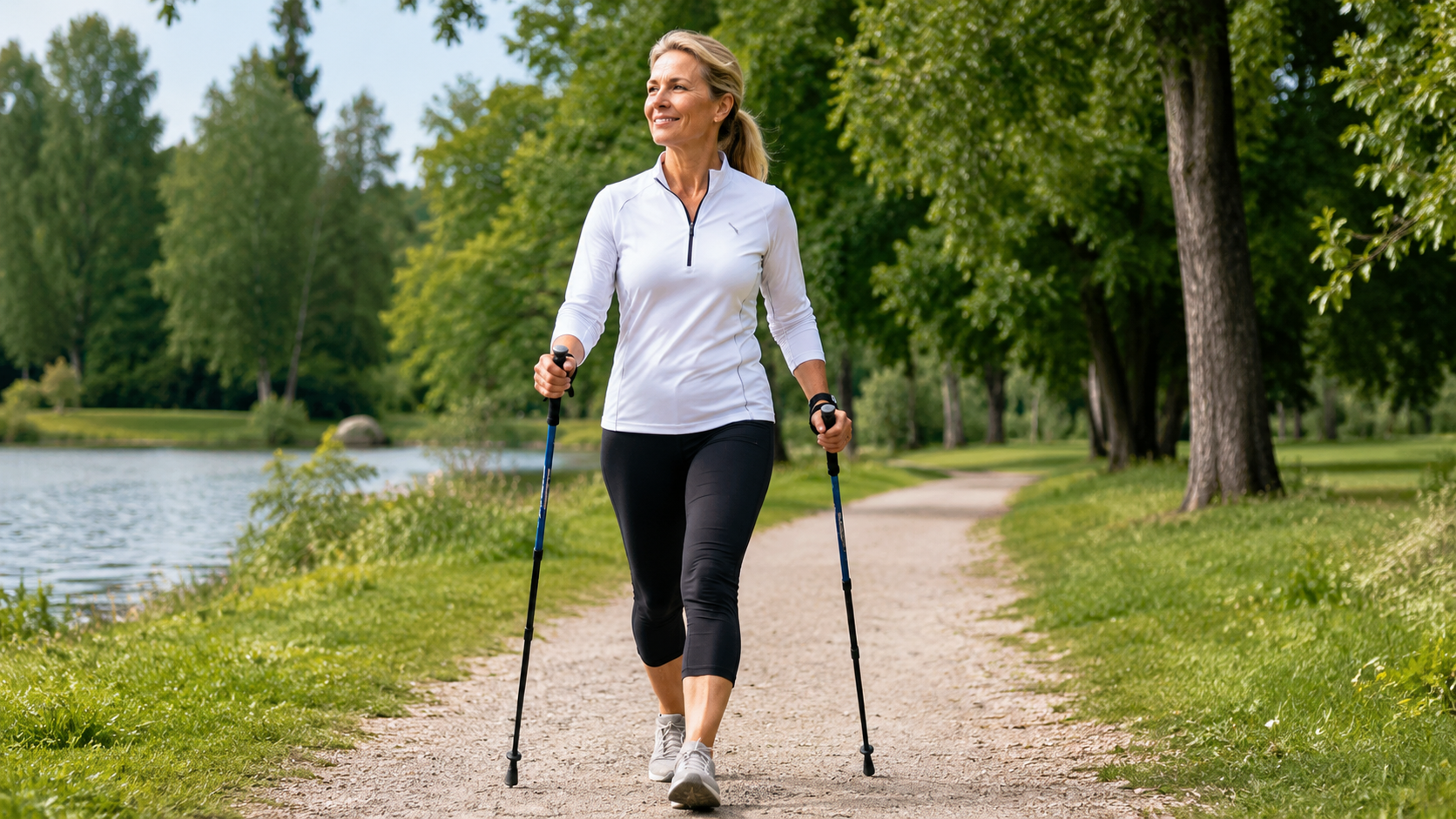
Nordic Walking Precautions: How to Use Poles Without Straining Your Shoulders
Minjin Park
·
Nordic walking looks simple at first. You walk, you hold poles, and you move your arms in rhythm with your steps. It seems like something anyone can start right away without much thought.
And in many ways, that is true. Nordic walking is approachable, low-impact, and suitable for many fitness levels. It can turn an ordinary walk into a fuller-body workout by involving the arms, shoulders, upper back, core, and legs. For people who find regular walking a little too easy but running too stressful, Nordic walking can feel like the perfect middle ground.
But the poles are not just accessories. They change how your upper body moves.
Used well, poles can help you walk with better rhythm, more engagement, and a smoother stride. Used poorly, they can irritate your shoulders, neck, wrists, elbows, or upper back. The most common problem is not that Nordic walking is dangerous. It is that people often grip too tightly, plant the poles too far ahead, choose the wrong pole length, or force their shoulders to do more work than they should.
The good news is that most shoulder strain from Nordic walking can be prevented with a few simple habits.
Why Shoulder Strain Can Happen During Nordic Walking
Nordic walking asks your arms to move repeatedly for the entire walk. That repetitive motion is usually gentle, but it can become irritating if your technique is off.
Your shoulder is a mobile joint. It is designed to move in many directions, but that also means it depends on good positioning, smooth rhythm, and support from surrounding muscles. If you swing the poles too forcefully or keep your shoulders tense, the joint may start to feel overworked.
Shoulder strain can also happen when the poles are too long. Long poles may push your arms too high, causing your shoulders to lift or shrug with every step. Poles that are too short can make you hunch forward or jam the poles into the ground awkwardly.
Another common issue is overusing the arms instead of letting the whole body share the movement. Nordic walking should not feel like you are stabbing the ground or pushing with only your shoulders. The movement should feel connected: feet, hips, trunk, arms, and poles working together.
Start With the Right Pole Length
Pole length matters more than many beginners expect. If your poles are the wrong length, even a short walk can feel uncomfortable.
As a general guide, when you hold the pole grip with the tip on the ground, your elbow should be bent roughly around 90 degrees or slightly more open. Many Nordic walking poles are adjustable, which is helpful because you may need small changes depending on terrain, walking style, and comfort.
If the poles are too long, you may notice:
Your shoulders rising toward your ears
Your elbows staying too straight
Your arms feeling forced upward
Neck or upper shoulder tightness
A choppy rhythm
If the poles are too short, you may notice:
Hunching forward
Overreaching downward
Short, awkward pole contact
Less useful push-off
More pressure through the wrists
For flat walking, moderate pole length is usually best. On uphill routes, slightly shorter poles may feel more comfortable. On downhill routes, slightly longer poles may help with support, but only if they do not cause shoulder tension.
Do not assume the factory setting is right for you. Take a minute to adjust the poles before starting.
Keep Your Shoulders Low and Relaxed
One of the simplest Nordic walking precautions is also one of the most important: do not shrug.
When people focus too much on using the poles, they often lift their shoulders without realizing it. This creates tension in the neck and upper traps. Over time, that tension can turn into aching, stiffness, or a feeling that the walk is “working” the wrong muscles.
Your shoulders should stay relaxed and low. The arms swing from the shoulder, but the shoulder itself should not climb up with every step.
A helpful cue is to imagine your collarbones staying wide and your neck staying long. Your hands move, your arms swing, and the poles plant behind or near your body — but your shoulders do not need to rise.
If you notice your shoulders creeping up, pause for a moment. Shake out your arms. Roll your shoulders gently. Restart with a lighter grip and smaller arm swing.
Nordic walking should feel active, not tense.
Do Not Grip the Poles Too Hard
A tight grip is one of the fastest ways to create unnecessary strain. When you squeeze the pole handles, tension travels up your forearms, elbows, upper arms, and shoulders.
Nordic walking poles often have straps or glove-like attachments for a reason. They allow you to push through the strap without clenching the handle the entire time. The grip should be light during much of the movement.
Think of your hand as guiding the pole, not strangling it.
As the pole moves behind you, your hand can open slightly, allowing the strap to help transfer force. Then your hand returns naturally as the arm swings forward. This rhythm reduces hand and shoulder tension.
If your hands or wrists feel tired quickly, your grip may be too tight. If your shoulders feel tense even though your pace is easy, check your hands first. The problem often starts there.
Let the Arm Swing Come From Natural Walking
Nordic walking should build on a normal walking pattern. When your right foot steps forward, your left arm swings forward. When your left foot steps forward, your right arm swings forward. This opposite arm-and-leg rhythm is already part of walking.
The poles simply add support and propulsion to that natural rhythm.
A common mistake is turning Nordic walking into a separate arm exercise. People start moving the poles independently from their steps, or they make the arm motion too big and stiff. This can make the shoulders work harder than necessary.
Before focusing on strong pole push-off, practice walking with relaxed opposite-arm movement. Let the poles drag lightly behind you for a few steps if needed. Once the rhythm feels natural, begin planting the poles gently.
Your arms should swing like pendulums. Smooth, relaxed, and connected to your stride.
Avoid Planting the Poles Too Far in Front
Planting the poles too far ahead of your body can strain the shoulders and wrists. It can also interrupt your walking rhythm.
In classic Nordic walking, the pole usually plants around the area between your front foot and back foot, often slightly behind the front foot depending on technique and speed. It should not feel like you are reaching forward and pulling yourself along.
If the pole tip lands too far ahead, your shoulder may move into an awkward position. You may also end up braking yourself instead of moving forward smoothly.
A good pole plant feels light and angled backward. The pole helps you push behind you, not stab the ground in front of you.
If your shoulder feels pinched at the front, or if your arms feel like they are reaching too far, bring the pole plant closer to your body. Shorten the arm swing until the movement feels comfortable.
Keep the Poles Angled Backward
Pole angle affects shoulder comfort.
If the pole is too vertical when it hits the ground, you may push downward rather than backward. This can create jarring pressure through your wrist, elbow, and shoulder. It can also make the movement feel stiff.
For smoother Nordic walking, the pole should usually angle backward as it contacts the ground. This allows you to push back through the pole and move forward naturally.
The push should come from the arm moving behind you, assisted by the strap and supported by your trunk and walking rhythm. It should not feel like a heavy downward jab.
On very steep hills or rough terrain, pole angle may change for balance and support. But on ordinary flat ground, a backward angle tends to feel smoother and more shoulder-friendly.
Do Not Force a Huge Arm Swing
A strong-looking arm swing is not always a better arm swing. If you exaggerate the motion too much, your shoulders may become irritated.
Beginners often think they need to reach far forward and push far behind to “do it correctly.” But if your mobility, strength, or coordination is not ready for that range, forcing it can cause tension.
Start with a moderate, comfortable swing. Let the hand move forward to about waist or lower chest level, depending on your pace and technique. Let the arm travel back naturally without twisting your torso aggressively.
As you improve, the movement may become longer and more powerful. That should happen gradually.
Nordic walking is rhythmic. It should not feel like your shoulders are being pulled to their end range with every step.
Pay Attention to Shoulder Movement, Not Just Pole Placement
Many people focus only on where the pole tip lands. That matters, but shoulder movement matters too.
Your shoulder should move smoothly. It should not pinch, jerk, hike upward, or feel like it is grinding. You should not feel sharp pain when your arm swings forward or backward.
A little muscular effort in the upper back and arms is normal. Pain inside the shoulder joint is not something to ignore.
If these happen, shorten the session, reduce pole force, and check your technique. If pain persists, it is better to stop and get appropriate guidance rather than pushing through.
Use Your Upper Back, Not Just Your Shoulders
Nordic walking should involve the upper back and trunk, not just the shoulder joint.
When you push through the pole, think about gently engaging the muscles around your shoulder blades. Your shoulder blade should move naturally with your arm. This helps distribute the effort instead of concentrating everything in the front of the shoulder.
Good posture helps here. Stand tall, keep your chest open, and avoid rounding your upper back. If you hunch forward, your shoulders may end up in a weaker position.
That does not mean you should walk stiffly upright. Your posture should feel tall but relaxed. The ribs, hips, and shoulders should move naturally as you walk.
A helpful cue is: “Push back, not up.” The pole helps move you forward through backward pressure, not through shoulder lifting.
Match the Pole Effort to Your Fitness Level
Nordic walking can be gentle or surprisingly intense. The harder you push through the poles, the more upper-body effort you create.
If you are new, recovering from inactivity, or dealing with shoulder sensitivity, start with light pole pressure. Use the poles mainly for rhythm and gentle engagement. You do not need to push hard from the beginning.
As your coordination improves, you can increase the effort gradually. Your arms, shoulders, and upper back need time to adapt just like your legs do.
Avoid turning every walk into a maximum-effort workout. If your shoulders feel tired before your legs, you may be pushing too hard through the poles.
A good Nordic walking session should leave you feeling worked, not beaten up.
Warm Up Your Shoulders Before Longer Walks
Because Nordic walking uses the upper body, a shoulder warm-up is useful, especially before longer or faster sessions.
You do not need anything complicated. A few gentle movements can help prepare your joints and muscles.
Try:
Shoulder rolls
Arm circles
Gentle chest opening
Wrist circles
A few minutes of easy walking without strong pole pressure
Start the walk at an easy pace. Let your rhythm settle before you push harder. Cold shoulders and sudden forceful pole use are not a great combination.
This is especially important in cool weather, early morning, or if you sit at a desk for long hours.
Adjust for Hills Carefully
Hills change how you use the poles.
Going uphill, many people naturally lean forward and push harder. That can be helpful, but if you overdo it, your shoulders may tense up. Keep the poles slightly shorter if adjustable, take shorter steps, and use the poles to assist rather than force yourself uphill.
Going downhill, the poles can help with balance and reduce some pressure on the legs. But planting them too far ahead or locking the arms straight can jar the shoulders. Keep your elbows soft and your movements controlled.
On steep hills, it is fine to slow down. Nordic walking is not about maintaining the same speed everywhere. Let the terrain guide your effort.
If a hill makes your shoulders feel tense, reduce pole pressure and focus on stable foot placement.
Choose the Right Surface When Learning
The best place to learn Nordic walking is a flat or gently rolling path with enough space. Smooth park paths, firm dirt trails, quiet sidewalks, or wide walking routes are good choices.
Avoid starting on crowded streets, rocky trails, slippery surfaces, or steep hills. When you are still learning the rhythm, difficult terrain can make your technique messy.
A smooth surface lets you focus on pole length, grip, arm swing, and shoulder relaxation. Once those feel natural, uneven paths become easier to manage.
Also make sure the pole tips match the surface. Rubber tips are useful on pavement. Carbide or metal tips may be better for dirt or trails, depending on your poles. Poor tip choice can cause slipping or awkward impact, which can travel up to the shoulders.
Keep a Comfortable Walking Rhythm
Rhythm is one of the most important parts of Nordic walking. When your poles, arms, and feet move together smoothly, the activity feels almost effortless. When the rhythm is off, everything feels clunky.
Try not to rush the poles. Let each pole plant match the opposite foot. The left pole works with the right foot, and the right pole works with the left foot.
If you lose rhythm, slow down. Walk normally for a few steps. Let the poles drag lightly behind you. Then start again with gentle pole plants.
A smooth rhythm reduces strain because no single joint has to absorb sudden, awkward force. Your whole body shares the movement.
Do Not Ignore Wrist and Elbow Position
Shoulder comfort is connected to wrist and elbow position. If your wrists are bent awkwardly or your elbows are locked, the shoulder may compensate.
Keep your wrists neutral and relaxed. Avoid bending them sharply when the pole hits the ground. Your elbows should stay soft, not rigid. The arm can extend behind you, but it should not feel locked or forced.
If your pole straps are too loose or too tight, they can also affect your wrist and shoulder comfort. Adjust them so your hand feels supported without being trapped.
A comfortable strap lets you release the grip slightly during the backward push and regain the handle naturally as the arm swings forward.
Take Breaks Before Tension Builds
Shoulder tension often builds gradually. At first, you may feel fine. Then your neck gets tight. Then one shoulder feels heavy. Then your walking form becomes stiff.
It is better to reset early.
During longer walks, take short breaks to shake out your arms, roll your shoulders, and loosen your hands. You can also walk without using the poles for a minute.
This does not ruin the workout. It improves it. A short reset can help you maintain better technique for the rest of the walk.
If you only notice tension after it becomes painful, you waited too long.
Final Thoughts
Nordic walking can be a wonderful way to make walking more active, engaging, and full-body. The poles can help with rhythm, posture, and upper-body involvement. They can also make ordinary walks feel more purposeful and energizing.
But good technique matters.
Choose the right pole length. Keep your shoulders low and relaxed. Avoid gripping too tightly. Plant the poles near your body instead of reaching far ahead. Let the poles angle backward, and use a smooth opposite-arm-and-leg rhythm. Start with light pressure, especially if your shoulders are not used to the movement.
The goal is not to force the poles into the ground or turn every walk into an upper-body workout. The goal is to move naturally, with the poles supporting your stride rather than stressing your joints.
When your shoulders stay relaxed and your rhythm feels smooth, Nordic walking becomes much more comfortable. And that is when the poles start to feel less like extra equipment and more like part of the walk itself.
Hi, I’m the creator and editor behind ZestyHabit. I research everyday safety, first aid, and practical wellness topics using official guidance and reliable public sources, then turn that information into clear, realistic steps for daily life.
My goal is to help readers make safer, better-informed choices at home and beyond.