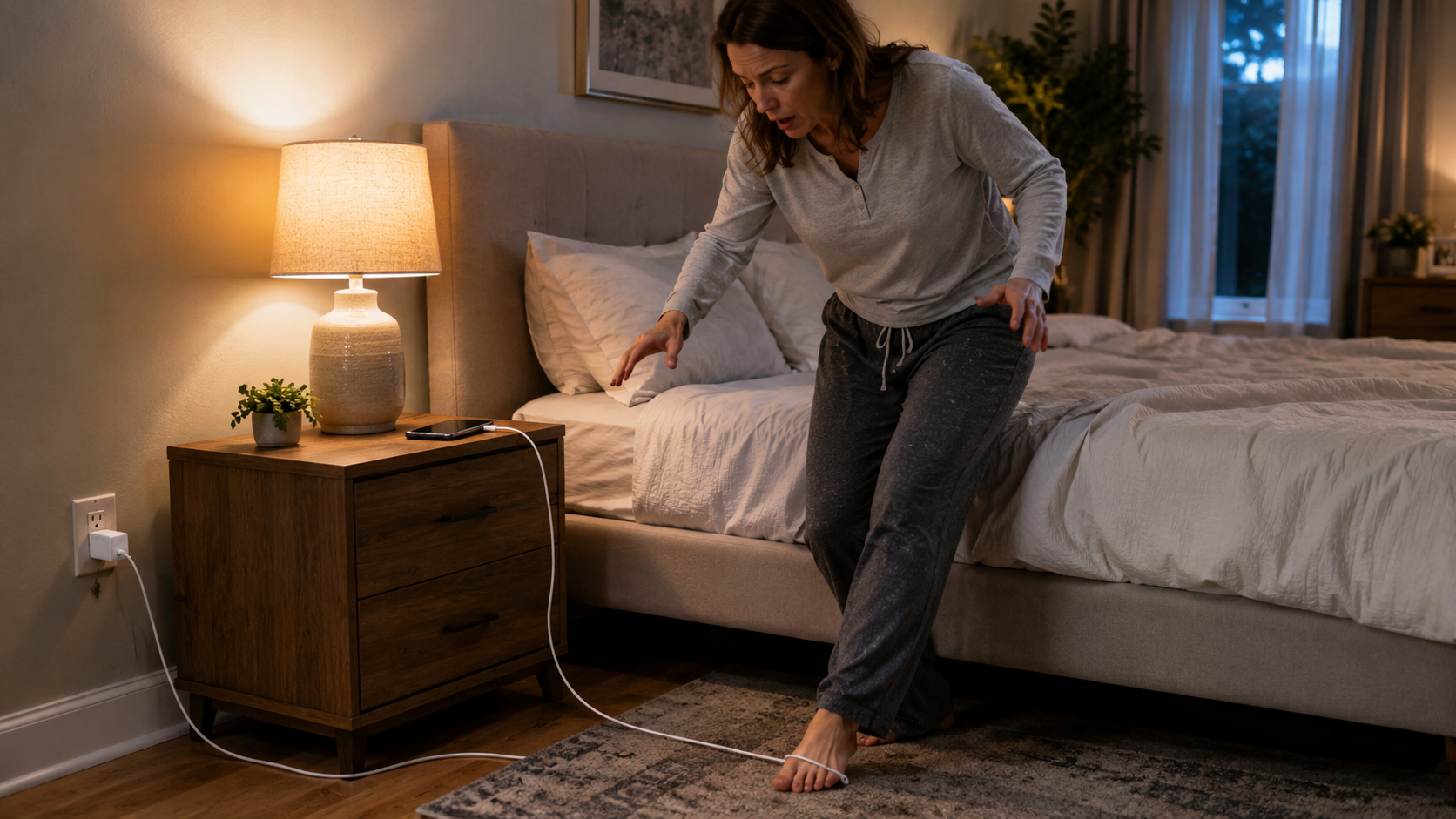
Can Charging Cables Beside the Bed Cause Falls? A Simple Bedroom Safety Guide
Minjin Park
·
Charging cables beside the bed may seem harmless, but loose cords can create nighttime tripping hazards. Learn how bedside cords cause falls and simple ways to make your bedroom safer.
The Small Bedside Habit Most of Us Don’t Think About
Most bedrooms have at least one charging cable near the bed.
A phone charger trails from the wall to the nightstand. A smartwatch cable hangs off the edge. A tablet charger stretches across the floor. Maybe there is also a lamp cord, white noise machine, heating pad, laptop charger, CPAP machine cord, humidifier cord, or an extension cord tucked behind the bed.
At first, it all seems normal. After all, we charge our devices where we sleep because it is convenient. We want the phone nearby for alarms, messages, emergency calls, or late-night scrolling.
But loose charging cables beside the bed can create a real fall risk, especially at night.
The danger is not dramatic. It is ordinary. You wake up groggy, step out of bed in the dark, and your foot catches a cable. Maybe the cord loops around your toes. Maybe it tugs a phone off the nightstand. Maybe you stumble forward while trying not to step on the device. In that half-awake moment, even a small cord can become enough to throw off your balance.
For children, older adults, pets, and anyone who gets up during the night, cable clutter near the bed deserves more attention than it usually gets.
The good news is that this is an easy problem to fix. You do not need to stop charging devices in the bedroom. You just need to keep cords out of walking paths, off the floor when possible, and organized in a way that works even when the room is dark.
Why Bedside Charging Cables Can Be a Fall Hazard
Nighttime movement is different
During the day, you can usually see a cord and step over it. At night, everything changes.
Your eyes may still be adjusting. You may be half asleep. The room may be dark. You might be rushing to the bathroom, checking on a child, answering the door, or reaching for water.
Your balance and reaction time are not as sharp when you first wake up. A cable you would normally avoid can catch your foot before you notice it.
That is why the area next to the bed matters so much. It is one of the first places your feet land.
Cables are easy to forget
Charging cables are thin, flexible, and often the same color as the floor, rug, bedding, or furniture. A black cable on a dark rug can nearly disappear. A white cable on a light floor may blend in at night.
Even worse, cords move. You may plug your phone in neatly before bed, then pull it closer while scrolling. By morning, the cable has shifted across the floor or looped near your slippers.
A cord does not have to be thick to become a tripping hazard. It only has to catch your foot at the wrong moment.
Devices can become part of the trip
The cable itself is not always the only problem.
If the cable is attached to a phone, tablet, laptop, or power bank, tripping on the cord can pull the device off the bed or nightstand. You may instinctively try to catch it, twist your body, or step awkwardly to avoid breaking it.
That sudden movement can make a small stumble worse.
Common Bedside Cord Setups That Cause Problems
The long cable across the floor
This is probably the most common setup. The outlet is on the far side of the bed, so a long cable runs across the floor to reach the nightstand or mattress.
It works for charging, but it creates a clear trip line.
If you have to walk over a cable to get in or out of bed, the setup needs to change.
The charger under the pillow or blanket
Some people pull the phone into bed while it is charging. The cable ends up under the blanket, across the sheets, or hanging down the side of the mattress.
This creates several issues. The cord can wrap around a foot or hand. The phone can fall into the gap between the bed and wall. The cable may also bend sharply, fray, or get damaged over time.
Charging under pillows or bedding can also trap heat around devices, which is not a good habit.
The nightstand cable tangle
A nightstand can collect a surprising number of cords: phone, watch, lamp, earbuds, tablet, speaker, humidifier, and maybe a power strip.
When cords spill over the edge or drop onto the floor, they create loops where feet, slippers, pets, or vacuum cleaners can catch.
The extension cord shortcut
An extension cord may seem like a simple fix when outlets are too far away. But an extension cord stretched across the bedroom floor can become a larger tripping hazard than the original charger.
If an extension cord is used temporarily, it should not run across a walking path, under a rug, or where feet land beside the bed.
The cord hidden under a rug
Covering a cord with a rug might seem safer because you cannot see it. But it can create a raised edge or uneven surface.
A cord under a rug can also get damaged from foot traffic. If the rug shifts, the cord may reappear in a worse position than before.
Who Is Most at Risk?
Older adults
Falls can be more serious for older adults because balance, vision, strength, and reaction time may change with age.
A loose cable near the bed can be especially risky if someone gets up at night to use the bathroom, take medication, check the thermostat, or answer the phone.
Children may run, jump, or climb around beds. A charging cable can catch a foot, wrap around a toy, or pull a device down.
Kids also may not notice cords while playing, especially if the cable blends into bedding or carpet.
For children’s rooms, cords should be kept short, secured, and away from play areas.
Pets
Cats and dogs can drag cords, chew them, get tangled, or knock devices off nightstands.
A pet running beside the bed can pull a cable into the walkway. A cat playing with a dangling cord can create a loop on the floor. A dog’s paw can catch a cable and yank a phone down.
Pet-related cord movement is easy to overlook until it causes a mess or a stumble.
Anyone who wakes up often at night
Parents with babies, people who drink water before bed, anyone with insomnia, and people who use the bathroom during the night all have more chances to encounter a cord in the dark.
The more often you get up, the more important the bedside floor area becomes.
Warning Signs Your Bedside Charging Setup Is Unsafe
Your cord setup may need attention if:
You step over a cable to get in or out of bed.
A cable lies where your feet touch the floor.
Cords hang loosely from the bed or nightstand.
A device has fallen because the cable was pulled.
You have tripped or almost tripped on a cord.
The cable is frayed, bent, or pinched.
A rug is hiding a cord underneath.
Pets play with or chew the cables.
You use a long extension cord across the room.
The area beside the bed is hard to see at night.
You unplug devices by pulling the cord from across the bed.
One near-miss is enough reason to fix the setup. You do not need to wait for an actual fall.
Simple Ways to Make Bedside Charging Safer
Keep cords out of the footpath
The most important rule is simple: no cords where your feet land.
Stand beside your bed and look down. Where do your feet touch the floor when you get up? That zone should stay clear.
If a charger crosses that area, move the charging location, use a shorter cable, or route the cord behind furniture.
Charge on the nightstand, not in the bed
A phone charging on the nightstand is usually safer than one charging on the mattress, under a pillow, or beside your legs.
Use a cable long enough to reach the nightstand but not so long that it loops onto the floor.
If you like using your phone in bed, unplug it before holding it, or place the charger in a position where the cord does not cross your body or the floor.
Use cable clips
Adhesive cable clips are small, inexpensive, and useful. They can hold charging cords along the back of a nightstand, bed frame, or wall.
This keeps the cable from falling to the floor when unplugged.
A clip near the top of the nightstand can keep the charging end within reach without leaving the whole cord dangling.
Use a bedside charging station
A small charging station can organize multiple devices in one place. This works well for phones, earbuds, watches, and tablets.
Choose a station that sits securely on the nightstand and keeps cords short. Avoid setups that require several cables to hang down the front.
Route cords behind furniture
Whenever possible, run cords behind the nightstand or along the wall, not across open floor.
If the outlet is far away, consider rearranging the nightstand or bed so the charger does not cross a walking path.
Use shorter cables
Long cables are convenient, but they create more slack and more loops.
A shorter cable can reduce clutter. The right length should reach the device comfortably on the nightstand without falling onto the floor.
Add a night light
Good lighting does not fix a bad cord setup, but it helps.
This is especially helpful for older adults, children, guests, and anyone who gets up at night.
What About Power Strips Near the Bed?
Power strips are common beside beds because modern bedrooms have many devices. But they should be used carefully.
Place the power strip where it will not be stepped on, kicked, covered by bedding, or trapped under furniture. Do not let cords create a nest on the floor. Do not overload it with high-power devices.
Avoid placing a power strip under the bed where dust, blankets, and forgotten items can collect around it. Also avoid running cords under rugs or mattresses.
A power strip can help organize charging if it is positioned safely and used within its rating. It can also make clutter worse if it becomes a tangled hub.
Bedside Cords and Fire Safety
This article focuses on falls, but charging cables can also raise electrical safety concerns when they are damaged or misused.
Watch for:
Frayed cords Exposed wires Hot adapters Loose plugs Cords pinched under furniture Cheap or damaged chargers Cables bent sharply at the plug Power strips covered by bedding Chargers used under pillows or blankets
Replace damaged cables. Do not keep using a charger that gets unusually hot, sparks, smells strange, or fits loosely in the outlet.
Keeping cords tidy helps with both trip prevention and electrical awareness.
Special Tips for Older Adults’ Bedrooms
For older adults, the safest bedroom layout is usually simple and predictable.
Keep the path from the bed to the bathroom clear. Use a night light. Place the phone within easy reach on the nightstand. Route cords behind furniture. Avoid loose rugs near the bed. Keep slippers in the same spot every night.
If medical equipment is used, organize those cords separately and securely. Do not let them mix with phone chargers, lamp cords, and extension cords.
A bedside charging station with a short cord can be much safer than several loose cables.
Special Tips for Kids’ Rooms
Children’s bedrooms often have tablets, night lights, lamps, sound machines, toys, and chargers.
Keep charging areas away from the play zone and bed edge. Use cord clips along the wall or back of furniture. Avoid long cords across the room.
Teach kids to unplug by holding the plug, not yanking the cable. Also teach them not to wrap cords around furniture, toys, or themselves.
For younger children, charge devices outside the bedroom if possible. This reduces both cord clutter and late-night device use.
Special Tips for Guest Rooms
Guest rooms often have unfamiliar layouts. A guest may get up at night and not know where cords, furniture, or rugs are.
Before someone stays over, check the bedside area. Remove loose charging cords from the floor. Add a visible outlet or charging station on the nightstand. Use a night light if the room is dark.
This is especially thoughtful for older relatives or guests with mobility concerns.
What Not to Do With Bedside Charging Cables
Do not run cables across the walking path.
Do not hide cords under rugs.
Do not leave loops where feet land.
Do not charge phones under pillows.
Do not let cords hang loosely from the bed.
Do not use damaged chargers.
Do not place power strips under blankets or bedding.
Do not rely on “I know where it is” if the room is dark.
Do not assume a thin cable cannot trip someone.
Small cords can still cause big stumbles.
A Quick Bedside Cable Safety Reset
You can make the area safer in less than 10 minutes.
First, unplug everything near the bed.
Next, remove cables from the floor and untangle them.
Decide which devices truly need to charge beside the bed.
Move rarely used chargers to another room.
Place a charger on the nightstand or in a charging station.
Route the main cord behind the nightstand.
Use clips or ties to control slack.
Check where your feet land when getting out of bed.
Add a night light if the area is dark.
Replace any damaged cable.
Once you do this, the whole side of the bed usually feels calmer and cleaner.
A Simple Nighttime Habit
Before going to sleep, take a quick look at the floor beside the bed.
Ask:
Is anything where my feet will land?
Is a cord stretched across the floor?
Is my phone safely on the nightstand?
Could I get up in the dark without stepping over anything?
This check takes only a few seconds. It is the same kind of habit as making sure the stove is off or locking the door.
Keep It Simple : A Safer Bedroom Starts at Floor Level
A charging cable beside the bed may seem too small to worry about, but falls often happen because of small, ordinary things in the wrong place.
At night, a loose cord can be hard to see. Your balance may be slower. Your foot may catch before your brain fully wakes up. If the cable pulls a phone or device with it, the stumble can become even more awkward.
The safest fix is simple: keep cords out of walking paths, charge devices on a nightstand instead of in the bed, use cable clips or a charging station, avoid long loose cables, and add a night light if the room is dark.
You do not need a perfect bedroom. Just make sure the place where your feet land is clear.
That small change can make mornings, midnight bathroom trips, and everyday bedtime routines feel a little safer and a lot less cluttered.
Hi, I’m the creator and editor behind ZestyHabit. I research everyday safety, first aid, and practical wellness topics using official guidance and reliable public sources, then turn that information into clear, realistic steps for daily life.
My goal is to help readers make safer, better-informed choices at home and beyond.