
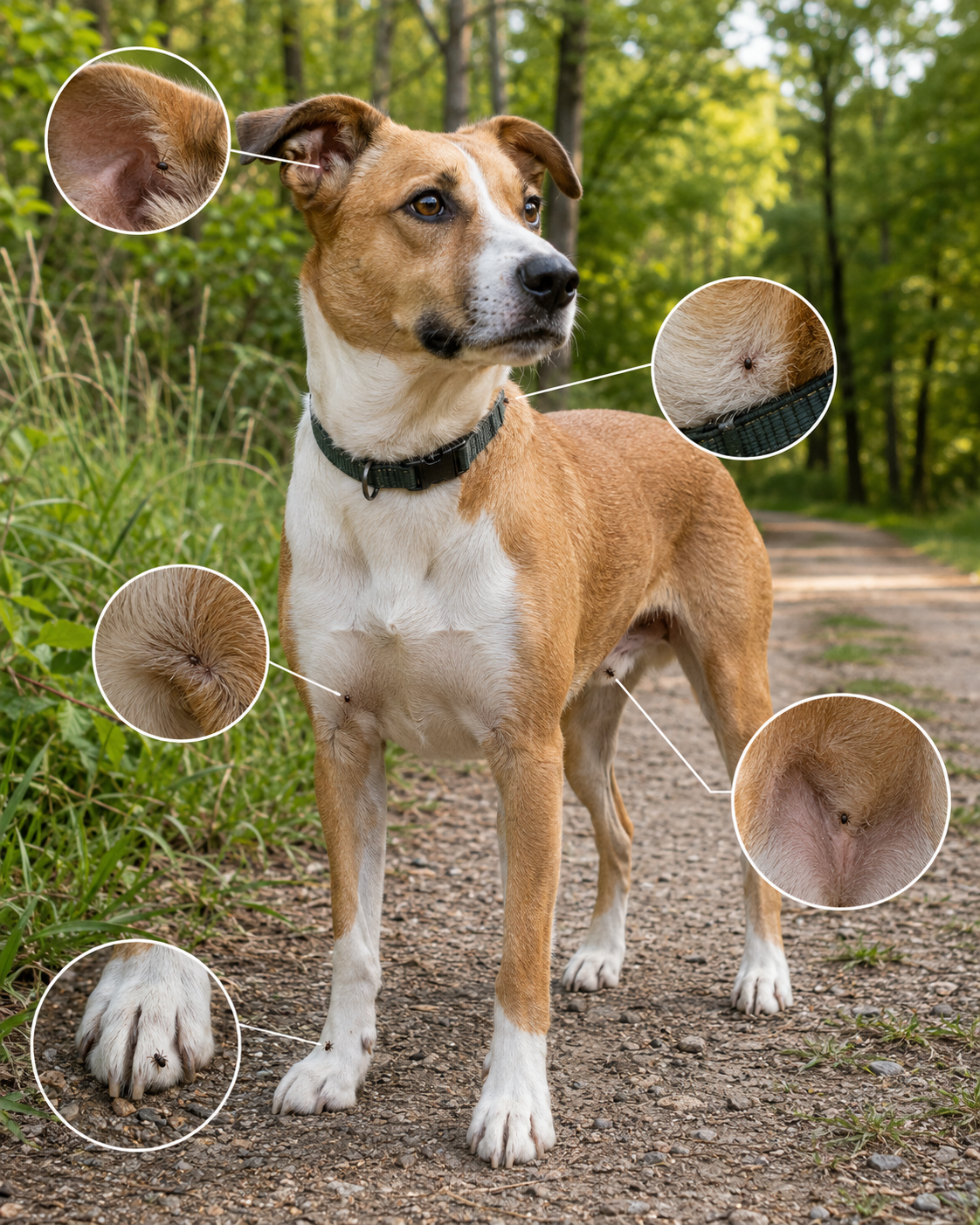

Learn where pets are most likely to encounter ticks, which body areas ticks often hide in, and how to perform a simple, thorough tick check after outdoor time.
A walk through the woods is an obvious time to think about ticks. A quick trip through the backyard usually is not.
That is one reason ticks are so easy to miss.
Dogs and cats can encounter ticks in ordinary places, including tall grass beside a sidewalk, leaf litter under shrubs, the edge of a neighborhood trail, or an overgrown corner of the yard. Once a tick climbs onto a pet, it may move through the coat before settling in a warm, protected area where the skin is easier to reach.
By the time an owner notices a small bump under the fur, the tick may already be attached.
Ticks are not only an outdoor nuisance. They can transmit disease to pets, and pets may carry unattached ticks into the home, where those ticks can later crawl onto another animal or a person. The brown dog tick is especially notable because it can infest indoor areas such as homes and kennels.
The goal is not to inspect your pet anxiously after every step outside. It is to learn the places that deserve a little extra attention and make tick checks part of a normal routine.
How Ticks Get Onto Pets
Ticks do not fly or jump. Many species wait on grasses, leaves, and low vegetation with their front legs extended. When an animal brushes past, the tick climbs onto the fur.
Ticks locate potential hosts by sensing signals such as body heat, moisture, movement, breath, and body odor. After climbing aboard, some attach quickly, while others wander across the body looking for thinner or more protected skin.
This explains why the tick may not be found on the part of the dog that first touched the grass.
A tick picked up near a front paw might later appear behind an ear, beneath a collar, or between the back legs. Long or thick fur gives it even more space to travel unnoticed.
Outdoor Places Where Pets Commonly Pick Up Ticks
Ticks can be present in both rural and suburban settings. You do not need to be deep in the wilderness for a pet to encounter one.
Tall Grass and Overgrown Weeds
Tall grass is one of the most familiar tick habitats.
A dog running through an unmowed field may brush against vegetation with its chest, face, legs, and belly. A cat exploring along a fence line may pass through the same kind of growth.
The edges of lawns are often more important than the center. Grass that grows tall around fences, sheds, trees, drainage areas, and utility boxes may receive less mowing and more wildlife traffic.
After a pet walks through these areas, check the lower legs, belly, chest, and face before assuming the coat is clear.
Wooded Trails and Forest Edges
Wooded areas provide shade, moisture, leaf litter, and animal hosts—all conditions that can support ticks.
The transition zone between a maintained trail and surrounding brush is particularly easy to overlook. Dogs often sniff along the trail edge rather than staying in the middle, placing their faces and shoulders directly against low plants.
Keeping pets near the center of a trail can reduce contact with vegetation, although it cannot eliminate the possibility of exposure. The CDC recommends avoiding grassy, brushy, and wooded areas when practical and checking pets after outdoor activity.
Leaf Litter
Piles of fallen leaves may look harmless, but they create a cool, sheltered layer close to the ground.
Dogs may push their noses into leaves while investigating scents. Cats may rest or hunt beneath shrubs where leaves have collected. Even a small pile beside a patio can create a place where pets come into contact with ticks.
Regularly removing leaf litter from frequently used areas can make the yard less welcoming to ticks.
Brush, Shrubs, and Ground-Cover Plants
Dense landscaping can place tick habitat surprisingly close to the house.
Pets may squeeze beneath bushes for shade, follow wildlife scents through ornamental grasses, or brush against plants while walking beside a building.
Ground-cover plants and low branches also make it difficult to see what the pet is touching. Trim back vegetation around pet paths, play areas, decks, and fences so animals have a clearer route.
Dog Parks and Shared Pet Areas
A closely mowed dog park may have less obvious vegetation, but ticks can still arrive on wildlife, other pets, or people.
Pay particular attention to wooded borders, shaded benches, unmaintained corners, and tall grass outside the main fenced area. Dogs often explore these edges while owners stand in the open center.
Boarding kennels, shelters, and other places where many dogs gather may also require strong parasite-control practices, especially because certain ticks can survive in environments associated with dogs.
Campgrounds and Picnic Areas
Campgrounds combine grassy sites, wooded borders, wildlife, tents, vehicles, and outdoor furniture.
A dog may spend hours lying on the ground, walking through brush, or resting beside a fire ring. Owners may not perform a check until the trip is over, giving ticks plenty of time to hide.
During a multiday trip, check the pet at least once each day rather than waiting until you return home.
Your Own Backyard
One of the most common mistakes is assuming that a familiar yard is automatically tick-free.
Wildlife such as deer, rodents, raccoons, rabbits, and stray animals may pass through residential properties. Ticks can also live around brush, woodpiles, stone walls, shaded borders, and leaf-covered areas.
The CDC recommends keeping grass mowed, clearing tall grass and brush, removing leaf litter, and placing play or sitting areas away from wooded or brushy edges. A barrier of gravel or wood chips between the lawn and wooded areas may also reduce contact with tick habitat.
Body Areas Where Ticks Often Hide on Pets
A quick glance over the pet’s back is not enough.
The CDC highlights several areas where ticks are commonly found on dogs: in and around the ears, around the eyelids, beneath the collar, under the front legs, between the toes, between the back legs, and around the tail.
These locations tend to be warm, protected, thin-skinned, or difficult for the pet to groom.
In and Around the Ears
Ears provide folds, warmth, and shelter.
Check the outside of each ear flap, the base of the ear, and the fur immediately behind it. Gently lift floppy ears so you can see the underside.
Do not insert tweezers, fingers, or tools deep into the ear canal. A dark object in the canal could be a tick, wax, debris, or another problem. A veterinarian should examine anything you cannot safely reach or identify.
Head shaking, repeated scratching, or sensitivity around one ear may be a reason to look more closely.
Around the Eyelids and Face
Ticks may settle near the eyelids, eyebrows, lips, chin, or cheeks, where the fur can be thinner.
Small ticks in this area may resemble a dark seed, crust, or skin tag. Do not pull at a bump near the eye until you are confident about what it is.
If a tick is attached very close to the eyelid or the pet will not hold still, professional removal is safer than working near the eye with tweezers.
Under Collars, Harnesses, and Clothing
Collars create a dark, protected space that owners may not inspect regularly.
Remove the collar during a tick check and feel all the way around the neck. Check beneath identification tags, buckle areas, and the edges of a harness.
Dogs that wear coats, life jackets, or hiking packs should be checked under every strap after use. Equipment may hide a tick or hold it close to the skin.
Under the Front Legs
The armpit area is warm, folded, and difficult for a pet to inspect.
Run your fingers gently through the fur under each front leg. Look for a small, firm bump attached to the skin rather than loose in the coat.
Be careful not to confuse nipples, skin tags, scabs, or small growths with ticks. Good lighting helps.
Between the Toes and Around the Paw Pads
Ticks picked up from ground-level vegetation can hide between the toes, around the nails, or at the edges of the paw pads.
Spread the toes gently and inspect both the top and underside of each paw. Long fur between the pads may make tiny ticks hard to see.
Repeated licking, nibbling at one foot, or limping may prompt a closer look, although many other paw problems can cause the same behavior.
Between the Back Legs and Around the Groin
The groin has thin skin, warmth, and natural folds.
Check the inner thighs, belly, and areas around—but not directly inside—the genital region. Be gentle, especially if the pet is sensitive about handling.
For cats or nervous dogs, it may be safer to check one area at a time rather than rolling or restraining the animal forcefully.
Around the Tail
Lift the tail and inspect its base, underside, and surrounding fur.
Ticks may hide where the tail meets the body or in long feathering around the rear legs. Check carefully after a dog has moved through brush or sat in tall grass.
Along the Neck, Chest, and Belly
Veterinary guidance also notes that ticks on dogs are frequently found around the neck, in the ears, within folds between the legs and body, and between the toes.
The chest and belly are often the first areas to brush against vegetation, especially in smaller dogs. Part the fur and look directly at the skin rather than examining only the coat surface.
How to Perform a Simple Tick Check
A thorough tick check does not need to take a long time.
Choose a well-lit area and slowly run your fingertips over the pet’s body using gentle pressure. You are feeling for small bumps, especially in places where the coat is thick or dark.
Start at the nose and move backward in the same order each time:
- Face and eyelids
- Ears and neck
- Collar and harness areas
- Chest and front legs
- Paws and toes
- Back and sides
- Belly and groin
- Back legs
- Tail and rear area
Part the fur whenever you feel something unusual. An unattached tick may still be crawling and can be very small, so check your hands, clothing, leash, and pet bedding as well.
The CDC recommends checking outdoor pets daily, particularly after they have spent time in areas where ticks may be present.
What an Attached Tick May Look or Feel Like
An attached tick may feel like a tiny hard bead, seed, or rounded bump.
Before feeding, some ticks are extremely small and flat. As they feed, their bodies may become larger and more rounded. The color can vary by species and feeding stage.
Look closely for legs near the base of the bump. A tick is attached at its mouthparts, so the body may project outward while the head is difficult to see.
Do not assume every bump is a tick. Nipples, moles, scabs, cysts, and skin tags are commonly mistaken for parasites.
When you are uncertain, take a clear photograph or ask a veterinary professional rather than pulling at the skin.
Common Tick-Checking Mistakes
Checking Only After Hiking
Neighborhood walks, yard play, hunting trips, camping, and brief contact with brush can all create exposure.
Make the decision to check based on where the pet went, not how adventurous the outing felt.
Looking Without Using Your Hands
A small tick can disappear beneath long, curly, thick, or dark fur.
Run your fingers over the entire body. Feeling a bump is often easier than seeing it.
Forgetting to Remove the Collar
The neck is one of the most common hiding areas, yet it is often covered by equipment.
Remove collars and harnesses instead of checking around them.
Assuming Preventive Products Repel Every Tick
Tick prevention can greatly reduce risk, but no method should replace routine checks.
A tick may still crawl on the coat, and some products work by killing ticks after contact rather than preventing every attachment. Talk with your veterinarian about a product appropriate for your pet and region.
Cats are especially sensitive to certain chemicals, so never apply a tick product to a cat without veterinary guidance.
Using Home Remedies to Remove a Tick
Petroleum jelly, nail polish, alcohol, heat, and other folk methods may delay removal and irritate the tick.
Veterinary guidance recommends grasping an attached tick as close to the skin as possible with fine-tipped tweezers and pulling upward with steady, even pressure. Avoid crushing it with bare fingers, then clean the bite area and your hands.
When the tick is near the eye, inside the ear, difficult to grasp, or the pet will not remain still, contact a veterinarian.
Signs to Watch for After Finding a Tick
Many pets remain completely normal after a tick bite, but it is still wise to watch for changes.
Possible concerns include reduced appetite, unusual tiredness, fever, stiffness, limping, swollen joints, weakness, pale gums, vomiting, or changes in behavior.
Signs of tickborne illness may not appear immediately. The CDC notes that changes can develop seven to 21 days after a bite—or sometimes later—depending on the infection.
These signs have many possible causes, so finding a tick does not automatically mean a pet will become ill. Contact your veterinarian when your pet seems unwell or when you are concerned about local tickborne diseases.
A Calm, Practical Takeaway
Pets are most likely to pick up ticks in tall grass, brush, leaf litter, wooded borders, shared outdoor spaces, and overgrown areas of the backyard.
Once aboard, ticks often move to protected body areas such as the ears, eyelids, neck, armpits, groin, toes, and base of the tail.
A good routine is simple: use veterinary-recommended prevention, keep frequently used yard areas maintained, and perform a slow nose-to-tail check after outdoor time. Remove collars and harnesses, use both your eyes and your fingertips, and pay extra attention to skin folds and long fur.
You cannot make every walk completely tick-free. You can, however, make ticks much less likely to remain hidden.
A few quiet minutes of checking your pet after an outing can protect the animal, reduce the chance of ticks entering the home, and help you notice problems early without turning everyday outdoor time into a source of worry.

Hi, I’m the creator and editor behind ZestyHabit. I research everyday safety, first aid, and practical wellness topics using official guidance and reliable public sources, then turn that information into clear, realistic steps for daily life.
My goal is to help readers make safer, better-informed choices at home and beyond.


