Subway Door Entrapment Accidents: How to Prevent Them and What to Do in an Emergency
Minjin Park
·
Learn how subway door entrapment accidents happen, how to board and exit safely, and what to do if a person, bag, leash, or clothing becomes caught in train doors.
Subway doors open and close thousands of times every day, usually without incident. Because the process feels so routine, it is easy to underestimate the danger of rushing through closing doors. A split-second decision to squeeze onto a departing train can result in a trapped hand, injured shoulder, crushed limb, or, in rare cases, a person being dragged along the platform.
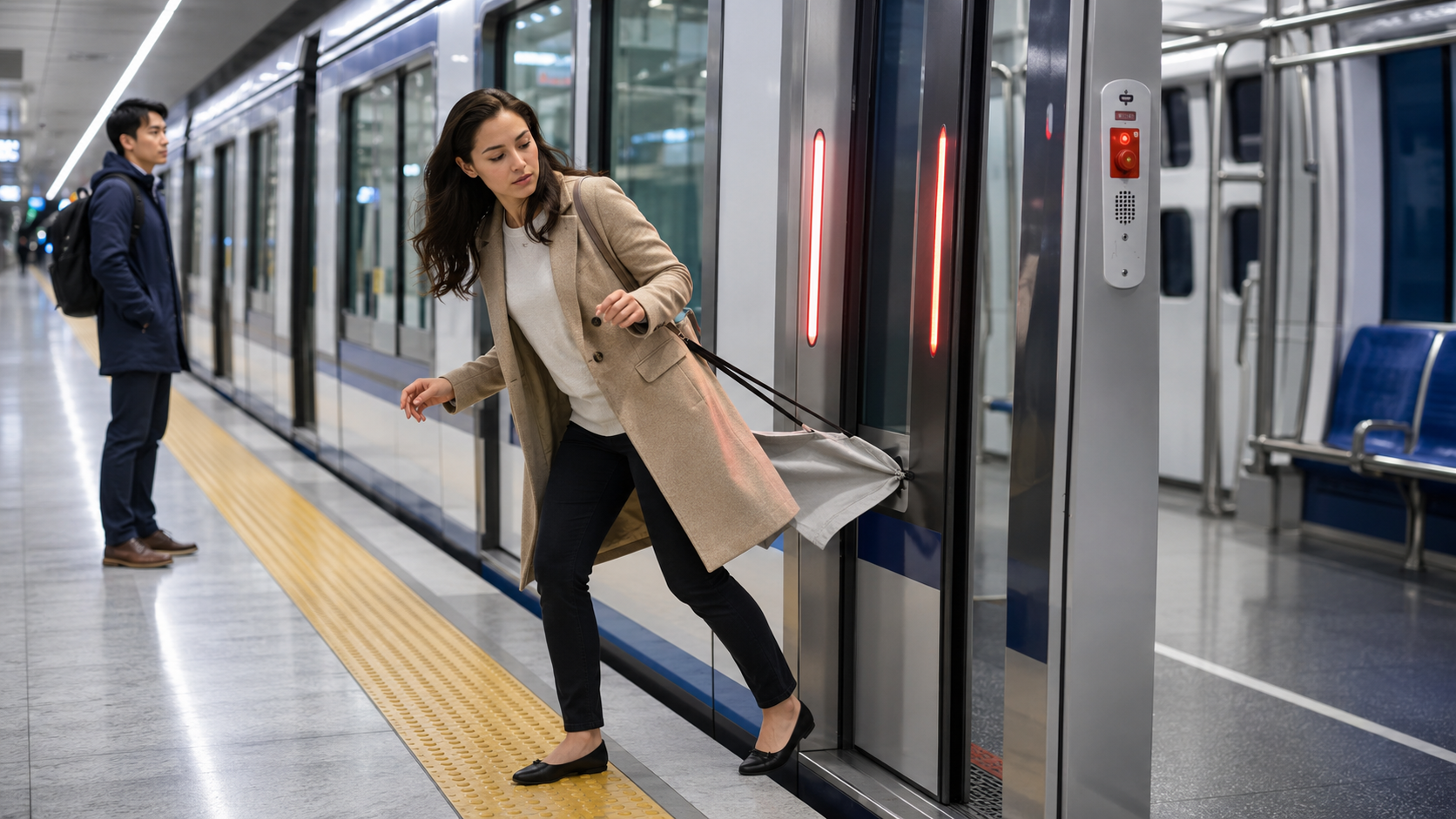
Subway door entrapment accidents do not happen only when an entire person becomes stuck between the doors. A coat, backpack strap, shopping bag, umbrella, stroller, or pet leash can also be caught. Thin items are especially dangerous because they may become trapped even though the doors appear to have closed normally.
The safest rule is simple: if the warning chime has sounded or the doors have started closing, wait for the next train. Missing one train may be inconvenient, but attempting to beat the doors can turn an ordinary trip into a serious emergency.
A subway door entrapment accident occurs when a passenger or an object connected to a passenger is caught between closing train doors. Common examples include:
A hand, arm, foot, or shoulder caught while boarding
Clothing trapped after the passenger has stepped onto the platform
A backpack or handbag remaining inside while its owner is outside
A child entering while the accompanying adult remains on the platform
A stroller or wheelchair becoming stuck in the doorway
A pet and its handler ending up on opposite sides of the doors
A leash, strap, belt, or charging cable being pinched between the door panels
Some train doors are equipped with obstruction-detection systems, and many trains cannot depart unless their systems indicate that the doors are closed. However, passengers should never assume that every object will be detected.
A particularly tragic National Transportation Safety Board investigation involved a passenger whose dog remained on a train while she stepped onto the platform. The doors pinched the thin leash, and the passenger was dragged when the train departed. The case demonstrates why narrow straps, cords, and leashes must never cross a train doorway.
Why Do Subway Door Accidents Happen?
Most entrapment incidents begin with a combination of timing, crowding, and distraction.
During rush hour, passengers may feel pressure to board quickly. People behind them may continue pushing forward even after the closing announcement begins. A traveler looking at a phone may not notice the warning lights, while someone carrying several bags may not realize that a strap is still hanging outside.
Other contributing factors can include:
Trying to hold the doors for another passenger
Running down stairs and directly into a train
Standing or leaning in the doorway
Allowing children to board ahead without holding their hands
Carrying a bag behind the body where it cannot be seen
Using a phone or headphones while boarding
Entering with a stroller or wheelchair at the last moment
Keeping a pet on a long leash
Overcrowded platforms that make movement difficult
A door sensor or mechanical component that does not function as expected
Train-door designs and operating procedures vary by transit system. For example, some doors are closed manually by the operator, while other functions may be automated. Washington Metropolitan Area Transit Authority operators still visually check that customers have cleared the doorway before closing the doors, even where automatic opening is used. Regardless of the technology, passengers remain responsible for staying clear and following announcements.
The Best Prevention: Do Not Race the Doors
The most effective way to prevent a subway door entrapment accident is to avoid treating the closing chime as a challenge.
Once the warning tone sounds or the door lights begin flashing, stop. Do not insert your hand, foot, umbrella, or bag to keep the doors open. The doors may not reopen, and even if they do, you could injure yourself or cause a dangerous crowd movement.
The Chicago Transit Authority advises passengers to stand clear of doors, allow riders to exit before boarding, and wait for another train if they need more time. This is good advice on any subway system.
A few additional habits can make boarding safer:
Prepare Before the Train Arrives
Put away your phone and remove your headphones, or lower the volume enough to hear announcements. Close your bag, shorten loose straps, and make sure shoelaces and clothing are secure.
If you are traveling with a child, hold the child’s hand before approaching the doorway. Keep the child beside you instead of allowing them to run ahead.
Let Passengers Exit First
Stand to the side of the doors and create a clear path for people leaving the train. Trying to push inside while others are exiting causes congestion and increases the chance that someone will still be in the doorway when the doors close.
Keep Your Group Together
Do not begin boarding if there may not be enough time for everyone to enter. Families and groups should decide in advance what to do if they become separated. A useful rule is for the person already on the train to get off at the next station and wait in a clearly visible place.
Never attempt to pull closing doors apart because someone in your group did not make it aboard.
Carry Bags in Front of You
A backpack, tote bag, or rolling suitcase can remain in the doorway after your body has cleared it. Hold bags close and, when possible, keep them in front of your body while entering or exiting.
Once inside, move away from the doorway so other passengers have enough space.
Be Careful With Pets
Use a short leash near trains and keep the animal directly beside you. The leash should never extend across the doorway. Do not enter or exit if there is a possibility that you and the animal will end up on different sides.
Whenever the transit agency permits it, a properly secured carrier can reduce the risks associated with a loose or leashed pet.
What to Do If You Are Caught in Subway Doors
Your response will depend on what has been trapped and whether the train is still stationary.
If the Doors Close on Your Body
Shout loudly and clearly: “Stop the train! Person caught in the door!”
Attract the attention of the train operator, station staff, and nearby passengers. If you can reach the train’s emergency intercom or operator call button without twisting or worsening the injury, use it immediately.
Do not keep violently pulling a trapped arm or leg. Forceful twisting may cause fractures, dislocations, or additional tissue damage. Concentrate on remaining upright and protecting your head while help is requested.
Nearby passengers may be able to activate an intercom or call box, but they should follow the equipment’s instructions. Emergency controls differ among transit systems.
If Your Clothing Is Caught
Immediately alert the operator and attempt to free yourself only if you can do so without falling toward the train or platform edge.
If the trapped item is something removable, such as a scarf, jacket, or loose outer layer, take it off as quickly as possible. Your safety is more important than the clothing.
Do not wrap the fabric around your hand or arm and pull with your full body weight. If the train unexpectedly moves, this could prevent you from releasing it.
If a Bag or Loose Object Is Caught
Let go of the object if doing so will separate you from the moving train. A bag, umbrella, phone, or suitcase can be replaced; a life cannot.
The situation is more dangerous when a strap is wrapped around your wrist, attached to your body, or connected to a backpack you are wearing. Try to release the buckle, slide out of the strap, or remove the bag while shouting for help.
Never run beside a departing train while holding a trapped object.
If a Leash Is Caught
Release the leash from your hand or body immediately if the train begins moving. This is one reason a leash should never be tied to a backpack, belt, stroller, or wheelchair near train doors.
If a pet remains on the train while you are on the platform, alert transit staff at once. Tell them the train line, direction of travel, car location, and the next station. Do not attempt to follow the train onto the tracks.
What Bystanders Should Do
A calm and observant bystander can help prevent a door entrapment from becoming a dragging accident.
Shout a direct warning and signal toward the operator. Use the emergency intercom, platform call box, or help point if one is nearby. State exactly what is happening: “A person is caught in the third car door,” for example.
If the train begins to move, call 911 or the local emergency number. Give the station name, platform, train direction, and approximate car number. Specific information is far more useful than simply saying that there is an accident on the subway.
Do not jump onto the tracks or try to enter the space between the train and platform. Subway tracks may contain an electrified third rail, and trains can move without warning. The CTA’s emergency and evacuation guidance tells passengers not to open train doors or evacuate unless instructed by transit personnel, except when there is an immediate threat to life.
Bystanders should also avoid surrounding the injured person so closely that staff or paramedics cannot reach them.
When to Use an Emergency Door Release
Some railcars have a labeled emergency door-release mechanism. It is not the same as an ordinary door-open button and should not be used simply because a passenger missed a stop.
Activating an emergency release can introduce new hazards, including access to an electrified track area or the possibility of falling from a train that is not properly aligned with a platform. Use it only according to the posted instructions, when directed by transit employees, or when an immediate life-threatening danger makes waiting impossible.
Whenever possible, contact the operator first and follow official instructions. On systems such as Washington Metro, onboard call boxes allow passengers to communicate with the operator, who can contact central control and emergency responders. The agency advises passengers to follow the operator’s directions during emergencies.
First Aid After a Door Entrapment Injury
Even when the person is freed quickly, do not assume that the injury is minor. Crushing pressure can damage muscles, nerves, bones, blood vessels, or internal organs without producing dramatic external bleeding.
Call 911 for severe pain, breathing difficulty, heavy bleeding, numbness, weakness, visible deformity, loss of consciousness, confusion, pale or clammy skin, or an injury involving the head, neck, chest, abdomen, or pelvis. The American Red Cross notes that crushing forces can cause blunt trauma and internal bleeding.
While waiting for help:
Move everyone away from the platform edge.
Keep the injured person still and comfortable.
Apply firm, direct pressure to serious external bleeding with clean material.
Do not straighten a deformed limb.
Do not move someone with a possible head, neck, or back injury unless the location remains dangerous.
Keep the person warm and watch for changes in breathing or alertness.
If the person becomes unresponsive and is not breathing normally, begin CPR and use an AED if available and you are trained or can follow dispatcher instructions.
A person with persistent swelling, bruising, tingling, reduced movement, or worsening pain should receive medical evaluation even if emergency transportation was not initially required.
Extra Precautions for Children and Passengers With Mobility Needs
Children may not recognize a closing-door warning or understand why they should stop. Adults should hold their hands and cross the doorway together. Never stand inside the train and reach back for a child who is still on the platform.
Passengers using wheelchairs, walkers, or strollers should board only when there is enough time and space. Approach the doorway straight rather than at a sharp angle, and avoid entering as the warning chime begins. Ask station staff for assistance when needed.
Other passengers can help by allowing extra room instead of pushing from behind. A few seconds of patience may prevent a serious accident.
Train Door Safety Is a Shared Responsibility
Transit agencies are responsible for maintaining door systems, training operators, investigating failures, and providing usable emergency communication equipment. Door problems should always be reported, even when nobody is injured.
Passengers also play an essential role. Do not lean against doors, block them, or assume that sensors will detect your body or belongings. Pay attention to announcements, keep loose items controlled, and wait for the next train when the doors begin to close.
Subway door entrapment accidents are uncommon, but the consequences can be severe. The best protection is not a clever escape technique—it is the decision to stay clear of closing doors in the first place. Have you ever seen someone or something become caught in subway doors, and how did the people nearby respond? Share your experience or your best train-safety tip in the comments below.
Hi, I’m the creator and editor behind ZestyHabit. I research everyday safety, first aid, and practical wellness topics using official guidance and reliable public sources, then turn that information into clear, realistic steps for daily life.
My goal is to help readers make safer, better-informed choices at home and beyond.