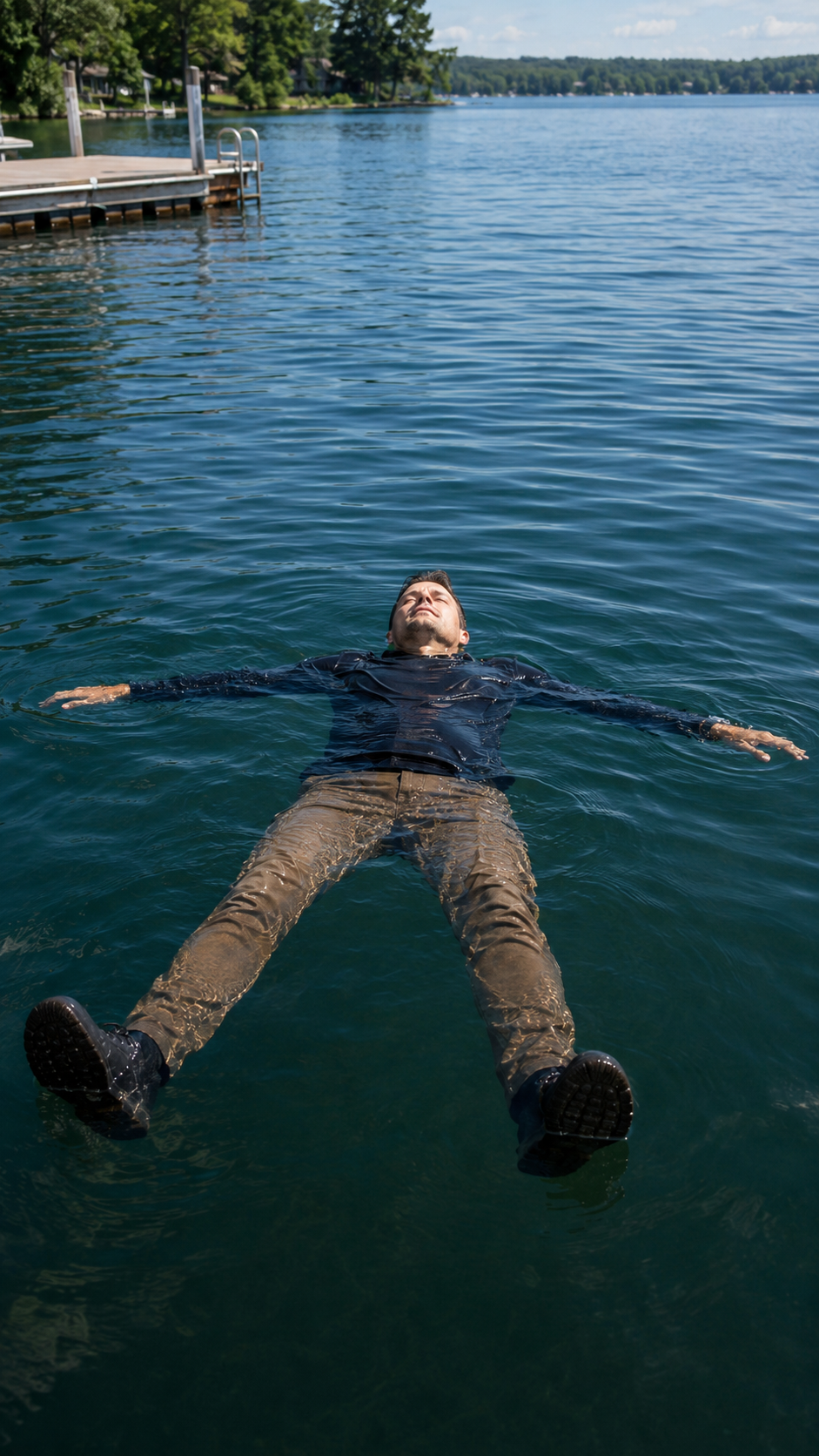
Best Position to Survive After Falling Into Water: Float First and Conserve Your Energy
Minjin Park
·
Learn the best survival position to use after falling into water, how to control your breathing, conserve body heat, handle currents, and signal for rescue.
Falling unexpectedly into deep water can be terrifying. One moment you are standing on a riverbank, fishing from a boat, or walking beside a canal, and the next you are underwater. Your natural reaction may be to kick hard, wave your arms, and try to swim immediately.
Unfortunately, panic and frantic movement can use up energy at the exact moment you need to conserve it.
The most important first step is usually not to swim. It is to get your breathing under control and place your body in a stable floating position. In many situations, floating on your back with your face above the surface gives you time to recover, assess your surroundings, and decide whether to call for help, hold onto something, or swim toward safety.
Different environments require slightly different techniques, so it is worth knowing how your position should change in cold water, moving rivers, and strong ocean currents.
Tilt your head back until your ears are partially or fully in the water.
Look upward rather than trying to lift your head toward your chest.
Relax your neck and shoulders.
Spread your arms and legs to improve stability.
Move your hands and feet gently if you need help staying afloat.
Breathe slowly and normally once the initial shock begins to pass.
Do not worry if your legs sink lower than the rest of your body. People float differently depending on body composition, clothing, lung volume, and water conditions. Your body does not need to lie perfectly flat. The important point is that your airway remains above the surface.
Trying to hold your entire face and head high above the water usually makes floating more difficult. Lifting your head pushes your hips and legs downward, forcing you to kick harder. Letting your head rest back allows the water to support more of your body.
Sudden immersion can cause an involuntary gasp followed by rapid, uncontrolled breathing. This reaction is known as cold-water shock. It can happen even on a warm day because rivers, lakes, reservoirs, and coastal waters may remain surprisingly cold.
The RNLI notes that water below 15°C, or 59°F, can trigger cold-water shock. Its immediate effects usually begin to ease within about a minute. During that time, trying to swim hard can make it more difficult to control your breathing.
Instead, focus on three simple priorities:
Keep your mouth above the surface.
Relax into a floating position.
Concentrate on taking slower, steadier breaths.
Avoid holding your breath for a long time. Breathe out fully and allow your breathing rate to settle. Once you can think clearly, look around for the nearest safe exit, floating object, boat, or person who can help.
A useful phrase to remember is: Float first, breathe, then decide.
How to Get Into a Stable Floating Position
If you surface upright after falling into the water, you may initially feel as though your body is sinking. Try not to respond by violently pushing the water downward.
Take a breath, lean your upper body backward, and allow the back of your head to approach the surface. Open your arms to the sides and let your legs move apart.
Use small, slow movements rather than large splashes. You can gently sweep your hands back and forth beneath the surface. This is sometimes called sculling. Small kicks may also help stabilize your body, but they should not be so forceful that they exhaust you.
If waves occasionally wash over your face, time your breaths when your mouth is clear of the water. Turn your face slightly away from incoming spray if necessary, but avoid repeatedly lifting your head.
Some people find floating more difficult than others. If a back float does not keep your airway clear, use a gentle survival tread instead. Keep your movements slow, use your arms and legs together, and periodically return to a supported floating position whenever possible.
What to Do If You Are Wearing a Life Jacket
If you are wearing a properly fitted life jacket, keep it on. Do not try to remove it because it feels bulky or makes swimming less natural.
Lean back into the buoyancy of the jacket and allow it to support your upper body. Keep your chin above the water and check that the jacket has not ridden up around your face. A correctly fitted jacket should remain secure and help maintain a position that allows you to breathe.
Some life jackets are specifically designed to turn an unconscious person face-up, while others mainly provide buoyancy. Understanding your equipment before an emergency matters. The U.S. Coast Guard recommends choosing a life jacket that is appropriate for your size and activity and testing its fit in controlled water.
Pool floats, inflatable toys, and water wings are not substitutes for approved life jackets.
The HELP Position for Cold-Water Survival
When you are wearing a life jacket and rescue may take time, you may be able to reduce heat loss by using the Heat Escape Lessening Posture, commonly called the HELP position.
To assume this position:
Keep your life jacket securely fastened.
Draw your knees upward toward your chest.
Press your legs together.
Hold your arms close across your chest or around the life jacket.
Keep your head and airway above the surface.
This position protects areas where heat can be lost quickly, including the sides of the chest and the groin. The U.S. Coast Guard’s boating safety guidance recommends HELP when you cannot get out of cold water and rescue is not immediate.
The HELP position is intended for someone supported by a life jacket. If you do not have flotation, curling tightly into a ball may make it harder to keep your mouth above water. In that situation, prioritize a stable back float.
If several people wearing life jackets are in the water together, form a huddle. Stay close, put your arms around one another, and keep children or injured people near the center. A group huddle may conserve warmth, provide emotional reassurance, and make everyone easier for rescuers to spot.
Your Position Should Change in a Moving River
A river current requires a different survival position from calm water.
If you are being carried downstream, roll onto your back and point your feet downstream. Keep your toes near the surface, your hips raised, and your knees slightly bent. This allows your feet to absorb contact with rocks or other obstacles instead of your head.
Use your arms to back-paddle and angle yourself gradually toward calmer water or the shore. Do not try to stand while the current is still strong. Your foot could become trapped between rocks while the force of the water pushes your body forward and underwater.
The American Red Cross advises people swept into a river current to float on their backs with their feet pointing downstream and to steer using their arms. Once you reach slower, shallower water, you can swim or carefully move toward the bank.
Avoid low-head dams, fallen trees, bridge supports, and other obstacles whenever possible. These hazards can trap a person against or beneath the surface. If you are approaching a serious obstacle, attracting attention and positioning yourself early may be critical.
What If You Are Caught in a Rip Current?
A rip current can pull a swimmer away from shore, but it does not usually pull a person deep underwater. The greatest danger is exhaustion caused by trying to swim directly against it.
If you feel yourself being carried away from the beach:
Do not fight the current by swimming straight toward shore.
Float on your back to recover your breathing.
Raise one arm and call for help if lifeguards or other people are nearby.
When you have enough energy, swim parallel to the shoreline until you move out of the current.
Then angle back toward shore or continue floating while waiting for assistance.
Even a strong swimmer can quickly become exhausted when fighting moving water. Staying afloat keeps your airway clear and gives rescuers more time to reach you.
Should You Swim or Wait for Rescue?
Once your breathing is controlled, decide whether swimming is realistic.
Swimming may be appropriate when the exit is close, clearly visible, and safely reachable. Examples include a pool wall a few feet away, a boat beside you, a low dock with a ladder, or a calm shoreline within a short distance.
Waiting may be safer when:
The water is very cold.
The shore is far away.
Waves or currents are strong.
You are injured or unusually tired.
A boat or large floating object is nearby.
Rescuers already know your location.
If a boat has capsized but remains afloat, stay with it unless remaining there creates another immediate danger. Climb onto it or lift as much of your body out of the water as possible. A boat is easier for rescue crews to see than a single person in the water.
Do Not Rush to Remove Your Clothing
Many people assume that wet clothing will immediately pull them underwater. As a result, they may waste valuable energy trying to remove shoes, trousers, or a jacket.
The Coast Guard advises remaining calm and avoiding frantic attempts to remove clothing or footwear. Air trapped inside clothing may initially provide some buoyancy, and excessive movement can accelerate fatigue and heat loss.
Remove an item only if it is clearly tangled, caught on something, or directly preventing you from breathing or moving. Otherwise, focus on floating and maintaining control.
Common Mistakes That Reduce Survival Time
Several instinctive reactions can make a water emergency worse:
Thrashing or kicking as hard as possible
Trying to shout before the airway is stable
Lifting the head and shoulders continuously
Swimming immediately during cold-water shock
Fighting directly against a strong current
Attempting a long swim without judging the distance
Removing a life jacket
Trying to stand in a fast-moving river
Separating from a floating boat or other large object
Relying on an inflatable toy as lifesaving equipment
Remaining calm does not mean ignoring the danger. It means using your energy deliberately and making one decision at a time.
Practice Floating Before an Emergency Happens
The best time to discover your natural floating position is not during an emergency. Practice in a supervised swimming pool or another controlled location with a qualified instructor or capable partner nearby.
Experiment with the position of your head, arms, and legs. Practice floating while wearing ordinary lightweight clothes, if the facility permits it, because falling into water often happens when people are fully dressed. You can also practice turning from a face-down position onto your back and transitioning from floating to gentle swimming.
Formal swimming and water-safety lessons can reduce drowning risk, according to the CDC. However, swimming ability does not eliminate the need for life jackets, supervision, and careful decisions around natural water. Conditions in a lake, river, or ocean can be very different from those in a pool.
Final Thoughts
The best survival position after falling into water is usually a relaxed, face-up float with your head tilted back, ears in the water, and arms and legs spread for stability. Control your breathing before deciding whether to swim. In cold water with a life jacket, use the HELP position; in a river, float feet-first downstream; and in a rip current, avoid fighting directly toward shore. Most importantly, wear a properly fitted life jacket whenever the activity calls for one.
Have you ever practiced floating in regular clothes or learned a water-survival technique that helped you feel more confident? Share your experience or your most useful water-safety tip in the comments below.
Hi, I’m the creator and editor behind ZestyHabit. I research everyday safety, first aid, and practical wellness topics using official guidance and reliable public sources, then turn that information into clear, realistic steps for daily life.
My goal is to help readers make safer, better-informed choices at home and beyond.