
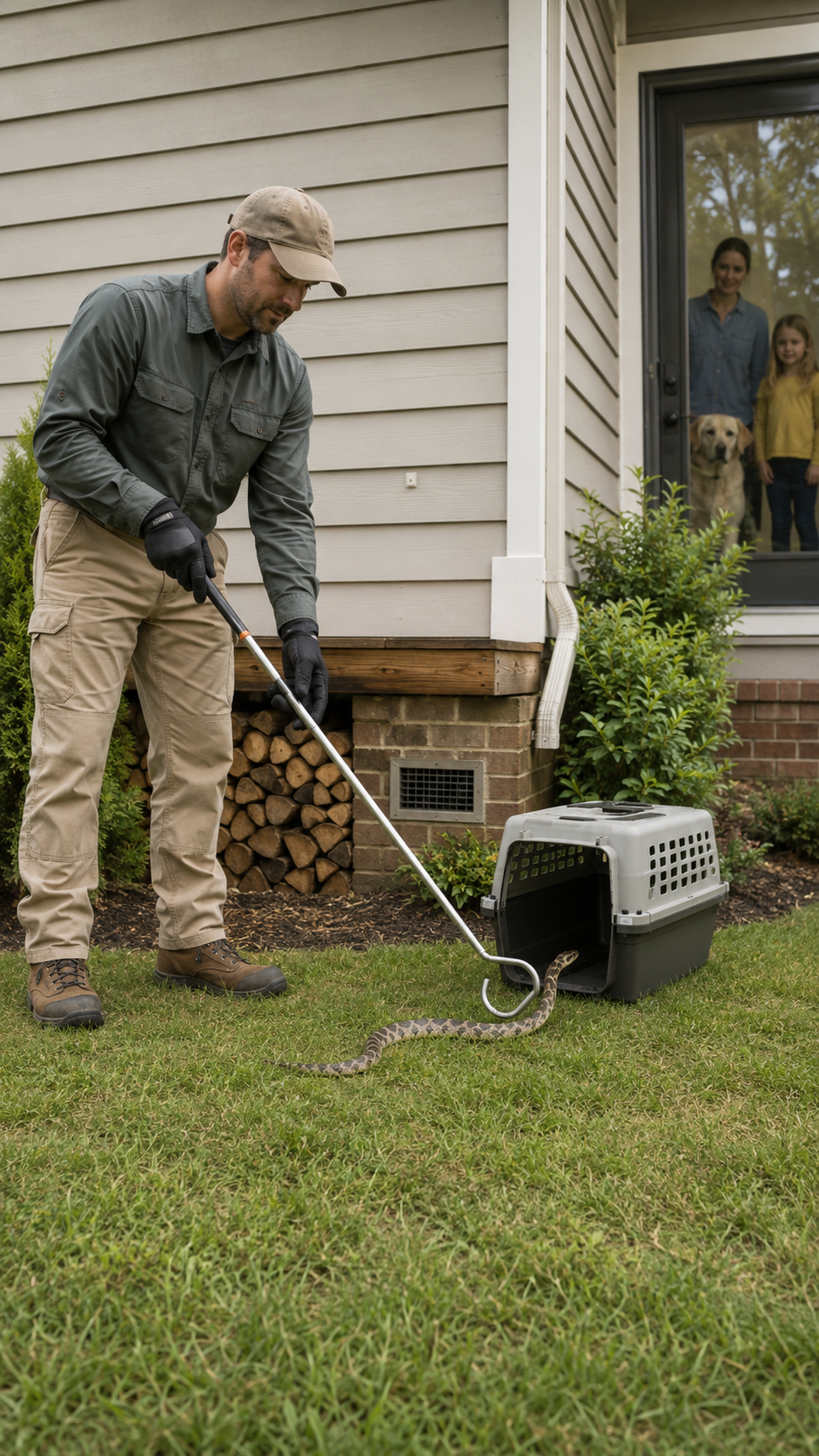

Learn how to get rid of snakes safely, prevent them from entering your home, avoid ineffective repellents, and respond correctly to a snakebite.
Finding a snake near your porch, garage, garden, or child’s play area can be alarming. The first instinct may be to grab a shovel, spray a chemical, or try to trap it. Unfortunately, approaching a snake is often more dangerous than simply giving it a way to leave.
The safest form of snake control is not confrontation. It is a combination of distance, professional removal when necessary, habitat management, rodent control, and careful sealing of entry points.
According to the Centers for Disease Control and Prevention, snakes generally bite when they feel threatened or trapped. The CDC specifically advises homeowners not to remove or trap a snake inside the home themselves. Instead, move people and pets away and call animal control or a qualified wildlife professional.
This guide explains what to do when you see a snake, how to make your property less attractive to snakes, which popular remedies do not work, and how to respond if someone is bitten.
Why Are Snakes Coming to Your Property?
Snakes usually appear because a property offers one or more things they need: food, shelter, water, or a suitable temperature.
Common food sources include:
- Mice and rats
- Small birds and bird eggs
- Frogs and toads
- Lizards
- Insects
- Slugs and other small animals
Common hiding places include:
- Tall grass and thick weeds
- Leaf litter
- Brush and compost piles
- Stacked lumber or firewood
- Rock walls and landscaping stones
- Spaces beneath sheds, decks, and porches
- Cracks in foundations
- Open crawl spaces
- Cluttered garages and storage buildings
A snake repeatedly appearing near a home may therefore be a sign of a rodent or shelter problem. Removing one snake without correcting those conditions may leave the property attractive to another.
Snakes also play a useful ecological role. They consume rodents and other animals that can damage property or spread disease. For that reason, the goal should usually be to keep snakes away from occupied areas—not to eliminate every snake from the surrounding environment.
What to Do When You See a Snake Outside
If the snake is outdoors and moving away from people, the safest response is usually to leave it alone.
Follow these steps:
- Stop and create distance. Do not step closer to identify or photograph it.
- Bring children and pets indoors. Dogs are especially likely to approach, bark at, or bite a snake.
- Do not block the snake’s escape route. A cornered snake may become defensive.
- Observe from a protected location. If necessary, note its approximate length, colors, markings, and location.
- Wait for it to leave. Many snakes will move on when they no longer feel threatened.
- Call a professional if it remains in a high-use area. This is especially important near a doorway, school, playground, pet enclosure, or crowded public space.
Do not poke the snake, throw objects at it, spray it with a hose, or try to move it with a broom. A startled snake may travel in an unpredictable direction.
Trying to kill the animal is also dangerous. The CDC notes that most bites occur when people attempt to catch or kill venomous snakes. Even a recently killed snake should not be handled because reflex movements may still cause a bite.
What to Do If a Snake Is Inside Your Home
A snake inside a house, garage, basement, or occupied outbuilding requires more caution.
Immediately move children and pets to another area. If you can do so without approaching the snake, close interior doors to limit its movement. Do not reach under furniture, appliances, boxes, or shelving to find it.
Call one of the following:
- Local animal control
- Your state wildlife agency
- A licensed wildlife-removal company
- A pest-control company specifically trained to handle snakes
- Emergency services if the snake creates an immediate danger
Tell the dispatcher where the snake was last seen and whether anyone may have been bitten. Keep watching from a safe location only if you can do so without entering the snake’s path.
Do not attempt to pick up the snake with kitchen tongs, a trash container, a blanket, a broom, or homemade equipment. Online videos may make snake handling look easy, but professionals use training, species knowledge, protective equipment, and controlled procedures.
Do Not Rely on Head Shape or Color Alone
Many people have heard that a triangular head, vertical pupils, or a certain color pattern always identifies a venomous snake. These shortcuts are not reliable enough for an untrained person to make a close-range decision.
Some harmless snakes flatten their heads when frightened, making them appear triangular. Lighting can make pupils difficult to see, and juvenile snakes may look different from adults. Several venomous and nonvenomous species also have similar colors.
Learn which venomous snakes naturally occur in your region using information from your state wildlife agency or university extension office. If identification is necessary, use a photograph taken from a safe distance with zoom. Never move closer solely to obtain a better picture.
In the United States, medically significant native venomous snakes include rattlesnakes, copperheads, cottonmouths and coral snakes. Local risks vary considerably, so regional information is more valuable than generalized identification tricks found on social media.
1. Control Rodents and Other Food Sources
Rodent control is one of the most effective long-term ways to discourage snakes.
The CDC recommends removing the food, water, and shelter that support rodent infestations. Start by:
- Storing pet food, livestock feed, birdseed, and grain in sealed containers
- Cleaning spilled seed from beneath bird feeders
- Bringing pet food and water bowls indoors overnight
- Using trash cans with tight-fitting lids
- Cleaning outdoor grills and eating areas
- Picking up fallen fruit
- Managing compost properly
- Repairing plumbing leaks
- Removing clutter that provides nesting material for mice
Bird feeders deserve particular attention. Seeds dropped on the ground attract mice, which can then attract snakes. Move feeders farther from the house, use a seed-catching tray, and clean the area regularly.
If you already have a significant rodent problem, use an integrated pest-management approach or hire a licensed professional. Poisoned rodents can harm pets, birds of prey, and other wildlife, so rodenticides should never be scattered casually.
2. Remove Places Where Snakes Hide
A tidy property does not guarantee that you will never see a snake, but it gives snakes fewer protected places to rest and makes them easier to notice from a safe distance.
Regularly:
- Mow tall grass
- Trim dense vegetation near the foundation
- Remove leaf piles and accumulated yard debris
- Clear brushy fence lines
- Dispose of unused boards, bricks, roofing material, and metal
- Repair spaces beneath sheds and porches
- Remove abandoned equipment and outdoor clutter
- Keep walking paths visible
Store firewood away from the home and elevate it on a rack. Mississippi State University Extension recommends raising firewood at least 12 inches above the ground. Wear sturdy boots and gloves when moving wood, and never place your hands into a gap you cannot see.
Be cautious with decorative rock piles and dense groundcover near entrances. These features may provide both shelter and access to prey. You do not necessarily have to remove all landscaping, but creating a clear, open strip around the foundation can reduce hiding opportunities.
3. Seal Gaps Around the Home
Snakes cannot chew through solid building materials, but they can use surprisingly small existing gaps.
Inspect the exterior of your home for:
- Foundation cracks
- Damaged crawl-space vents
- Gaps beneath doors
- Openings around pipes and utility lines
- Torn window screens
- Loose siding
- Spaces around garage doors
- Unscreened basement windows
- Holes where different building materials meet
Mississippi State University Extension advises sealing openings larger than one-quarter inch. Depending on the location, appropriate materials may include mortar, metal flashing, quality exterior caulk, expanding foam, door sweeps, or fine-mesh metal hardware cloth.
Do not seal a hole if you know an animal is currently inside the structure. Trapping wildlife within a wall or crawl space can create additional safety, odor, and property-damage problems. Ask a professional to inspect the area first.
Make garage doors fit tightly, especially at the corners. Keep garages and sheds uncluttered so that an animal cannot remain hidden behind boxes for long periods.
4. Consider a Snake-Resistant Fence
A properly constructed barrier may help protect a small, high-priority area such as a backyard play space, pet run, childcare facility, or patio in a region with frequent venomous snake activity.
Colorado State University Extension describes a barrier using quarter-inch galvanized hardware cloth approximately 36 inches high, buried six inches into the ground and angled outward. Gates must fit tightly, and vegetation should be kept away from the fence because some snakes can climb.
A snake-resistant fence is not a simple decorative garden fence. Gaps beneath gates, overhanging plants, drainage openings, and nearby objects can defeat the barrier. Installation may also need to comply with building codes, drainage requirements, and wildlife laws.
For these reasons, consult a regional wildlife professional before investing in a barrier. Fencing is most practical around a limited area, not around an entire rural property.
5. Make Outdoor Activities Safer
Even after improving the property, assume that a snake could occasionally pass through.
Reduce the chance of an accidental encounter by following these habits:
- Use a flashlight when walking outside at night
- Wear closed shoes or boots in tall grass and wooded areas
- Wear long pants and gloves during yard work
- Look before stepping over logs or rocks
- Never reach into a hole, brush pile, woodpile, or dark storage space
- Lift boards and debris from the side farthest from your body
- Keep dogs leashed in snake habitat
- Teach children never to touch a snake, even if it appears dead
- Inspect play areas before allowing young children outside
- Be especially cautious after floods, storms, and major landscaping work
Snakes may become more visible when their habitat is disturbed or when weather conditions push them to seek dry shelter, shade, warmth, or water.
Snake Repellents and Home Remedies: What Does Not Work?
Numerous products claim to drive snakes away using a strong odor, vibration, or irritating chemical. Common suggestions include:
- Mothballs
- Sulfur
- Lime
- Ammonia
- Vinegar
- Cayenne pepper
- Essential oils
- Garlic
- Predator urine
- Smoke
- Ultrasonic devices
- Special ropes placed around a campsite
There is no dependable evidence that these methods provide lasting snake control. Mississippi State University Extension reports that tested remedies—including sulfur, lime, mothballs, cayenne spray, artificial skunk scent, and other substances—failed to repel black rat snakes.
Mothballs are particularly concerning. They are pesticides designed for specific labeled uses in sealed containers. Scattering them around a yard, crawl space, garden, or play area can expose children, pets, wildlife, soil, and water to toxic chemicals. Using a pesticide in a way that conflicts with its label may also violate federal law.
Never combine chemicals or pour gasoline, bleach, ammonia, pesticide, or another substance into a suspected snake hiding place. Mixing products can create toxic gases, fires, environmental contamination, and serious injuries without solving the problem.
Glue traps are also not a safe general solution. They can capture pets and non-target wildlife and may leave a frightened live snake stuck in a location where someone must eventually handle it.
Is It Legal to Kill or Relocate a Snake?
Wildlife laws vary by state, county, species, season, and property type. Some snakes are protected, and releasing captured wildlife on public land or someone else’s property may be illegal.
Relocation is not automatically humane. An animal released into unfamiliar habitat may have difficulty finding shelter or food, and moving it can spread disease or create a problem for another community.
Before trapping, killing, or relocating any snake, contact your state wildlife agency. A licensed professional can identify the species, explain local laws, remove it safely, and inspect the property for entry points.
What to Do If Someone Is Bitten
Treat every unidentified snakebite seriously. Do not wait for swelling, severe pain, or other symptoms before seeking help.
In the United States, the CDC estimates that approximately 7,000 to 8,000 people are bitten by venomous snakes each year. About five die, largely because modern emergency treatment and antivenom are available. Survivors can still experience significant tissue damage, impaired movement, or other lasting injuries.
If a bite occurs:
- Move the person away from the snake.
- Call 911 immediately.
- Keep the person as calm and still as possible.
- Remove rings, watches, or tight items before swelling develops.
- Follow instructions from emergency dispatchers.
- Note the snake’s appearance from a safe distance, but do not capture it.
- Contact Poison Control at 1-800-222-1222 if directed or if emergency assistance is not immediately available.
Do not:
- Apply a tourniquet
- Cut the bite
- Attempt to suck out venom
- Use a commercial suction device
- Apply ice
- Immerse the wound in water
- Give alcohol or caffeinated drinks
- Use electric shock
- Try to catch or kill the snake
- Delay medical care while searching for the species
The emergency department does not need the physical snake. A description or safely obtained photograph may be helpful, but treatment should never be delayed to get one.
The Safest Strategy Is Prevention, Not Confrontation
Getting rid of snakes safely is less about finding a miracle repellent and more about changing the conditions that attracted them. Control rodents, remove hiding places, seal openings, supervise children and pets, and rely on trained professionals when a snake enters an occupied building or remains in a high-risk area.
Most importantly, resist the urge to prove that you can handle the situation yourself. A snake quietly crossing a yard is usually less dangerous than a snake being chased, cornered, or grabbed.
Have you ever found a snake in your home or yard, and what steps helped prevent it from returning? Share your experience in the comments—including your general region if you are comfortable doing so—but please avoid recommending risky handling techniques or unverified chemical remedies.

Hi, I’m the creator and editor behind ZestyHabit. I research everyday safety, first aid, and practical wellness topics using official guidance and reliable public sources, then turn that information into clear, realistic steps for daily life.
My goal is to help readers make safer, better-informed choices at home and beyond.


