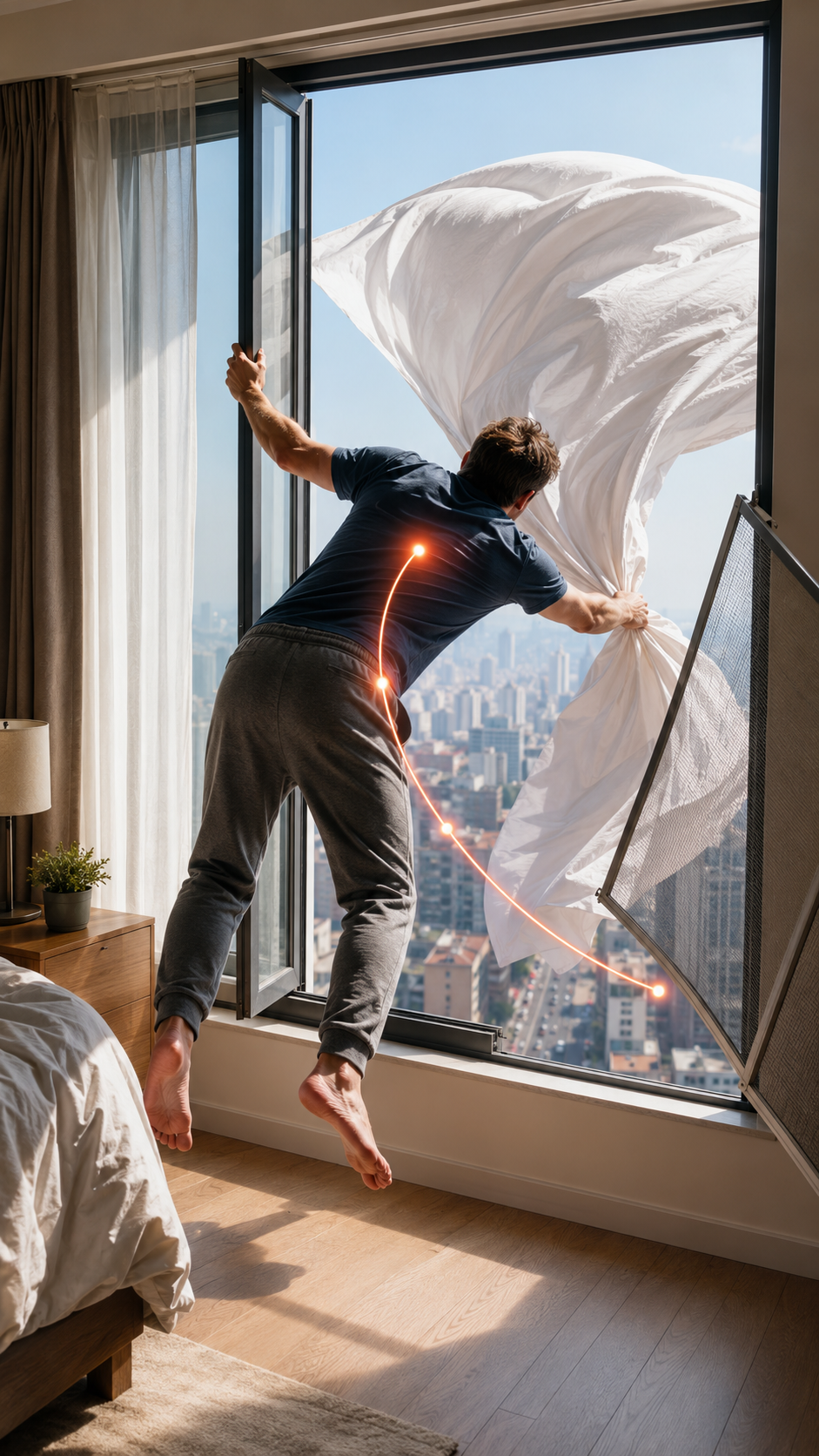
Why Shaking Bedding Out of a Window Can Cause a Fatal Fall
Minjin Park
·
Shaking dust, hair, or crumbs from a blanket may seem like an ordinary household chore. In apartments, some people open a window or step onto a balcony, hold the bedding over the edge, and shake it several times before bringing it back inside.
The entire task may take less than a minute, but it can create a serious fall hazard.
Large blankets are heavy, awkward, and capable of catching the wind. Shaking one requires forceful arm movements that can shift the body’s center of gravity. If a person leans over a windowsill or balcony railing, even a small slip, sudden gust, or attempt to catch a falling blanket may move the upper body beyond the point where balance can be recovered.
A railing, windowsill, or insect screen may create a false sense of security, but none of these features makes leaning outward safe. At height, a routine loss of balance can have irreversible consequences.
A Real Accident Involving a Blanket and a High-Rise Balcony
In November 2025, a man in his twenties died after falling from a 20th-floor apartment in Namyangju, South Korea. Police and fire authorities found a blanket near the scene and believed that he had likely lost his balance while shaking it from the balcony. At the time of reporting, police were still investigating the exact circumstances.
The Korea Times report on the accident also referred to a similar 2021 incident in which a woman in her sixties died after falling from a 13th-floor apartment while shaking bedding.
These tragedies illustrate an important point: a person does not need to be climbing outside, behaving recklessly, or standing on a narrow ledge to experience a fatal fall. An everyday chore can become dangerous when body weight, momentum, wind, and an open edge come together.
1. Leaning Forward Moves Your Center of Gravity
A standing person remains balanced when the body’s center of gravity stays above the area supported by the feet. When you lean forward, that center moves toward the front of your body.
Normally, you can compensate by shifting your hips backward, stepping forward, or holding a stable object. At a window or balcony, however, the railing may block your legs while your upper body continues moving outward.
If your center of gravity passes beyond the railing, your feet may no longer be able to restore balance. The railing can then act like a pivot point, allowing the upper body to rotate over it.
This risk increases when:
The railing is below the person’s waist or center of mass
The person bends at the hips rather than keeping the body upright
Both arms are extended outside
The chest or abdomen is pressed against the railing
The person rises onto their toes for extra reach
One foot leaves the floor
A chair, box, or stool is used to gain height
A taller person is not automatically safer. Depending on the railing height and body proportions, a tall person’s center of gravity may be positioned farther above the barrier.
2. Shaking a Blanket Creates Momentum
A blanket does not simply move by itself. To snap it outward, you accelerate it with your arms, shoulders, and upper body. When the blanket reaches the end of that motion, its weight pulls against your hands.
Repeated shaking creates alternating forward and backward forces. On solid ground, your legs and core usually absorb those forces without difficulty. Near an open edge, the same movement can gradually pull your torso forward.
The danger may not be obvious on the first shake. The person may lean slightly farther with each repetition. Fatigue, reduced grip strength, or the blanket sliding through the hands can then cause a sudden movement.
Large comforters, quilts, sleeping bags, and weighted blankets are especially difficult to control. Wet bedding is heavier and may pull more strongly than expected.
3. A Blanket Can Act Like a Sail
Wind is one of the most unpredictable parts of shaking bedding outdoors. A large sheet or blanket presents a broad surface that can catch moving air like a sail.
Even when the weather seems calm at street level, wind around a high-rise building may be stronger and less predictable. Airflow can change direction near corners, gaps between buildings, and open windows. Opening doors on opposite sides of a home may also create a strong cross-breeze.
A gust may:
Pull the blanket away from the building
Push it back into the person’s face
Twist it around the arms
Obstruct vision
Cause a person to step or lean suddenly
Make someone instinctively tighten their grip
The safest response is to release the blanket rather than allow it to pull your body forward. Bedding can be retrieved or replaced; a fall cannot be undone.
Do not shake bedding from an open window or balcony during strong or gusty weather, even if the task will take only a few seconds.
4. People Instinctively Reach for Falling Objects
One of the most dangerous moments occurs when the blanket begins to slip.
People often react before thinking. A person may lunge forward, reach with both hands, twist at the waist, or lift one leg behind them while trying to catch the fabric. This automatic reaction can place most of the upper body beyond the railing.
Similar accidents can happen when people try to retrieve laundry, phones, toys, tablecloths, or plant pots that are falling from a balcony.
Create a household rule in advance:
If an object falls toward an open edge, let it go.
Do not climb, stretch, or lean over a railing to see where it landed. Move away from the edge and notify building management or someone at ground level when necessary. Warn people below only from a safe position.
5. Bedding Can Block Your View
A blanket held in front of the body may temporarily hide the floor, window frame, railing, furniture, pets, and other obstacles.
If the material blows toward your face, you may lose visual orientation completely. A person who cannot see the floor may step backward onto an object, sideways into an open door, or forward toward the edge.
Before handling bulky items near any opening, remove clutter from the area. However, clearing the floor does not make leaning outside safe. The most effective precaution is to keep the entire task away from the open edge.
6. Slippery or Unstable Footing Makes Recovery Harder
Balconies may become slippery because of rain, condensation, dust, algae, laundry water, or cleaning products. Indoor floors near windows may also be slick, especially when someone is wearing socks, loose slippers, or worn footwear.
A blanket can catch on furniture or wrap around a leg. Pets and children may move unexpectedly near the person’s feet. Balcony thresholds create another trip hazard because they are raised from the surrounding floor.
Risk increases when a person:
Stands in socks or backless slippers
Has wet feet
Uses a folding chair or unstable stool
Steps onto the window ledge
Stands on a bed positioned under a window
Works in poor lighting
Moves backward without checking the floor
Has dizziness, impaired balance, or reduced vision
Has consumed alcohol or medication that causes drowsiness
Older adults and anyone with a history of falls should be especially cautious. The CDC recommends nonslip, properly fitting footwear, good lighting, regular vision checks, and reviewing medications that may cause dizziness or drowsiness as part of fall prevention.
7. Railings Are Not Supports for Leaning
A balcony railing is a protective barrier, but it should not be treated as exercise equipment, a work surface, or an anchor for the body.
Railings may have loose fasteners, corrosion, cracked concrete, deteriorated wood, or previous damage that is not visible. Decorative railings may also have wide openings or horizontal features that encourage climbing.
Do not test a railing’s strength by pushing or shaking it yourself. If it moves, makes noise, appears rusty, or has separated from the wall or floor, close access to the balcony and report it to the property owner or building manager.
Never tie a blanket around a railing and pull on it. Do not sit on the rail, place a chair against it, or allow children to climb it.
Building requirements vary by location, and compliance with minimum code does not make outward leaning safe. A properly constructed railing is intended to reduce accidental falls during normal use—not to support someone whose upper body is hanging beyond it.
8. Window Screens Cannot Stop a Fall
Insect screens are designed to keep bugs outside while allowing ventilation. They are not designed to hold a child, adult, pet, or heavy object.
A screen may appear secure because it fits tightly in the frame. However, modest outward pressure may dislodge it, tear the mesh, or bend the frame. Never rest your hand, shoulder, or body against a screen while shaking bedding.
The U.S. Consumer Product Safety Commission repeatedly warns that screens do not prevent falls. Its 2026 window safety recommendations advise installing suitable window guards or stops, keeping furniture away from windows, and never relying on a screen as a fall barrier.
Window guards must be appropriate for the building and should not trap occupants during a fire. On lower floors, an emergency-release design may be necessary. Consult local building and fire-safety requirements before installation.
Dangerous Habits to Avoid
The following methods may seem convenient but create unnecessary risk:
Leaning through a window to shake a blanket
Bending over a balcony railing
Standing on a chair, bed, box, or windowsill
Holding the railing with only one hand
Asking another person to hold your waist or legs
Shaking bedding during strong winds
Allowing children to help near the opening
Trying to catch fabric that begins to fall
Hanging most of a heavy blanket outside the railing
Trusting a screen, temporary barrier, or clothesline for support
Shaking bedding when dizzy, tired, or under the influence of alcohol
Using a damaged balcony before it has been inspected
Having another person nearby does not make these actions safe. A helper may be unable to stop a sudden fall and could also be pulled toward the edge.
Safer Ways to Remove Dust and Debris From Bedding
The safest method is one that keeps your body and the bedding away from an elevated opening.
Shake It at Ground Level
If the care instructions permit shaking, carry the bedding in a bag or basket to a designated ground-level outdoor area. Choose a location away from pedestrians, vehicles, open windows, food, and other people’s laundry.
Check building rules before using shared spaces. Some apartments prohibit shaking bedding where dust and debris can affect neighbors.
Use a Vacuum or Upholstery Attachment
A vacuum with a clean upholstery attachment can remove hair, crumbs, and surface debris without spreading them into the air. Use the lowest effective suction for delicate fabrics and follow the bedding manufacturer’s instructions.
People with allergies may prefer a vacuum equipped with an effective particulate filter. Empty or clean the vacuum according to its manual.
Wash and Dry According to the Care Label
Regular laundering is more effective than briefly shaking bedding when the goal is to remove sweat, skin oils, dust, or allergens. Follow the care label for water temperature, detergent, drying method, and machine capacity.
Do not overload the washing machine with a comforter that is too large. Use a suitably sized household or commercial machine.
Use a Lint Roller or Fabric Brush
A lint roller or fabric brush is useful for pet hair, lint, and small debris. Work on a bed, clean floor, or large table away from windows and balcony doors.
Air Bedding on a Secure Rack
If you want to air a blanket, place it on a stable drying rack entirely inside the balcony railing. Keep the rack away from the edge and secure lightweight items so they cannot blow away.
Do not drape heavy bedding over the outside of a railing. In addition to creating a fall risk during placement and retrieval, falling fabric may injure or obstruct someone below.
Make Windows and Balconies Safer
A safer home setup reduces the chance that someone will casually approach an open edge while doing chores.
Consider these precautions:
Keep beds, chairs, tables, and storage boxes away from windows
Install appropriate window stops or guards where children are present
Lock balcony doors when young children are unsupervised
Keep balcony floors clean, dry, and uncluttered
Provide bright lighting near thresholds
Inspect railings visually for rust, cracks, looseness, or missing parts
Report defects instead of attempting an improvised repair
Store drying racks and cleaning tools away from the railing
Avoid leaving toys or pet items on balconies
Teach every household member to let falling objects go
The CPSC recommends limiting accessible window openings to four inches where appropriate and using guards or safety netting to reduce falls from windows, balconies, decks, and landings. These devices should be inspected regularly and installed without compromising necessary fire escape routes. See the agency’s home childproofing guidance for more information.
What to Do If Someone Falls
Call emergency services immediately. Give the dispatcher the exact address, floor, side of the building, and location where the person landed.
Do not move the injured person unless there is an immediate danger such as fire, traffic, or falling debris. A high-level fall can cause spinal, head, chest, abdominal, and internal injuries even if the person is awake and speaking.
Do not offer food or drink. Follow the dispatcher’s instructions, monitor breathing, and provide first aid only within your training. Keep other people away from the area above and below the balcony in case additional objects are loose.
Never lean over the railing to look for the person or dropped bedding. Doing so could create a second casualty.
One Simple Rule Can Prevent a Tragedy
The safest rule is straightforward: do not extend your upper body beyond an elevated window or balcony railing for any household chore.
A blanket is replaceable. Dust can be removed another way. Even if you have shaken bedding from the same window hundreds of times, the next gust, slippery step, damaged railing, or instinctive reach may be different.
Have you ever seen someone lean from a window or balcony to shake bedding, and which safer cleaning method would be easiest to use in your home? Share your thoughts in the comments—your suggestion may help another reader change a risky habit before an accident happens.
Hi, I’m the creator and editor behind ZestyHabit. I research everyday safety, first aid, and practical wellness topics using official guidance and reliable public sources, then turn that information into clear, realistic steps for daily life.
My goal is to help readers make safer, better-informed choices at home and beyond.