Basement Radon in Older Homes: Exposure Risks and Safe Remodeling
Minjin Park
·
An unfinished basement can look like unused potential. With new flooring, brighter walls, better lighting, and a little insulation, it might become a bedroom, home office, playroom, or family room. In an older house, however, renovation should begin with something less exciting than paint colors or floor plans: a radon test.
Radon is an invisible, odorless radioactive gas created by the natural breakdown of uranium and radium in soil and rock. It can move through the ground and enter a house through cracks, construction joints, sump openings, pipe penetrations, wall cavities, and other gaps in the foundation. Because you cannot see, smell, or taste it, testing is the only reliable way to know whether a home has an elevated radon level.
Basements deserve particular attention because they sit closest to the soil and are often less ventilated than upper floors. Finishing a basement also changes how people use the home. A space that was once visited only for laundry or storage may suddenly be occupied for several hours every day.
The good news is that elevated radon can usually be reduced. The safest approach is to test before remodeling, include radon control in the construction plan when necessary, protect any existing mitigation equipment, and test again after the project is complete.
Radon itself breaks down into radioactive particles. When these particles are inhaled, they can become trapped in the lungs and damage lung tissue over time. Long-term exposure increases the risk of lung cancer, usually without causing early warning symptoms.
In the United States, radon is the second-leading cause of lung cancer after smoking and the leading cause among people who do not smoke. The EPA and the U.S. Surgeon General estimate that radon contributes to more than 21,000 lung cancer deaths in the country each year. People who smoke face a substantially greater risk when they are also exposed to elevated radon.
Risk depends on several factors, including:
The radon concentration in the building
How many years a person is exposed
How much time is spent in the affected part of the house
Whether the person currently smokes or smoked in the past
Other airborne particles that may be inhaled with radon decay products
Radon exposure is not an immediate poisoning event. Spending one afternoon in a basement is not the same as living or working there for years. The concern is repeated, long-term exposure, which is why converting a basement into frequently occupied living space deserves careful planning.
Are Older Homes More Likely to Have Radon?
Age alone does not determine a house’s radon level. Elevated radon has been found in new homes, old homes, drafty houses, tightly sealed houses, buildings with basements, and buildings constructed directly on slabs. Neighboring homes can also produce very different test results because soil conditions, foundation openings, drainage systems, construction details, and indoor air pressure vary.
Older homes may still present several practical concerns.
Foundations can develop cracks as materials settle and age. Stone foundations, block walls, dirt crawl spaces, uncovered sump pits, old floor drains, and gaps around utility lines may provide pathways for soil gas. Previous owners may also have patched, waterproofed, or remodeled the basement without considering radon.
At the same time, an old house with visible cracks does not automatically have a high reading, and a newly renovated basement is not automatically safe. Testing the individual home is more useful than relying on its age, appearance, neighborhood, or a regional radon map.
Why Remodeling Can Change Radon Levels
A basement renovation can change air movement and pressure inside a house. New insulation, windows, drywall, flooring, weatherstripping, or air sealing may make the building tighter. New bathroom fans, range hoods, dryers, fireplaces, or HVAC equipment may change how air is exhausted or distributed.
Workers may also open or close potential soil-gas pathways when they cut the slab, relocate plumbing, install a bathroom, replace a sump pump, repair drainage, or frame over foundation walls. EPA guidance warns that major renovations can change radon levels and recommends testing both before and after the work.
This does not mean that insulation or air sealing should be avoided. A better-sealed house can be more comfortable and energy efficient. It simply means that energy improvements and radon control should be planned together rather than treated as unrelated projects.
Test Before You Design the Finished Basement
The best time to discover a radon problem is before new walls, flooring, built-in cabinets, or finished ceilings block access to the foundation.
EPA guidance recommends testing the lowest level of the house that could be used regularly, whether it is currently finished or unfinished. When an unfinished basement may later become occupied living space, it should be tested before renovation begins. Installing a radon-reduction system during construction is often easier and less expensive than opening newly finished surfaces afterward.
Place the test in a location that represents the future occupied area. Do not put it directly on the floor, beside an exterior door, next to a window, in a bathroom, inside a sump pit, or near a dehumidifier or strong air current. Follow the device manufacturer’s placement instructions carefully.
Short-Term Radon Tests
Short-term tests are commonly used for an initial screening and may run from two to seven days. During a short-term test, the house generally needs to remain under closed-house conditions. Windows should stay closed, exterior doors should be opened only for normal entry and exit, and equipment that brings outdoor air into the house should not be operated unless the testing instructions permit it.
For tests lasting two to four days, closed-house conditions should begin at least 12 hours before testing and continue throughout the measurement period. The home’s heating and cooling system can usually operate normally when it recirculates indoor air.
Avoid beginning a short-term test during severe storms, unusually strong winds, or major construction work unless a qualified tester advises otherwise. Do not move, cover, or disturb the device.
Long-Term Radon Tests
A long-term test lasts more than 90 days and is more likely to represent the home’s average radon exposure across changing weather and seasons. It can be particularly useful when a short-term result is close to the level at which action is being considered and there is no urgent construction deadline.
When renovation must begin quickly, a qualified radon measurement professional can help select an appropriate testing strategy.
Understanding Your Radon Test Result
In the United States, radon is commonly measured in picocuries per liter of air, abbreviated as pCi/L.
The EPA recommends fixing a home when the radon result is 4 pCi/L or higher. It also recommends considering steps to reduce radon when the result is between 2 and 4 pCi/L, because no level of radon exposure is known to be completely risk-free.
A reading below 4 pCi/L should not be interpreted as a guarantee of safety. It is an action level, not a line separating harmless air from dangerous air. Reducing a long-term exposure whenever reasonably possible may further lower lung cancer risk.
Follow-up testing may be appropriate before making a final mitigation decision, particularly when the first result comes from a short-term device. However, a very high result should be taken seriously. Contact a qualified radon professional rather than delaying the project while repeatedly testing under different conditions in hopes of receiving a lower number.
The Most Common Radon Mitigation Method
For homes with basements or slab foundations, active sub-slab depressurization is the most common and generally the most reliable radon-reduction method.
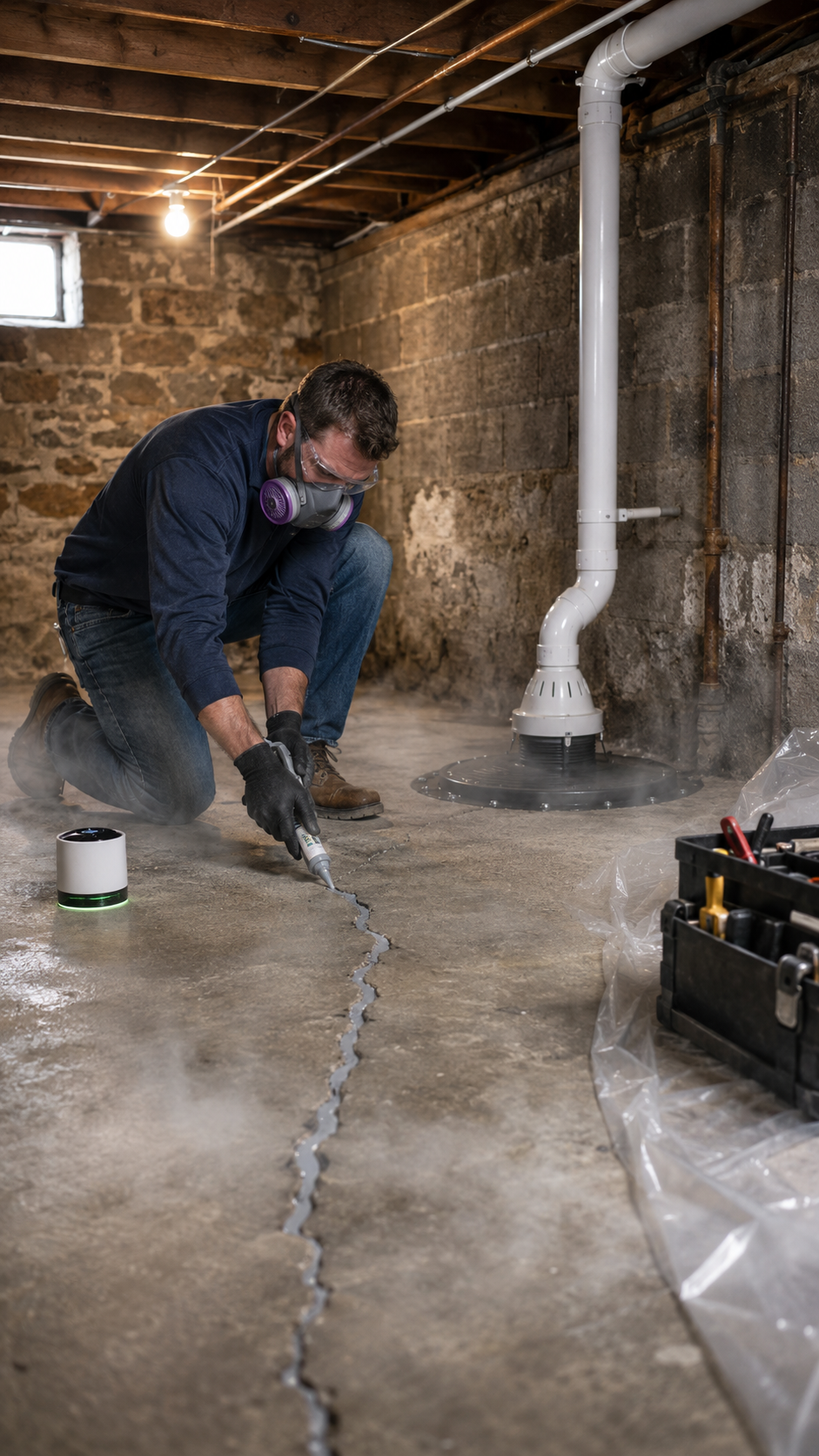
A contractor creates one or more suction points through the concrete slab. A pipe and continuously operating fan draw soil gas from beneath the house and vent it safely outdoors above the building. By creating lower pressure beneath the slab, the system intercepts radon before it enters the occupied space.
Depending on the foundation, a contractor may instead use or combine:
Drain-tile suction
Sump-hole suction
Block-wall suction
Submembrane depressurization in a crawl space
Additional suction points for separate foundation sections
Older houses sometimes have mixed foundations, such as a full basement under one section and a crawl space or slab under an addition. These homes may need more than one technique or suction zone.
A qualified contractor should inspect the foundation, review the test results, evaluate air movement beneath the slab, and provide a written proposal. The system should comply with applicable state and local requirements and recognized radon mitigation standards.
Why Sealing Cracks Is Not Enough
Sealing visible cracks, floor-wall joints, utility penetrations, and sump openings can support a radon mitigation system. It may reduce air leakage, improve the efficiency of soil depressurization, and make finished surfaces easier to maintain.
However, sealing alone is generally not considered a dependable solution for an elevated radon problem. Hidden cracks can remain behind walls or beneath flooring, sealants can deteriorate, and new gaps may appear as the structure moves. EPA guidance favors methods that prevent radon from entering, particularly soil suction, rather than relying only on surface sealing.
Opening windows may temporarily lower the concentration by diluting indoor air, but natural ventilation is not a permanent mitigation strategy. Radon levels can rise again as soon as windows are closed, and leaving a basement open year-round is rarely practical.
How to Incorporate Radon Safety Into a Basement Remodel
Treat radon as part of the original construction plan, not as a problem to address after the furniture arrives.
Coordinate the Contractors
The remodeling contractor, plumber, electrician, HVAC contractor, waterproofing company, and radon professional should know about one another’s work.
A plumber cutting a new bathroom drain through the slab may affect a suction field. A waterproofing crew may modify the drain tile or sump. A carpenter may unintentionally box in a radon system monitor, and an electrician may disconnect a fan circuit without realizing that it must operate continuously.
Discuss these interactions before demolition begins.
Preserve Access to Important Components
Do not permanently bury sump covers, system monitors, cleanouts, junction boxes, or pipe connections behind drywall and built-in cabinets.
A sump cover used as part of a mitigation system should remain sealed but accessible for pump service. Any viewing port, warning device, or pressure gauge should remain visible so occupants can recognize a system failure.
Protect the Vent Pipe and Fan
Radon vent piping should not be cut, reduced, repurposed, or tied into plumbing, dryer, bathroom, or furnace exhaust. The radon fan must be installed in an appropriate unoccupied location, such as outside the living area or in an attic, depending on the system design and applicable standards.
If an existing pipe must be moved to accommodate the new floor plan, have a radon professional redesign that section rather than asking a general remodeler to reroute it casually.
Plan for Crawl Spaces and Sumps
A dirt crawl space may require a durable membrane sealed over the soil and connected to a depressurization system. Sump pits may need airtight, serviceable covers that accommodate electrical wiring and discharge piping.
These details are easier to install before flooring, finished walls, or permanent storage systems restrict access.
Consider Future Occupancy
Test and design for how the basement will actually be used. A workshop visited once a week is different from a child’s bedroom, rental unit, or home office occupied eight hours a day.
Finishing a lower level increases the amount of time people spend close to the radon source. Even when the original reading was taken elsewhere in the house, the newly occupied basement deserves its own appropriate assessment.
Test Again After Remodeling
A pre-renovation result cannot confirm that the finished basement is safe. Test again after the construction work is complete and the house has returned to normal operating conditions.
Retesting is important even when:
The original result was below 4 pCi/L
Foundation cracks were sealed
A mitigation system was installed
The basement was previously tested
The contractor used radon-resistant materials
No obvious foundation damage occurred
EPA and CDC guidance specifically recommends retesting after remodeling because building changes may affect radon levels. A post-mitigation test is also necessary to verify that the system actually reduced the concentration.
Continue monitoring after the project. EPA recommends checking the system’s warning device regularly and retesting at least every two years to confirm that levels remain low. Retest sooner if the fan fails, the foundation is altered, drainage work is performed, or the basement’s use changes.
Common Basement Radon Remodeling Mistakes
One common mistake is assuming that a drafty old basement cannot trap radon. Another is relying on a neighbor’s result or a regional map rather than testing the house itself.
Homeowners also make problems harder to fix when they install expensive flooring before testing, frame directly over major foundation cracks, hide the sump beneath permanent cabinetry, or disconnect an existing mitigation fan because it is noisy.
Other mistakes include using a consumer radon monitor during active demolition and treating the unstable reading as a final result, testing beside an open window, or assuming that waterproofing automatically controls radon.
Moisture control, waterproofing, energy efficiency, and radon reduction may complement one another, but they are not interchangeable. Each concern requires its own assessment.
Frequently Asked Questions
Is radon always highest in the basement?
Radon levels are often higher in basements and lower floors because these areas are closest to the soil, but the pattern is not identical in every house. Air movement, HVAC operation, foundation design, and pressure differences can distribute radon to upper floors. Test the lowest regularly usable level and consider additional testing when occupancy patterns require it.
Can a dehumidifier remove radon?
A standard dehumidifier removes moisture from the air but is not designed to remove radon gas. It may improve comfort and help control dampness, but it should not replace testing or a professionally designed mitigation system.
Will finishing the basement seal radon out?
Drywall, laminate flooring, carpet, and paint are not reliable radon barriers. Radon can enter through hidden openings and move through wall and floor cavities. A finished appearance does not reveal the air’s radon concentration.
Does a radon mitigation system need to run all the time?
Active soil-depressurization systems generally depend on a continuously operating fan. Turning the fan off can allow radon levels to rise again. Check the system indicator regularly and contact a qualified professional if the warning device changes or the fan stops.
Should I test a basement that is only used for storage?
Yes. Testing provides useful information about the home, and the basement may later become a workshop, office, bedroom, or recreation area. Testing is especially important before changing an unfinished area into regularly occupied living space.
Final Thoughts
Basement radon is manageable, but it cannot be judged by smell, appearance, home age, or the quality of a renovation. Test the lowest potentially occupied level before work begins, involve a qualified radon professional when results are elevated, protect mitigation components during construction, and test again after the basement is finished.
Planning early may prevent newly installed walls and floors from being opened later. More importantly, it helps ensure that a beautiful new living space does not quietly increase your family’s long-term exposure to a preventable lung cancer risk.
Have you tested an older basement before or after remodeling? Share your radon result, the type of foundation you have, or any challenges you encountered during mitigation in the comments. Your experience could help another homeowner ask the right questions before beginning a basement renovation.
Hi, I’m the creator and editor behind ZestyHabit. I research everyday safety, first aid, and practical wellness topics using official guidance and reliable public sources, then turn that information into clear, realistic steps for daily life.
My goal is to help readers make safer, better-informed choices at home and beyond.