Slippery Fish Fillet Knives: How to Prevent Fishing Injuries and Handle a Cut
Minjin Park
·
A slippery fish and a sharp fillet knife can cause a serious hand injury. Learn safer fish-cleaning techniques, first aid for cuts, infection warning signs, and when to seek medical care.
Cleaning a freshly caught fish can be one of the most satisfying parts of a successful fishing trip. It can also be one of the most dangerous.
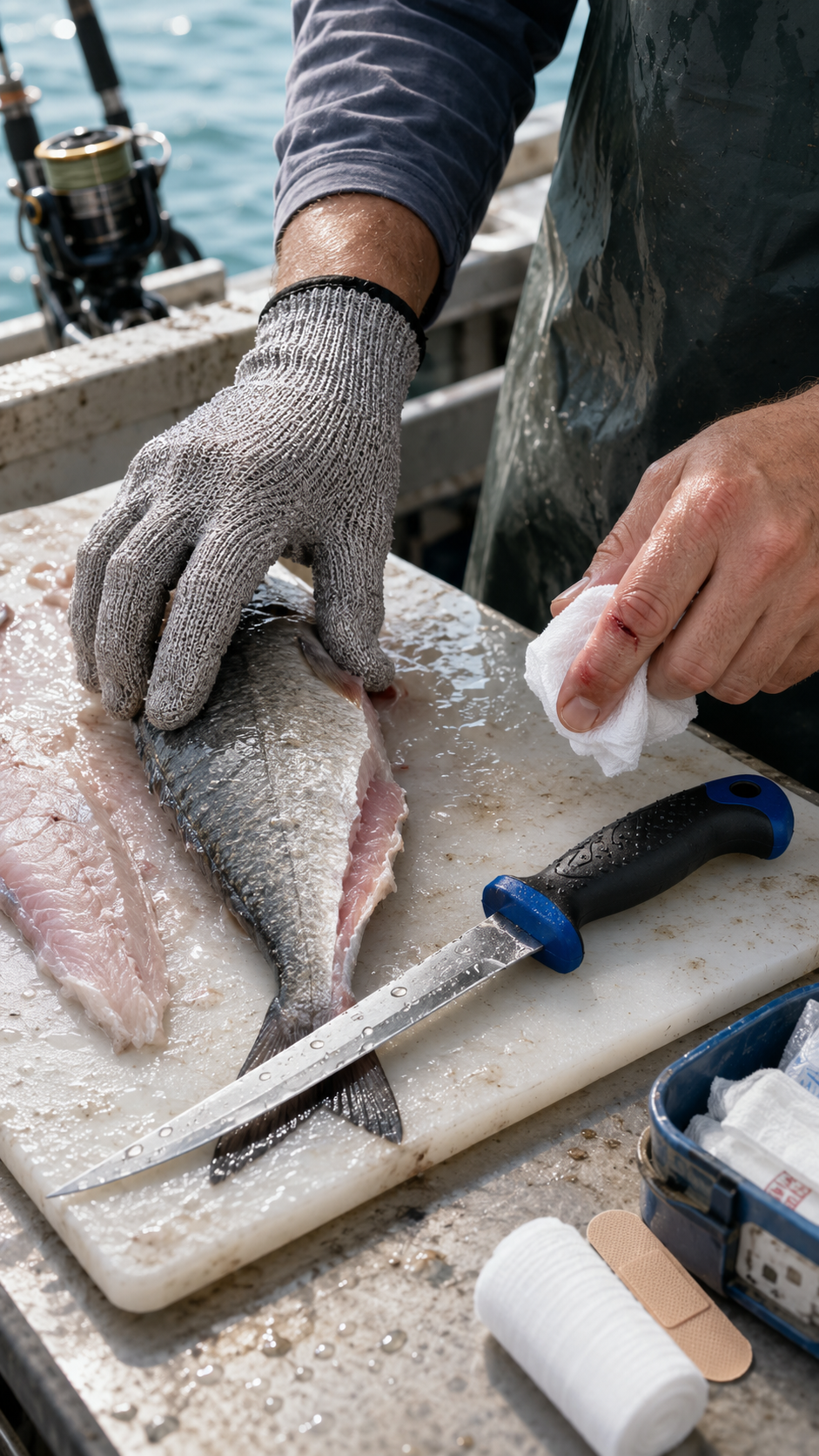
Fish slime, blood, water, bait residue, and a moving boat can create the perfect conditions for a knife to slip. The blade may be extremely sharp, the fish may suddenly move, and the hand holding it is often positioned only inches from the cutting path.
A small mistake can cause a deep cut to a finger, palm, wrist, or forearm. In addition to bleeding, a fishing-related knife wound may damage a tendon, nerve, blood vessel, or joint. If the wound comes into contact with raw seafood, saltwater, or brackish water, infection becomes another serious concern.
Fortunately, most fillet-knife injuries are preventable. The key is to treat fish cleaning as a controlled cutting task—not something to rush through on a wet dock, unstable cooler, or rocking boat.
A fillet knife is designed to be thin, sharp, and flexible. These qualities allow the blade to follow bones and remove skin without wasting meat. They also mean that the knife can move quickly and deeply when control is lost.
Several hazards often occur at the same time:
The fish is covered in slippery mucus.
The user’s hands are wet or bloody.
The cutting board moves across the work surface.
The knife handle becomes coated with fish residue.
The fish is still alive and suddenly struggles.
The person uses excessive force because the knife is dull.
The boat, dock, or shoreline surface is uneven.
Other people stand too close to the cutting area.
Commercial fishing safety research notes that decks can become dangerously slippery because of water, ice, oils, and fish or shellfish tissues and fluids. Although recreational anglers work on a smaller scale, the same combination of contaminants can make footing and knife control less predictable.
A person may focus so closely on following the backbone or removing a fillet that they stop noticing where the supporting hand, legs, or other people are positioned. When the blade breaks through a tough section unexpectedly, it continues moving into whatever lies beyond the fish.
A Sharp Knife Is Usually Safer Than a Dull One
It may sound logical to use a dull knife because it seems less capable of causing a severe cut. In practice, a dull fillet knife often requires more pressure and is more likely to skid off scales, bones, or tough skin.
OSHA recommends keeping knives sharp and in good condition because dull blades tend to slip. It also advises directing every cut away from the body and keeping fingers and thumbs outside the cutting line.
A safe fillet knife should:
Be sharp enough to cut without excessive force
Be the correct size and flexibility for the fish
Have a secure, nonslip handle
Be free of cracks, loose parts, or corrosion
Fit inside a protective sheath when not in use
Do not continue using a knife if the handle twists, the blade feels loose, or the grip becomes difficult to hold securely. Stop, clean the handle, dry your hands, and correct the problem before making another cut.
Sharpen knives before the trip or at a stable workstation. Trying to sharpen a blade while standing on a wet deck or holding equipment against your body creates another opportunity for injury.
Stabilize the Fish Before Cutting
Never attempt to fillet a fish while holding it in the air, balancing it across your knee, or pinning it against an unstable cooler lid.
Place the fish on a flat, solid cutting surface. State conservation and extension guidance for fish preparation recommends using a flat work surface or cutting board with a clean, sharp fillet knife.
The board should not slide when pressure is applied. On land, placing a damp towel or nonslip mat underneath the board can help keep it from moving. Cutting-safety guidance similarly recommends stabilizing both the object and the cutting surface and keeping hands and legs clear of the blade’s travel path.
On a boat, wait until conditions are calm whenever possible. Do not clean fish while the vessel is accelerating, turning sharply, crossing a wake, or operating in rough water. One unexpected movement can throw your weight forward while the blade is exposed.
A freshly caught fish may continue to twitch or thrash. Handle it carefully and wait until it can be positioned securely. Use a fish gripper, towel, or other suitable tool when necessary rather than trying to overpower a slippery fish with your bare hand.
Use a Cut-Resistant Glove Correctly
A properly fitted cut-resistant glove can provide an extra layer of protection for the hand holding the fish. Steel-mesh, Kevlar, and other purpose-designed gloves are used in food-processing environments where workers handle knives and slippery products. OSHA recognizes cut-resistant hand protection as a possible control when hands are exposed to laceration hazards.
The glove should normally be worn on the nondominant hand—the hand that holds or stabilizes the fish. It should fit closely enough that loose material cannot catch on fins, bones, or the knife.
However, a cut-resistant glove is not cut-proof. It cannot make an unsafe direction of cutting acceptable, and not every glove protects against punctures from a knife tip or sharp fish spine.
Some gloves also become difficult to grip when coated with slime. Choose a design with a gripping surface suitable for wet work and replace it if it becomes torn, stretched, or damaged. Aquaculture safety guidance emphasizes selecting the correct glove size and a gripping surface when handling slippery objects.
For food hygiene, clean reusable gloves according to the manufacturer’s instructions. If the glove material is absorbent or difficult to sanitize, consider wearing an appropriate waterproof outer glove where practical.
Always Cut Away From Your Body
Before every cut, imagine where the knife will travel if it suddenly passes through the fish.
No part of your body should be in that path.
Do not pull the blade toward your palm, stomach, thigh, or supporting hand. Reposition the fish or your body so the knife can move away from you. Keep your free hand behind the blade rather than in front of it.
Use short, controlled strokes. Long, forceful sawing motions increase the distance the knife travels when it slips. Let the sharpness and flexibility of the blade do the work instead of forcing it through bones.
When removing skin, keep the fillet flat on the board. Hold the skin from a protected position and angle the knife almost parallel to the cutting surface. If the skin starts to tear or the blade stops moving smoothly, pause and reset instead of applying more force.
Do not use a fillet knife as a screwdriver, pry bar, can opener, or tool for cutting heavy bones. Use sturdy kitchen shears, pliers, or a knife designed for the specific task.
Keep the Work Area Organized
A cluttered cleaning station makes it easier to reach across an exposed blade, knock the knife onto the ground, or lose track of where it was placed.
Before starting, prepare:
A stable cutting board
A sharp fillet knife with a sheath
A cut-resistant glove
Clean water
Soap or hand-cleaning supplies
Paper towels or clean cloths
A container for waste
Ice and a clean container for the fish
A stocked first-aid kit
Set the knife down in the same designated place whenever it leaves your hand. Do not leave it hidden under fish, towels, bait, or packaging.
Never place a knife in a sink or bucket filled with water where someone may reach in without seeing it. OSHA specifically advises against storing knives in sinks and recommends using a designated holder or storage area with the cutting edge covered.
If a knife falls, step back and let it fall. Trying to catch it can turn a minor equipment mishap into a severe hand injury.
When passing a knife to another person, place it on a stable surface and allow that person to pick it up. Avoid transferring it directly from hand to hand on a moving boat.
Avoid Cleaning Fish When Distracted or Impaired
Filleting requires full attention. Stop cutting when someone speaks to you, the boat changes direction, a child approaches, or another fish begins moving nearby.
Alcohol and recreational drugs can affect coordination, judgment, and reaction time. Fatigue, cold hands, dehydration, and rushing at the end of a long fishing day can also make precise knife control more difficult.
Turn off or sheath the blade before taking photographs, answering a phone, adjusting fishing gear, or moving to another part of the boat.
Children should not stand within reach of the knife or cutting path. Beginners should learn under close supervision in a stable environment, not for the first time on a crowded or moving vessel.
What to Do Immediately After a Fillet-Knife Cut
Put the knife down safely before touching the wound. Make sure the boat or surrounding area is secure so that the injured person does not fall into the water.
Control the bleeding
Use clean gauze, a dressing, or the cleanest available cloth and apply firm, continuous pressure directly over the wound.
Do not repeatedly lift the dressing to check whether the bleeding has stopped. Maintain pressure long enough for clotting to occur. If blood soaks through, continue direct pressure while arranging medical help.
The American Red Cross recommends immediate direct pressure for severe external bleeding. Bleeding that flows continuously, spurts, or is accompanied by signs of shock requires emergency medical treatment. A tourniquet may be appropriate for life-threatening bleeding from an arm or leg when one is available and the rescuer is trained to use it.
Call emergency services immediately when bleeding is severe or cannot be controlled. On a boat, notify the operator and begin heading toward the nearest safe location for emergency access.
Remove rings and tight items
Take off rings, bracelets, watches, or tight gloves from the injured hand before swelling increases. Do not force an item off if doing so worsens bleeding or causes significant pain.
Rinse a minor wound after bleeding is controlled
Once serious bleeding is controlled, rinse a minor cut with clean running water. Remove visible dirt or fish residue that can be washed away easily.
Do not dig deeply into the wound or attempt to remove an embedded hook, knife fragment, fish spine, or other object. Stabilize the object and seek professional medical care.
Do not pour harsh chemicals, fuel, concentrated bleach, or other damaging substances into the wound. Clean water and appropriate wound care are safer than improvised disinfectants that may injure tissue.
Cover the cut
Apply a clean sterile dressing and keep the wound protected. A waterproof covering may be useful until the person is away from seawater, raw seafood, and contaminated surfaces.
Do not return to fish cleaning with an open cut. The wound may reopen, and additional exposure to fish fluids or coastal water can introduce harmful bacteria.
The Special Risk of Seawater and Raw Seafood
A cut made while cleaning fish may be exposed immediately to fish slime, raw seafood juices, saltwater, or brackish water. These exposures can introduce bacteria that are not typical of an ordinary household cut.
Vibrio bacteria naturally live in coastal waters. The CDC warns that open wounds can become infected after contact with saltwater, brackish water, raw seafood, or seafood juices and drippings. It recommends washing exposed cuts thoroughly with soap and clean running water and keeping open wounds away from coastal water whenever possible.
One species, Vibrio vulnificus, can cause rapidly progressive and life-threatening wound infections. People with liver disease, diabetes, immune suppression, or certain other underlying conditions may face a greater risk of severe illness. Some infections require intensive care or surgery, and CDC data indicate that approximately one in five people with Vibrio vulnificus infection die.
This does not mean that every small fishing cut will become infected. It does mean that a saltwater-exposed wound should be cleaned promptly and watched carefully.
Tell the healthcare provider clearly that the cut occurred while handling raw fish and whether it was exposed to saltwater or brackish water. That information may affect testing and treatment decisions.
Warning Signs of a Wound Infection
Check the wound regularly over the next several days.
Seek prompt medical care for:
Increasing redness or discoloration
Rapidly worsening pain
Swelling or warmth
Pus or cloudy drainage
Red streaks extending from the cut
Fever or chills
Blisters near the wound
Skin that becomes purple, dark, or unusually pale
Numbness or increasing weakness
A bad odor
Pain that seems much worse than the wound’s appearance
CDC guidance identifies fever, redness, pain, swelling, warmth, discoloration, and wound discharge as possible signs of a Vibrio wound infection. Because serious Vibrio infections can progress quickly, clinicians are advised not to delay treatment when the condition is suspected.
People with liver disease or weakened immune systems should seek medical advice promptly after a significant wound exposed to coastal water or raw seafood, even before obvious infection develops.
When a Knife Cut Needs Medical Care
Get urgent medical evaluation when:
Bleeding does not stop with firm pressure
Blood is spurting or flowing heavily
The cut is deep, wide, or gaping
Fat, tendon, bone, or another deep structure is visible
The wound crosses a finger joint, wrist, or palm crease
A finger cannot bend or straighten normally
There is numbness, tingling, weakness, or loss of sensation
The finger becomes pale, blue, or cold
A foreign object remains inside the wound
The wound was heavily contaminated by fish tissue or coastal water
Signs of infection develop
The injured person has diabetes, liver disease, poor circulation, or immune suppression
Hand injuries can look deceptively small while damaging a tendon or nerve beneath the skin. A person who cannot move a finger normally after a cut should not assume that swelling is the only reason.
Check Your Tetanus Vaccination Status
Tetanus bacteria can enter the body through broken skin. The need for a booster depends on the type of wound and the person’s vaccination history.
Current CDC guidance recommends vaccination for people with an unknown or incomplete tetanus vaccination history. For someone who completed the primary series, a booster may be recommended if the last dose was at least 10 years ago for a clean, minor wound or at least five years ago for a dirty or major wound.
A clinician should make the final decision, particularly when the cut is deep, contaminated, or contains damaged tissue. Antibiotics should not be used solely to prevent tetanus; appropriate wound care and vaccination are the primary preventive measures.
Build a Fishing-Specific First-Aid Kit
A basic household kit may not be enough when fishing far from shore or road access.
Consider carrying:
Sterile gauze pads
Roller bandages
Adhesive dressings
Medical tape
Disposable gloves
Antiseptic wipes for surrounding skin
Clean irrigation water
Trauma shears
A commercially made tourniquet
A waterproof emergency blanket
Emergency contact information
A charged phone or marine communication device
First-aid supplies are most useful when you know how to use them. Taking a certified first-aid and severe-bleeding course can help anglers respond more confidently when professional medical care is not immediately nearby.
The Bottom Line
A fillet knife should be sharp enough to cut smoothly, but the fish, cutting board, hands, and surrounding area must be kept as stable and controlled as possible. Use a nonslip surface, wear suitable hand protection, keep every cut directed away from the body, and stop working whenever the boat moves or your attention is interrupted.
If a cut occurs, put the knife down, control serious bleeding with direct pressure, rinse minor wounds with clean water, and keep the injury away from fish fluids and coastal water. Seek medical care for deep wounds, uncontrolled bleeding, impaired finger movement, numbness, or any sign of infection.
Have you ever had a fillet knife slip while cleaning a catch, or have you developed a safety routine that makes fish preparation easier? Share your experience and best fishing-knife safety tip in the comments—your advice could help another angler prevent a painful trip to the emergency room.
Hi, I’m the creator and editor behind ZestyHabit. I research everyday safety, first aid, and practical wellness topics using official guidance and reliable public sources, then turn that information into clear, realistic steps for daily life.
My goal is to help readers make safer, better-informed choices at home and beyond.