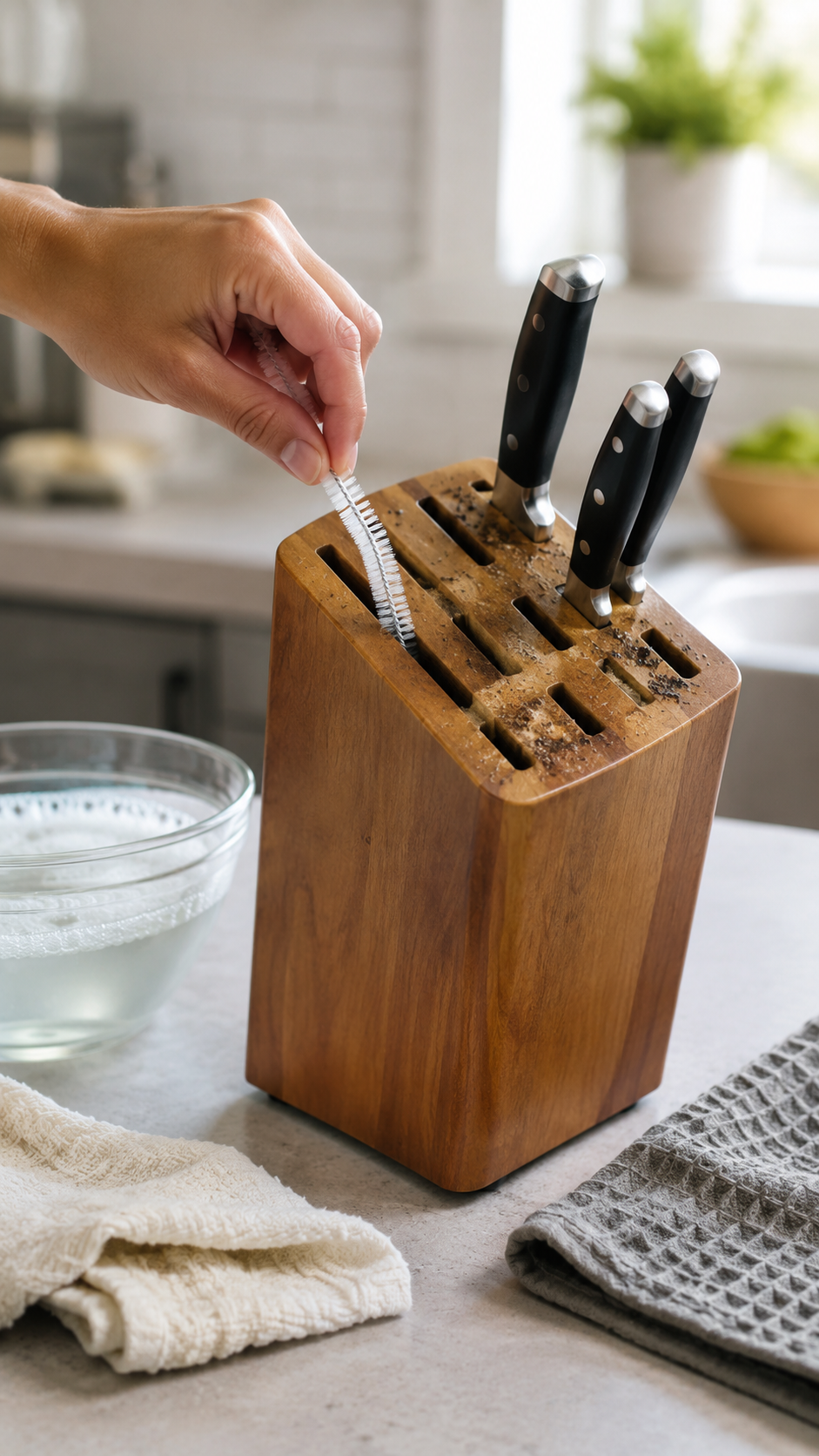
Is Your Knife Block Really Clean? Hidden Germs and the Right Way to Sanitize It
Minjin Park
·
Is your knife block hiding bacteria, yeast, or mold? Learn where germs collect, how to clean and sanitize each slot safely, and when to replace the block.
A knife block looks like one of the cleanest objects in the kitchen. After all, it does not directly hold food, collect dirty dishes, or sit inside the sink. Most people simply wash a knife, slide it back into its slot, and forget about the block itself.
Unfortunately, those narrow, dark slots can collect more than knives.
Tiny crumbs, grease, dust, moisture, and food residue may fall into a knife block over time. If a knife is stored while it is still damp—or placed back without being washed properly—the enclosed space can become an inviting environment for yeast, mold, and bacteria.
This does not mean every knife block is dangerously contaminated. A well-maintained block holding clean, completely dry knives is generally low-risk. The problem is that the interior is difficult to see, difficult to reach, and easy to overlook during routine kitchen cleaning.
Here is how knife blocks become contaminated, how often they should be cleaned, and the safest way to clean and sanitize them without damaging the material.
A knife block is designed to protect sharp blades and keep them organized. Its enclosed construction, however, also creates several cleaning challenges.
Most traditional blocks contain deep slots with limited airflow. Once dirt or moisture enters, it may remain trapped where an ordinary sponge or cloth cannot reach it.
Common sources of contamination include:
Knives stored before they are fully dry
Blades returned without being washed
Food particles left near the handle or bolster
Crumbs falling from a nearby toaster or cutting board
Grease and cooking residue settling on the surface
Dirty hands touching the block
Water splashed from the sink
Raw meat or poultry juices transferred during food preparation
Dust, pet hair, or insects entering open slots
Even a clean-looking blade can carry moisture along its edge. When that moisture is pushed deep into a narrow wooden slot, it may take a long time to evaporate.
The National Sanitation Foundation’s kitchen germ study detected yeast and mold in knife blocks from participating homes. The organization identified the dark, potentially damp interior as an area that is commonly neglected during kitchen cleaning.
Where Do Germs Hide in a Knife Block?
The most obvious hiding places are the blade slots, but they are not the only areas that deserve attention.
Deep inside the slots
The deepest part of each slot receives very little light and airflow. Crumbs and residue can settle at the bottom, while moisture may remain along the walls.
Because you cannot see these surfaces, contamination may continue unnoticed until the block develops an odor or visible mold appears near an opening.
Around the slot openings
The edges surrounding each slot frequently touch knife handles, fingers, and the upper part of the blade. Grease and skin oils can gradually form a sticky layer that attracts dust.
The bottom of the block
The underside may trap water when the block sits near a sink. Rubber feet, seams, and recessed areas can collect grime or develop mold if the counter remains damp.
Cracks and joints
Wooden blocks may develop small cracks as they age or experience changes in humidity. Glued joints and decorative seams can also hold food residue and moisture.
Removable bristle inserts
Universal knife blocks often use flexible plastic rods or bristles instead of fixed slots. These inserts may collect crumbs and grease between hundreds of narrow strands. They can be easier to remove than traditional slots, but only if they are actually taken out and washed.
Can a Dirty Knife Block Recontaminate a Clean Knife?
Yes, it is possible.
A freshly washed knife may rub against residue inside its slot. If the interior contains moisture, mold, or bacteria, the blade can pick up some of that contamination before its next use.
The risk is greater when the knife will be used on ready-to-eat foods such as:
Bread
Cheese
Fresh fruit
Salad vegetables
Cooked meat
Sandwich ingredients
These foods may not receive additional cooking that could reduce microbial contamination.
However, the knife block is only one part of the food-safety chain. The most important preventive habit is to wash every knife thoroughly after use and allow it to dry completely before storage.
Cleaning, Sanitizing, and Disinfecting Are Different
These terms are often used interchangeably, but they describe different processes.
Cleaning uses soap, water, and physical scrubbing to remove grease, crumbs, dirt, and some germs.
Sanitizing reduces the number of germs to levels considered safer for food-contact items.
Disinfecting uses chemicals or other methods to kill a broader range of remaining microorganisms. A stronger disinfectant may be appropriate after known contamination, but it must be approved for the surface and used according to its label.
Always clean first. Grease and visible debris can prevent a sanitizer from reaching the surface effectively. As the USDA explains, sanitizing works best after dirt has been removed.
How Often Should You Clean a Knife Block?
The outside of the block should be wiped whenever it becomes dusty, greasy, or splashed with food.
For a block used regularly, a thorough interior cleaning approximately once a month is a reasonable routine. Clean it immediately rather than waiting for the monthly schedule if:
A dirty knife was inserted
Raw meat juice may have touched it
Water was spilled into the slots
You see crumbs or insects
The block smells musty
Mold is visible
A knife was stored while wet
The kitchen recently had a pest problem
A block used only occasionally may not need deep cleaning as frequently, but it should still be inspected periodically.
What You Need to Clean a Knife Block
Gather the supplies before beginning so the block does not remain wet longer than necessary.
You may need:
Mild dish soap
Warm or hot water
A clean microfiber cloth
A small bottle brush or baby-bottle nipple brush
Narrow reusable straw brushes
Clean pipe cleaners intended for household cleaning
A vacuum with a narrow crevice attachment
A food-contact-safe sanitizer
Clean paper towels
Protective gloves if required by the sanitizer label
Check the block manufacturer’s care instructions before applying water or chemicals. Wood, bamboo, plastic, stainless steel, and composite blocks may require different treatment.
How to Clean a Traditional Wooden Knife Block
Wooden blocks require care because prolonged soaking may cause swelling, splitting, or warping.
Step 1: Remove every knife
Place the knives somewhere safe where the blades cannot fall or be touched accidentally. Do not leave sharp knives loose in a sink full of water.
Wash each knife separately with dish soap and warm water. Pay attention to the area where the blade meets the handle. Rinse and leave the knives to air-dry completely.
Step 2: Remove loose debris
Turn the empty block upside down over a trash can and shake it gently. Tap the sides with your hand to loosen crumbs.
A vacuum with a narrow attachment can remove additional dust from the openings. Avoid inserting a metal tool or knife into the slots because it can damage the wood or cause an injury.
Compressed air is sometimes recommended, but it may blow contaminated dust around the kitchen. If you use it, take the empty block outdoors and direct the openings away from your face.
Step 3: Wash the exterior
Dip a cloth in warm, soapy water and wring it out well. Wipe the top, sides, underside, feet, and areas around the slot openings.
Do not saturate unfinished wood. Use enough moisture to remove grime without allowing water to pool on the surface.
Step 4: Scrub the slots
Dip a narrow brush into warm, soapy water, then shake off excess liquid. Insert it carefully into each slot and scrub the interior walls.
Choose a brush long enough to reach the bottom but not so thick that it becomes stuck. Clean the brush between slots if it picks up visible residue.
If the manufacturer says the block can be fully washed, you may rinse the slots with clean water. If soaking is prohibited, use a clean damp brush or cloth to remove the soap with as little water as practical.
Step 5: Sanitize correctly
Use a sanitizer specifically labeled as suitable for food-contact surfaces and compatible with the block’s material. Follow its dilution, contact-time, ventilation, and rinsing directions exactly.
Household bleach varies in concentration, so the product label should be your primary guide. Use only regular, unscented bleach when a bleach solution is appropriate. Never use splashless, scented, or gel bleach unless the product specifically allows it for this purpose.
The NSF’s knife-block guidance describes filling cleaned slots with an appropriately diluted bleach solution, allowing one minute of contact, rinsing thoroughly, and air-drying the block upside down. However, full immersion or saturation may damage some wooden blocks. Follow the block manufacturer’s care instructions and use a compatible food-contact sanitizer if soaking is not permitted.
Step 6: Dry it completely
Turn the block upside down on a clean rack or unused paper towels so water can drain out of the slots.
Leave it in a well-ventilated area for at least 12 to 24 hours, or longer if the slots still feel damp. A fan can improve airflow, but do not use an oven, microwave, hair dryer on high heat, or direct heater. Excessive heat can split wood, weaken glue, or create a fire risk.
Never return knives to a damp block.
How to Clean Plastic or Composite Knife Blocks
Plastic and composite blocks may tolerate water better than wood, but they should still be cleaned according to the manufacturer’s instructions.
Remove loose debris, wash the slots with hot soapy water and a narrow brush, rinse, and apply an approved food-contact sanitizer.
Some models are dishwasher-safe, while others may warp under high heat. Do not assume that a plastic block can go into the dishwasher unless its care instructions specifically say so.
Air-dry the block upside down until every slot is completely dry.
How to Clean a Universal Bristle Knife Block
A universal block holds knives between flexible rods rather than inside fixed wooden slots.
For this type:
Remove all knives.
Pull out the bristle insert if it is removable.
Shake or vacuum crumbs from the outer container.
Wash the container with warm soapy water.
Separate and agitate the bristles while washing the insert.
Rinse thoroughly.
Sanitize according to the manufacturer’s directions.
Let both components air-dry completely before reassembly.
Some bristle inserts are dishwasher-safe, making them easier to sanitize. High heat can deform other inserts, so verify the instructions first.
Replace the insert if the rods remain greasy, develop mold, become bent, or cannot be cleaned adequately.
What About Magnetic Knife Strips?
A wall-mounted magnetic strip is generally easier to inspect and clean because it does not contain enclosed slots.
Remove the knives carefully, wash them, and wipe the strip with warm soapy water. Apply a compatible sanitizer if needed, then dry the strip completely to reduce the risk of rust or damage.
Do not spray cleaning solution directly onto a strip with wooden components, seams, or mounting hardware. Apply the product to a cloth instead.
When replacing the knives, bring the spine toward the magnet first rather than striking the sharp edge against it.
Can You Use Vinegar to Sanitize a Knife Block?
Vinegar may help remove odors or mineral deposits, but it should not automatically be treated as a reliable substitute for an approved sanitizer.
Its antimicrobial effect varies with concentration, contact time, surface type, and the microorganisms present. A quick spray of kitchen vinegar does not guarantee adequate sanitization.
If you use vinegar for routine cleaning, do not mix it with bleach. Combining bleach with acids such as vinegar can release dangerous chlorine gas.
Likewise, never mix bleach with ammonia, rubbing alcohol, or other cleaners. Use one product at a time and follow its label.
Can You Put a Wooden Knife Block in the Dishwasher?
Usually not.
Dishwashers expose items to prolonged water, strong detergent, and high heat. A solid wooden block may swell, crack, warp, or separate at glued joints. Water can also remain trapped deep inside the slots.
A removable plastic insert may be dishwasher-safe even when its outer wooden container is not. Check the instructions for each component separately.
Do not place raw-meat knives back between cutting tasks
Clean the counter beneath the block
Avoid positioning it beside a toaster or bread-cutting area
Inspect slots for crumbs, insects, moisture, and odors
Deep-clean the block regularly
Knives should not be washed loosely in a crowded dishwasher unless their manufacturer permits it. Dishwasher cleaning can damage handles and dull blade edges, while hidden blades can also create an injury risk.
When Should You Replace a Knife Block?
Cleaning is not always enough. Replace the block if:
Mold remains after proper cleaning
A musty odor returns after drying
The wood has deep cracks
Slots are swollen or splintered
There is evidence of insects inside
Raw meat liquid entered an area that cannot be reached
The block cannot dry completely
The finish is peeling or deteriorating
Knives no longer fit securely
Attempting to save a badly contaminated or damaged block may not be worth the risk. A washable in-drawer tray, removable bristle block, or magnetic strip may be easier to maintain.
Final Thoughts
A knife block is not automatically unhygienic, but it should not be treated as permanent furniture that never needs cleaning. Its narrow, dark slots can trap crumbs, grease, and moisture, especially when knives are returned while dirty or damp. Remove loose debris, wash with hot soapy water, sanitize with a food-contact-safe product, and allow the block to dry completely before replacing the knives. Most importantly, never place an unwashed or wet blade into storage.
When was the last time you cleaned inside your knife block—and what did you find when you turned it upside down? Share your cleaning routine or preferred knife-storage method in the comments so other readers can compare ideas.
Hi, I’m the creator and editor behind ZestyHabit. I research everyday safety, first aid, and practical wellness topics using official guidance and reliable public sources, then turn that information into clear, realistic steps for daily life.
My goal is to help readers make safer, better-informed choices at home and beyond.