
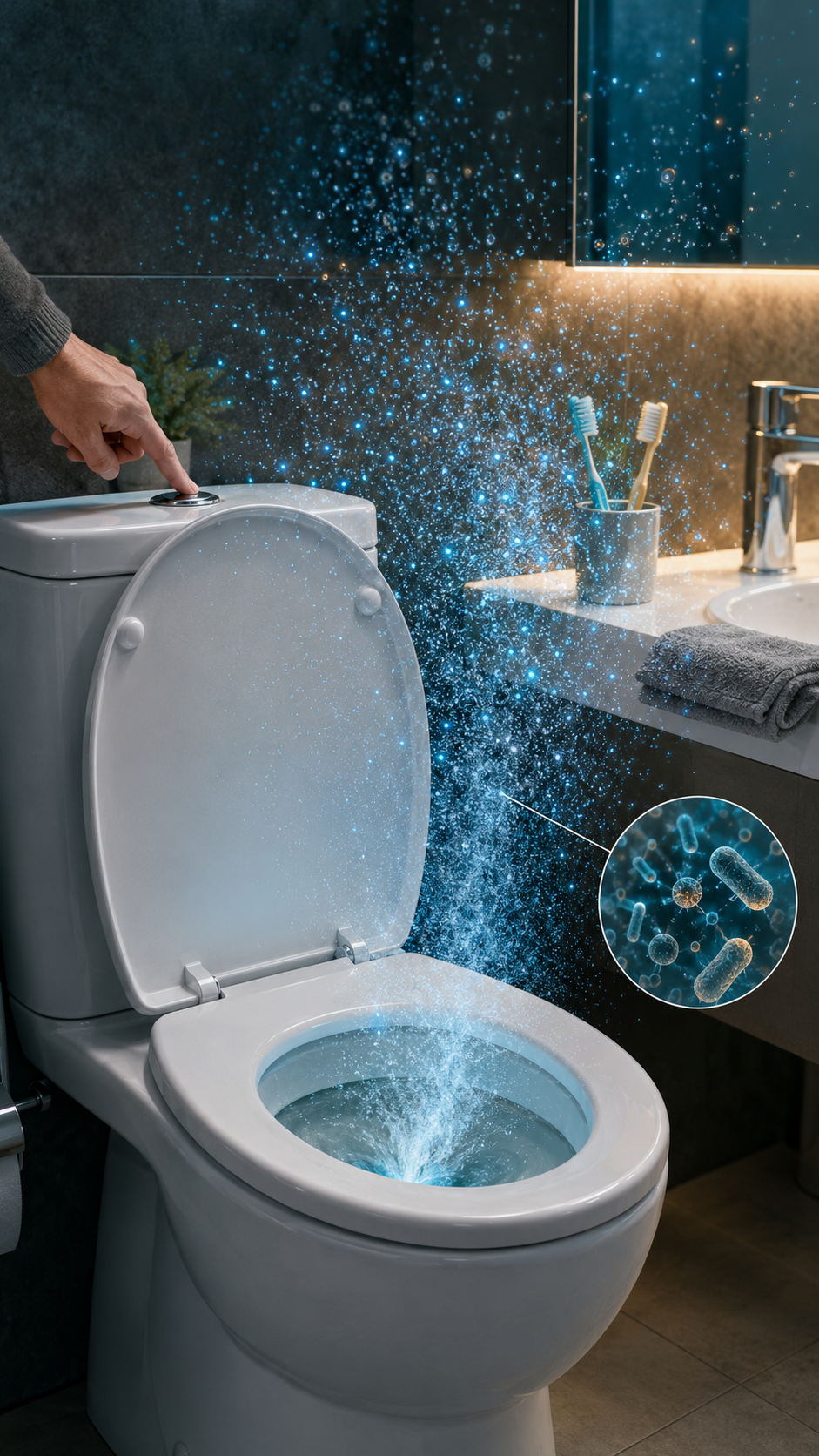

Flushing the toilet feels like the final step in using the bathroom. You press the handle, wash your hands, and move on with your day. But if you flush without closing the lid, the process may release tiny droplets and particles into the surrounding air.
This phenomenon is commonly called a toilet plume. It has inspired plenty of alarming headlines, including claims that every open-lid flush covers toothbrushes and towels with dangerous bacteria. The reality is more complicated.
Laboratory studies clearly show that flushing can send droplets and aerosols above the toilet bowl. Some of those particles may contain microorganisms if the bowl water is contaminated. However, detecting particles or bacteria in a laboratory does not automatically mean that a person will become ill after using a normal household bathroom.
So, is flushing with the toilet lid open a serious health hazard, a harmless habit, or something in between? Here is what the evidence says—and what you can realistically do about it.
What Is a Toilet Plume?
A toilet flush uses fast-moving water to remove waste from the bowl. As the water swirls, splashes, and changes direction, it transfers energy to the air above the water. This process can produce a mixture of visible droplets and much smaller aerosols.
Larger droplets usually settle on nearby surfaces relatively quickly. Smaller particles can travel higher and remain suspended for longer, depending on their size, the toilet’s design, the strength of the flush, room ventilation, and air movement.
If a toilet contains only clean water, the plume consists primarily of water droplets and particles already present in the bowl or surrounding air. If feces, urine, vomit, or infectious microorganisms are present, some particles generated during flushing may also contain biological material.
That possibility is why researchers have studied toilet plumes in homes, laboratories, hospitals, and public restrooms.
The Laser Experiment That Made Toilet Plumes Visible
One of the clearest demonstrations came from a 2022 study published in Scientific Reports. Researchers used green laser light and cameras to visualize particles released from a commercial, lidless toilet.
The experiment revealed a surprisingly energetic plume. Airflow speeds occasionally exceeded 2 meters per second, and aerosols reached heights of up to 1.5 meters—about five feet—within eight seconds after flushing began.
The images were dramatic, but the study needs to be interpreted correctly. The researchers used a commercial flushometer toilet containing pure tap water with no fecal matter, toilet paper, or added microorganisms. The study showed how particles move; it did not demonstrate that those particles caused infections.
The toilet was also tested in a large, ventilated laboratory rather than a small residential bathroom. Even so, the experiment provided striking evidence that flushing a lidless toilet can propel aerosols well beyond the bowl. You can read the full Scientific Reports toilet plume study.
Problem 1: Droplets Can Reach Nearby Surfaces
The most immediate problem with flushing while the lid is open is that droplets have a relatively unobstructed route out of the bowl.
Depending on the toilet and bathroom layout, particles may settle on the toilet seat, rim, flush handle, nearby floor, wall, cabinet, or other surfaces. Not every flush will contaminate every nearby object, and the distribution is unlikely to be uniform. Nevertheless, a bathroom that looks clean can still accumulate microscopic material over time.
This matters because people frequently touch several bathroom surfaces in sequence. Someone might flush the toilet, adjust the lid, touch a faucet handle, open the door, and then pick up a phone. If hands are not washed properly, microorganisms may be transferred from one surface to another.
In everyday life, this hand-to-surface route is generally more practical to control than worrying about every invisible particle in the air.
Problem 2: Bowl Contamination May Survive More Than One Flush
It is tempting to assume that one flush completely replaces the water and washes away everything in the bowl. Studies using microorganisms and surrogate particles, however, have shown that contamination can persist through repeated flushes.
Material can remain in residual bowl water, under the rim, or on internal surfaces. A later flush may then aerosolize small amounts of what was left behind. This means the toilet plume is not necessarily limited to the moment immediately following a bowel movement.
The practical lesson is not that your toilet is permanently dangerous. It is that flushing should not be treated as a substitute for regular cleaning, particularly after someone in the household has had diarrhea or vomiting.
Problem 3: Personal Items May Be Exposed Unnecessarily
Many bathrooms are small. Toothbrushes, razors, cosmetics, towels, contact-lens supplies, and medications may be stored only a few feet from the toilet.
Research on toilet plumes supports the possibility that particles can settle beyond the bowl. However, popular claims that an open-lid flush will inevitably coat your toothbrush with fecal pathogens—and make you sick—go beyond the available evidence. Microorganisms found on bathroom items can come from many sources, including hands, skin, mouths, mouths drains, damp towels, and the general environment.
Still, there is no advantage to storing personal-care items directly beside an open toilet. Keep toothbrushes upright where they can air-dry, avoid placing items on the toilet tank or bathroom floor, and use a drawer or cabinet for supplies that do not need to remain exposed.
These are simple precautions, not reasons to panic or sterilize the entire bathroom after every use.
Problem 4: The Risk Can Increase When Someone Is Sick
For a generally healthy household, flushing with the lid open is primarily a cleanliness concern rather than proof of an immediate health threat.
The situation deserves more attention when someone has infectious diarrhea or vomiting. Organisms such as norovirus or Clostridioides difficile can be shed in feces, and contaminated hands and surfaces can help spread them.
A 2012 hospital study found that flushing toilets contaminated with C. difficile could produce airborne bacteria and contaminate the surrounding environment. The researchers reported more contamination around lidless toilets and suggested avoiding lidless designs in settings where C. difficile infections are common. The study is indexed by PubMed.
At the same time, laboratory detection is not the same as evidence that toilet aerosols commonly make people ill. The CDC notes that toilet flushing produces aerosols but that there is no epidemiological evidence establishing those aerosols as a direct infection hazard. That distinction is essential: toilet plumes are real, while the size of the resulting health risk remains uncertain. The statement appears in the CDC’s environmental infection-control guidance.
Does Closing the Toilet Lid Solve the Problem?
Closing the lid before flushing is a sensible, low-effort habit when a lid is available. It creates a physical barrier and may reduce the upward movement of some larger droplets. Earlier experiments involving bacterial spores also found reductions in certain types of contamination.
However, an ordinary toilet lid is not an airtight seal. Gaps remain around the seat and hinges, so smaller particles can escape in other directions. Closing the lid may change where droplets travel rather than capturing everything.
A 2024 study in the American Journal of Infection Control illustrates this limitation. Researchers added MS2 bacteriophage—a virus used as a surrogate for human enteric viruses—to household and public toilet bowls. They found that surface contamination did not significantly depend on whether the household toilet lid was up or down.
The study does not prove that lids are useless in every bathroom or against every microorganism. It does show that lid closure alone should not be treated as complete protection. The details are available in the 2024 toilet lid and viral contamination study.
The most accurate advice, therefore, is straightforward: close the lid when possible, but combine that habit with handwashing, cleaning, and appropriate disinfection.
How to Reduce Toilet Plume and Surface Contamination
You do not need to disinfect your bathroom after every normal flush. A few consistent habits can reduce unnecessary exposure without turning bathroom cleaning into a full-time job.
1. Close the Lid Before Flushing
Lower both the seat and lid before pressing the handle. Although the lid cannot contain every aerosol, it provides a barrier against some splash and larger droplets.
After flushing, avoid immediately lifting the lid and leaning over the bowl. If you need to check whether everything cleared, give the flush a moment to finish first.
2. Wash Your Hands With Soap and Water
Handwashing remains one of the most important bathroom hygiene measures. Wet your hands, apply soap, scrub all surfaces—including between the fingers and around the nails—and rinse thoroughly.
Do not assume that touching the lid is cleaner than touching the seat or handle. The lid itself can become contaminated, especially if it is rarely cleaned.
Soap and water are particularly important when gastrointestinal illness is present. The CDC explains that hand sanitizers do not work as well as soap and water against certain germs, including norovirus and C. difficile. See the CDC’s hand sanitizer guidance for additional information.
3. Clean the Toilet and Nearby High-Touch Areas
Routine cleaning should include more than the inside of the bowl. Pay attention to:
- The top and underside of the lid
- Both sides of the toilet seat
- The rim and outer bowl
- The flush handle or button
- The floor immediately around the toilet
- Nearby faucet and door handles
Clean visibly dirty surfaces before disinfecting them. A disinfectant may not work properly through a layer of dirt or organic material. Follow the product label for dilution, application method, and contact time—the length of time the surface must remain wet.
Never mix bleach with ammonia, vinegar, toilet bowl cleaner, or other chemicals. Hazardous gases can form.
4. Take Extra Precautions After Vomiting or Diarrhea
When someone has vomited or had diarrhea, ordinary routine cleaning may not be enough. Wear disposable or rubber gloves, remove visible material carefully, and disinfect the affected area with a product registered for the suspected organism.
For norovirus, the CDC recommends an appropriate chlorine bleach solution or an EPA-registered disinfectant effective against norovirus. Contaminated laundry should be handled without shaking and washed promptly. Detailed instructions are available in the CDC’s norovirus prevention guidance.
If possible, a sick person should use a separate bathroom until symptoms have resolved. When that is not practical, clean commonly touched surfaces before other household members use the room.
5. Store Bathroom Items Wisely
Keep toothbrushes and grooming items away from the toilet when space permits. Close drawers and cabinets before flushing, and do not leave clean towels or contact-lens equipment on the toilet tank.
Good ventilation is also helpful for managing humidity, odors, and suspended particles. Run the exhaust fan or open a window if doing so is safe and practical.
What About Public Toilets Without Lids?
Many commercial toilets do not have lids, especially high-powered flushometer models. You cannot close what is not there, so focus on the precautions you can control.
Avoid placing your phone, purse, or other belongings on the bathroom floor. Step back after activating the flush, especially if the toilet uses an automatic sensor. Wash your hands thoroughly, dry them, and use a paper towel to operate the door handle when one is available.
There is no need to hold your breath, rush out in fear, or avoid public restrooms altogether. The presence of an aerosol plume does not mean infection is inevitable. Sensible hand hygiene and reduced contact with visibly dirty surfaces are more useful than anxiety.
The Bottom Line
Flushing with the toilet lid open can release droplets and aerosols into the surrounding bathroom. Research has confirmed that these plumes can rise several feet and may contribute to surface contamination when microorganisms are present in the bowl.
However, the evidence does not justify assuming that every open-lid flush causes illness or covers the entire bathroom in dangerous pathogens. Closing the lid is a reasonable precaution, but it is not an airtight solution. Regular cleaning, proper disinfection during gastrointestinal illness, careful storage of personal items, ventilation, and thorough handwashing provide a more complete defense.
Do you usually close the toilet lid before flushing, or is it a habit you have never thought about? Has learning about toilet plumes changed how you organize or clean your bathroom? Share your routine, concerns, or cleaning tips in the comments below.

Hi, I’m the creator and editor behind ZestyHabit. I research everyday safety, first aid, and practical wellness topics using official guidance and reliable public sources, then turn that information into clear, realistic steps for daily life.
My goal is to help readers make safer, better-informed choices at home and beyond.


