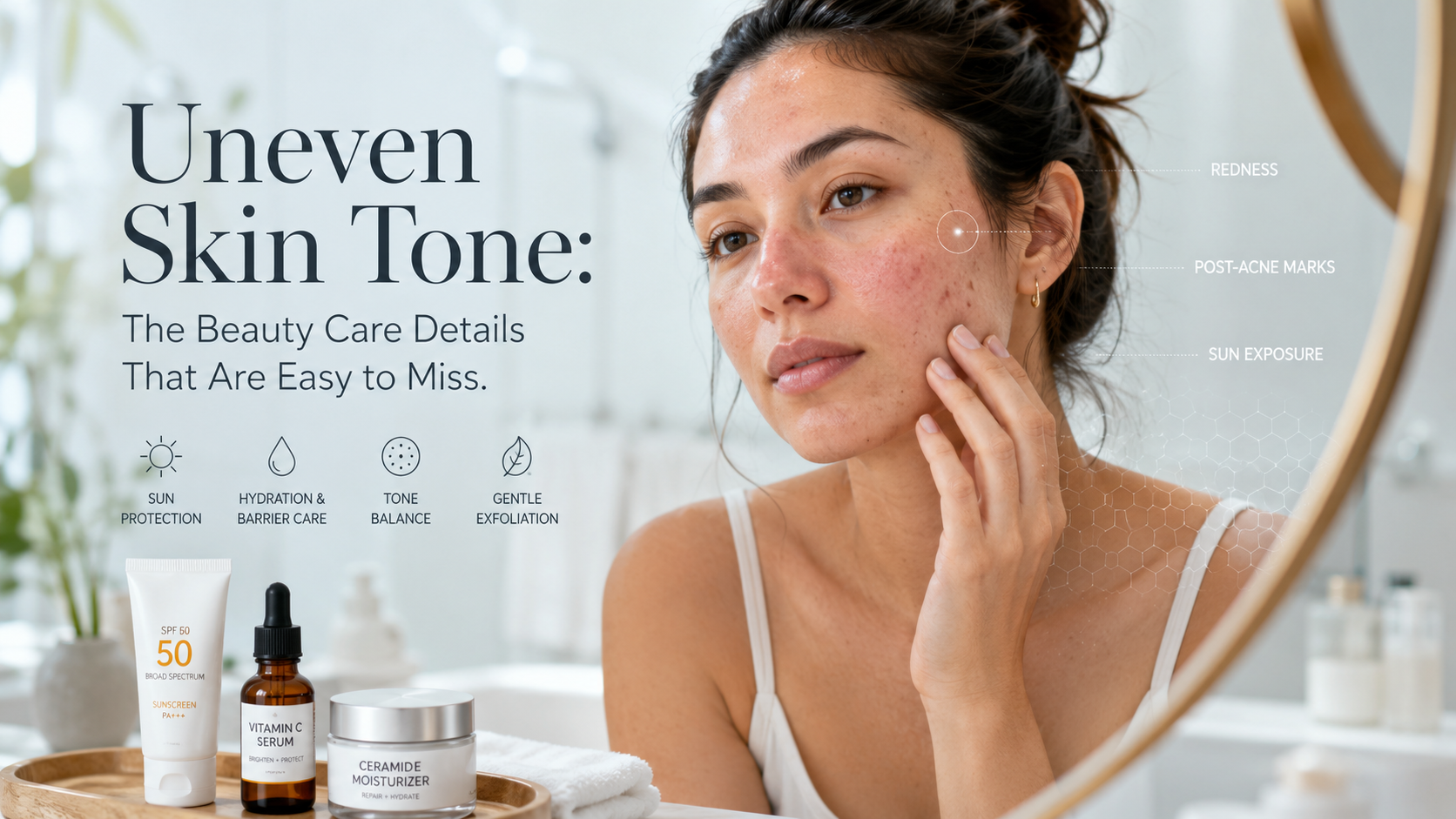
Uneven Skin Tone: The Beauty Care Details That Are Easy to Miss
Minjin Park
·
Uneven skin tone is one of those skin concerns that sneaks up quietly.
It’s not always dramatic. It may not look like a big breakout or a deep wrinkle. Sometimes it’s just a little dullness around the mouth, darker patches on the cheeks, redness near the nose, old acne marks that won’t leave, or a general feeling that your face looks “tired” even when you slept enough.
And because it can be subtle, uneven tone is easy to ignore until one day you apply makeup, stand near a window, and think, wait… when did that happen?
The tricky thing is that uneven skin tone doesn’t usually come from one single cause. Sun exposure, acne marks, dryness, irritation, hormones, inflammation, shaving, picking, harsh skincare, and even skipped sunscreen can all play a role.
That sounds like a lot, but don’t panic.
Managing uneven tone is less about doing everything perfectly and more about being consistent with a few basic habits. The boring habits, sadly, are usually the ones that work.
It can mean dark spots, redness, dull patches, acne marks, freckles, melasma-like patches, rough texture that reflects light unevenly, or areas that look gray, brown, pink, or inflamed compared to the rest of your face.
Sometimes it’s pigment. Sometimes it’s irritation. Sometimes it’s dryness. Sometimes it’s texture pretending to be discoloration.
That last one is important.
When skin is dry or rough, light doesn’t bounce off evenly. So even if you don’t have true dark spots, your face may look patchy or dull. This is why some people think they need a strong brightening serum when what they actually need is moisturizer and a gentler routine.
Not every uneven patch needs to be “faded.”
Some just need to calm down.
Sun Protection Is the Biggest Point People Miss
If uneven tone is your concern, sunscreen is not optional.
I know sunscreen is not the most exciting answer. Nobody wants to hear “wear sunscreen” for the thousandth time. It feels too basic, almost annoying.
But it matters.
Sun exposure can darken existing spots, make post-acne marks last longer, worsen melasma, and create new pigmentation over time. Even if you use brightening serums, exfoliants, retinoids, or expensive treatments, skipping sunscreen can undo a lot of that effort.
It’s like trying to clean the floor while walking through the room with muddy shoes.
Morning sunscreen should go on your whole face, including the areas people forget: around the mouth, under the jaw, sides of the face, ears, neck, and hairline. If you spend time outdoors, reapplication matters too.
And yes, sunscreen is still useful on cloudy days. UV rays do not politely disappear because the sky looks gray.
Very rude of them, but here we are.
Old Acne Marks Are Not Always Scars
A lot of people call every leftover acne mark a scar, but many are not true scars.
If the skin is flat but discolored, it may be post-inflammatory hyperpigmentation or post-inflammatory redness. Basically, your skin leaves a mark after inflammation. Acne, picking, irritation, bug bites, shaving bumps, and rashes can all do this.
These marks can fade, but slowly. Sometimes very slowly.
The biggest mistake is treating every new pimple aggressively and then picking at it. That creates more inflammation, which creates more marks, which makes the skin tone look even more uneven.
So if you want a clearer tone, don’t only think about fading old marks. Think about preventing new ones.
That means treating breakouts gently, not squeezing every bump, and protecting healing skin from the sun.
The mark you don’t create is always easier than the mark you have to fade.
Picking Makes Uneven Tone Worse
Picking is one of the fastest ways to turn a small skin issue into a long-term color problem.
A tiny pimple might last a few days. But if you squeeze it, scratch it, or peel the dry skin around it, you can create redness, swelling, scabbing, and pigmentation that lasts much longer.
This is especially true for deeper skin tones, which may be more prone to dark marks after inflammation. But honestly, anyone can get lingering redness or discoloration from picking.
The annoying part is that picking feels productive in the moment. You think you are “getting rid of it.”
But often you are just upgrading the problem.
A pimple patch can help if you keep touching spots. It creates a small barrier between your fingers and your skin. It also makes picking feel less available, which is half the battle.
Sometimes skincare is not about finding a magical ingredient.
Sometimes it’s about not making the spot worse at midnight.
Harsh Exfoliation Can Backfire
When skin tone looks uneven, it’s tempting to exfoliate harder.
A strong peeling toner. A scrub. An acid serum. Maybe a mask. Maybe all of them, because the skin looks dull and we want results immediately.
But uneven tone can get worse when the skin barrier is irritated.
Over-exfoliation can cause redness, dryness, peeling, burning, and tiny bumps. It can also make skin more sensitive to sunlight, which is not ideal when you’re trying to manage discoloration.
Exfoliation can help, but it needs to be controlled.
A gentle chemical exfoliant used one to three times a week may be enough for many people. Some people need even less. If your skin is already dry, stinging, or red, pause exfoliation and repair the barrier first.
Glowing skin and irritated skin can look similar for about ten minutes.
Then irritated skin wins.
Dryness Can Make Skin Look Patchy
Dry skin can make uneven tone look worse even when pigment is not the main problem.
When your skin lacks moisture, the surface becomes rough. Rough skin catches light unevenly. Makeup clings to flakes. Fine lines look sharper. Dark areas may look more shadowy. Red areas may look more obvious.
This is why moisturizing is part of tone care.
Not because moisturizer “bleaches” spots. It doesn’t. But hydrated skin looks smoother and more even because the surface is healthier.
If your skin feels tight after washing, your routine may be too drying. A gentle cleanser and a reliable moisturizer can make a surprisingly visible difference.
Beauty care does not always need to be complicated.
Sometimes your face is just thirsty and tired of being stripped.
The Area Around the Mouth Is Easy to Neglect
The skin around the mouth often becomes uneven, darker, or irritated, and people don’t always know why.
There are a few possible reasons.
Toothpaste residue can irritate the area. Lip products can spread beyond the lip line and clog or darken the surrounding skin. Frequent wiping, licking lips, spicy food, drooling during sleep, shaving, or hair removal can all create irritation.
If the area around your mouth looks darker or more textured, try brushing your teeth before washing your face. That way, any toothpaste residue gets cleansed off afterward.
Also, avoid dragging strong actives too close to the corners of the mouth if that area gets dry easily. The mouth area is sensitive and moves constantly, so irritation can happen fast.
It’s a small area, but it can change the whole look of the face.
Rude, but true.
Redness Is Also Uneven Tone
When people think of uneven tone, they often think only of brown spots. But redness counts too.
Redness around the nose, cheeks, chin, or between the brows can make the complexion look uneven. This may come from irritation, sensitivity, acne, rosacea-prone skin, weather changes, over-exfoliation, or harsh cleansing.
The mistake is trying to brighten redness the same way you would treat dark marks.
Redness often needs calming first.
Look for gentle, barrier-supporting products. Ingredients like niacinamide, panthenol, centella, ceramides, and azelaic acid may help some people, depending on tolerance. Avoid fragrance-heavy products if your skin reacts easily.
And if redness is persistent, burning, or comes with visible broken vessels or bumps, it may be worth speaking with a dermatologist. Not every red patch is something a serum can solve.
Shaving and Hair Removal Can Leave Marks
This point gets missed a lot.
Shaving, waxing, threading, plucking, or using depilatory creams can all irritate the skin. If irritation leads to bumps or inflammation, it can leave dark marks afterward.
This can happen on the face, underarms, legs, bikini line, or anywhere hair removal is repeated.
To reduce uneven tone from hair removal, be gentle. Don’t shave dry skin. Use a clean razor. Avoid going over the same area too many times. Moisturize afterward. Avoid strong actives right before or right after waxing or shaving if your skin is sensitive.
For the face, be especially careful around the upper lip and chin. These areas can develop pigmentation easily after irritation.
Hair removal should not feel like a punishment ritual.
If it burns every time, your skin is telling you something.
Brightening Ingredients Can Help, But They Need Time
There are ingredients that can help uneven tone, but none of them work overnight.
Common tone-supporting ingredients include niacinamide, vitamin C, azelaic acid, retinoids, licorice extract, tranexamic acid, alpha arbutin, and gentle exfoliating acids.
They can be useful, but the best one depends on your skin concern.
Vitamin C may help with dullness and antioxidant support. Niacinamide can support barrier health and uneven tone. Azelaic acid can help with redness, acne-prone skin, and marks. Retinoids can help with texture, acne, and long-term skin renewal. Exfoliating acids can smooth dull surface buildup.
But using all of them at once is usually not the answer.
That’s how people end up with irritated skin and even more uneven tone.
Pick one or two ingredients that match your skin needs. Use them consistently. Give them weeks, not three days.
Skin is slow. Very inconsiderate, but slow.
Sunscreen Makes Brightening Products Actually Worth It
This deserves its own section because it’s that important.
Brightening products without sunscreen are a frustrating waste of effort.
You can use vitamin C, niacinamide, azelaic acid, retinoids, and exfoliants, but if your skin gets daily UV exposure without protection, spots can darken again. The marks you are trying to fade may stay longer. New ones may appear.
This doesn’t mean you need to hide indoors forever. Just protect your skin properly.
Use sunscreen every morning. Apply enough. Reapply when outdoors for long periods. Wear hats or seek shade when the sun is strong.
Sunscreen is not just anti-aging. It is tone care.
It is probably the least glamorous but most important brightening product you own.
Makeup Can Hide Uneven Tone, But Skin Prep Matters
Makeup can help even out skin tone immediately, and there is nothing wrong with that.
But if the skin underneath is dry, irritated, or textured, makeup can sometimes make unevenness more obvious. Foundation may cling to flakes. Concealer may settle into lines. Powder may make dull patches look chalky.
Skin prep matters.
A gentle cleanse, light moisturizer, and sunscreen can make makeup sit better. If you have redness, a green-tinted corrector may help. If you have dark marks, a peach or orange corrector may work depending on your skin tone.
You don’t always need full-coverage foundation. Sometimes targeted concealing looks more natural.
The goal is not to erase your entire face.
It’s just to make the tone look more balanced if that helps you feel comfortable.
Your Neck and Chest Count Too
Uneven tone does not stop at the jawline.
The neck and chest often get sun exposure but less skincare. Over time, they can develop discoloration, redness, roughness, and dull patches. Then the face looks cared for, but the neck and chest tell a different story.
Bring sunscreen down to your neck and chest when they are exposed. Moisturize those areas too. If you use active ingredients there, go slowly because the neck and chest can be more sensitive than the face.
Face, neck, chest. Think of them as one visible zone.
A slightly needy zone, but still.
Lifestyle Habits Show Up More Than We Want
Skincare matters, but daily habits also affect how even your skin looks.
Poor sleep can make skin look dull. Stress can trigger breakouts and redness. Not removing makeup or sunscreen properly can lead to congestion. Frequent sun exposure can darken spots. Picking at skin creates marks. Smoking can affect skin tone and texture. Dehydration can make skin look tired.
This does not mean you need to live perfectly. Perfect routines are exhausting and usually fake.
But if your skin tone looks uneven, it helps to look at the whole picture. Are you sleeping badly? Over-exfoliating? Skipping sunscreen? Touching your face? Using a harsh cleanser? Trying too many new products?
Sometimes the problem is not that you need more skincare.
Sometimes you need fewer mistakes repeated daily.
A Simple Routine for Uneven Skin Tone
A good routine for uneven tone does not have to be complicated.
Morning:
Use a gentle cleanser or rinse with water. Apply a brightening or calming serum if you use one. Moisturize if needed. Apply sunscreen generously.
Night:
Cleanse properly, especially if you wore sunscreen or makeup. Use one treatment product, such as a retinoid, azelaic acid, niacinamide, or gentle exfoliant depending on your skin. Moisturize.
That’s the foundation.
Do not introduce five new products at once. If your skin reacts, you won’t know what caused it. Add products slowly, watch your skin, and keep sunscreen consistent.
The simpler the routine, the easier it is to know what is actually working.
When to Get Professional Help
Uneven tone is common, but some cases need professional care.
If you have melasma-like patches, sudden pigmentation changes, severe acne marks, scarring, persistent redness, or irritation that doesn’t improve, a dermatologist can help. Treatments may include prescription creams, chemical peels, lasers, or other options depending on your skin type and concern.
This is especially important with pigmentation because the wrong treatment can make it worse, particularly in deeper skin tones.
Professional help is not admitting defeat.
It is just getting a clearer plan instead of guessing from product labels.
So, What Are the Beauty Care Points That Are Easy to Miss?
Uneven skin tone is not only about dark spots. It can come from acne marks, redness, dryness, irritation, sun exposure, shaving, picking, and rough texture.
The most important care points are simple:
Wear sunscreen every day. Don’t pick at acne or dry skin. Avoid over-exfoliating. Keep the skin barrier moisturized. Treat redness gently. Be careful with hair removal irritation. Use brightening ingredients consistently, not aggressively. Don’t forget the mouth area, neck, and chest.
Uneven tone usually improves slowly. That can be frustrating, especially when you want a clear, smooth complexion right now. But skin is not a quick-edit photo app. It responds to repeated care.
Small daily choices add up.
And sometimes the biggest improvement comes not from adding another product, but from protecting your skin from the little things that keep upsetting it.
Hi, I’m the creator and editor behind ZestyHabit. I research everyday safety, first aid, and practical wellness topics using official guidance and reliable public sources, then turn that information into clear, realistic steps for daily life.
My goal is to help readers make safer, better-informed choices at home and beyond.