
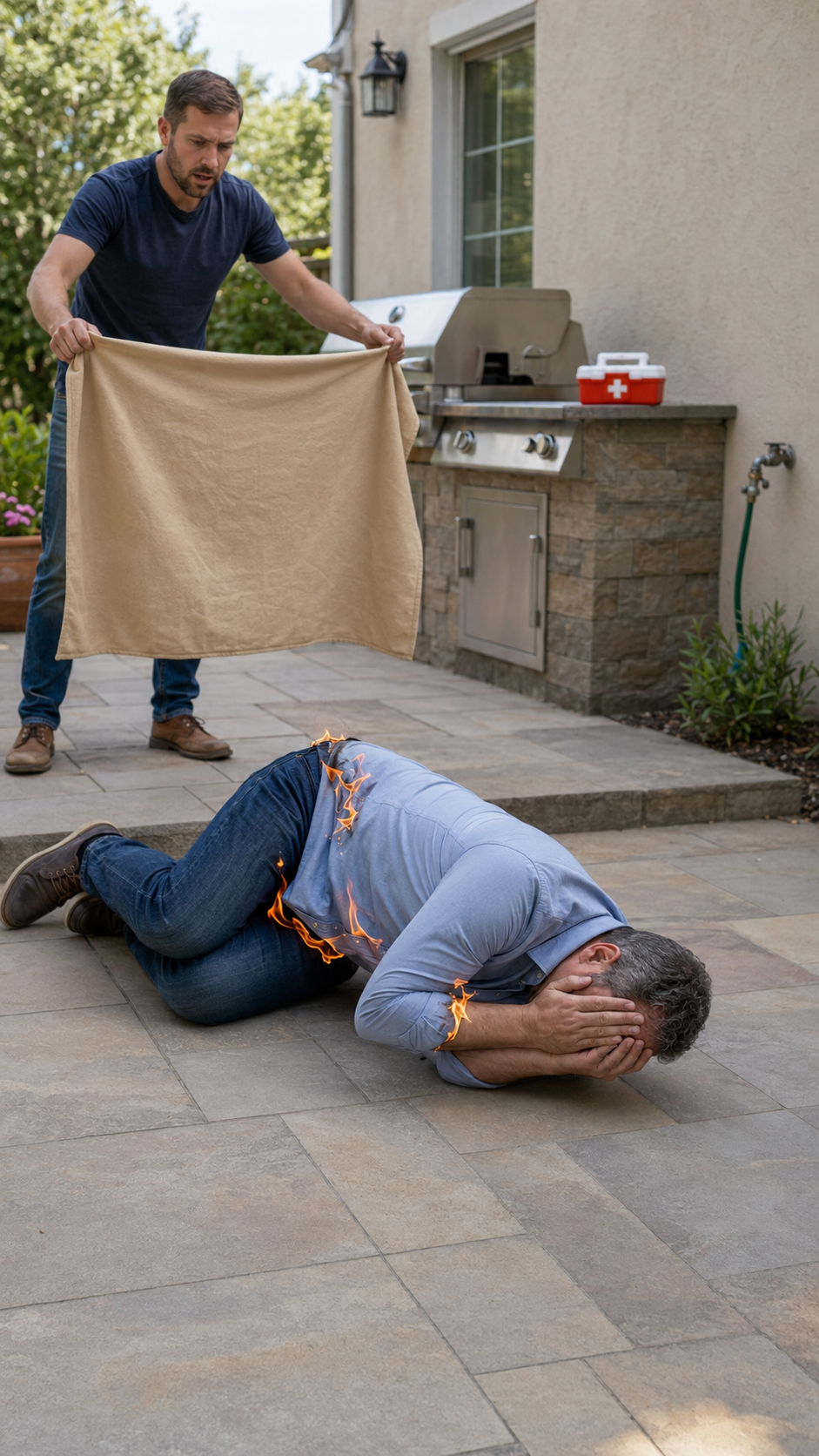
Few emergencies are as frightening as realizing that your clothing has caught fire. Your natural reaction may be to run, wave your arms, or search frantically for water. Unfortunately, running feeds the flames with more oxygen and can cause the fire to spread toward your face and hair.

The most important response is simple: stop, drop, and roll. These three actions can smother the flames quickly and reduce the amount of time your skin is exposed to heat. Once the fire is out, however, the emergency is not necessarily over. Flame burns can be deep, and smoke or hot gases may damage the airway even when the skin injury initially appears manageable.
This guide explains what to do if your clothes catch fire, how to help another person, how to provide immediate burn first aid, and when to call 911.
Important: This article provides general safety information and is not a substitute for professional medical care. Call 911 or your local emergency number whenever a burn appears serious or you are unsure how severe it is.
The Immediate Rule: Stop, Drop, and Roll
If any part of your clothing catches fire, remember these three words:
- Stop
- Drop
- Roll
Do not run toward a sink, shower, fire extinguisher, or exit unless it is only a step or two away. If you run, moving air can make the flames burn faster and spread upward.
Fire departments consistently teach stop, drop, and roll because it limits airflow around the flames and presses burning fabric against the ground. The Devon and Somerset Fire and Rescue Service also advises covering your face with your hands while rolling to help protect your face and head.
Step 1: Stop Moving
The moment you notice flames on your clothing, stop where you are.
Running may feel instinctive, especially if you can see a door, faucet, or another person nearby. However, even a short run can fan the fire and increase the severity of the burn. Flames also tend to travel upward, which means a fire that begins near your legs or waist may quickly reach your chest, neck, hair, and face.
If you are standing directly beside the original source of the fire—such as a burning stove, campfire, or spilled fuel—take only the minimum movement necessary to get away from it. Then immediately drop to the ground.
Step 2: Drop to the Ground
Lie down as quickly as you safely can. Stretch your legs out and keep your body as flat as possible.
Dropping serves two purposes. First, it reduces the chance that flames will rise toward your face. Second, it places you in the correct position to roll and smother the fire.
Cover your face with your hands if possible. Keep your fingers together and place your palms over your eyes, nose, and mouth while still leaving enough space to breathe. If your sleeves are burning, protect your face as much as you can without holding the flames directly against it.
A person with limited mobility may not be able to drop independently. In that situation, a nearby person should help lower them carefully rather than allowing them to fall.
Step 3: Roll Until the Flames Are Out
Roll back and forth continuously. Do not roll in only one direction and do not stop after a single turn.
The goal is to press every burning section of clothing against the floor or ground. Continue rolling until you or someone helping you confirms that all visible flames have been extinguished.
If a fire blanket, heavy coat, rug, or thick blanket is immediately available, another person can place it over the flames to help smother them. It should be pressed over the burning area without covering the person’s nose and mouth. According to the Scottish Fire and Rescue Service, a blanket, rug, or thick coat can be used when another person’s clothing catches fire.
Do not use thin, highly flammable material. Do not waste valuable time searching through another room for a blanket when rolling can begin immediately.
How to Help Someone Else Whose Clothes Are Burning
A person on fire may panic and run without responding to ordinary instructions. Speak loudly and clearly:
“Stop! Get down! Roll!”
If it is safe to approach, help the person to the ground. Protect yourself from the flames and avoid grabbing burning fabric with bare hands. Once the person is down, help them roll or smother the flames with a fire blanket, heavy coat, or thick blanket.
If water is immediately available, it may also be used to extinguish burning clothing. However, never use water if electricity is involved or if a hazardous chemical could react with it.
Have someone call 911 while you extinguish the flames. If you are alone, put out the flames first and then call. Do not assume the person is fine simply because they are awake and speaking. Clothing fires can cause deep burns surprisingly quickly.
After the flames are out, move the person away from smoke, heat, and any continuing fire—but do not put yourself in danger. If the surrounding room or building is burning, evacuate as soon as possible and remain outside.
What to Do After the Fire Is Out
Once every flame and glowing area has been extinguished, begin burn first aid.
Call for emergency help
Call 911 for a large or deep flame burn, any breathing difficulty, facial or neck burns, confusion, loss of consciousness, or significant smoke exposure. Clothing fires frequently affect more than a tiny area and deserve a low threshold for professional evaluation.
If someone is unconscious and not breathing normally, begin CPR if you know how and follow the dispatcher’s instructions. Do not delay the emergency call while trying to inspect every burn.
Remove smoldering material carefully
Remove loose, hot, or smoldering clothing when it can be lifted away easily. Also remove rings, watches, belts, shoes, and other tight objects before swelling develops.
Never pull away clothing that has melted or become stuck to the skin. Doing so can tear damaged tissue and make the injury worse. Cut around stuck fabric if necessary and leave the attached portion in place for medical professionals.
Cool a small, localized burn
Place a small or localized burn under cool, gently running water. Avoid water that is icy or uncomfortably cold. Cooling helps stop heat remaining in the tissue from causing additional injury.
The American Burn Association recommends cool running water for at least five minutes, while the NHS burn guidance advises cooling for approximately 20 minutes. When practical, cooling a small burn with cool running water for about 20 minutes is a useful first-aid target.
Do not immerse someone with extensive flame burns in cold water. Large-scale cooling can dangerously lower body temperature, especially in children, older adults, and people with major burns. For a significant clothing fire, follow the emergency dispatcher’s instructions and keep the person’s unburned areas warm.
Cover the burn loosely
After cooling, loosely cover the injured area with sterile nonstick gauze or a clean, dry, non-fluffy cloth. The covering helps protect exposed skin from contamination and air movement.
Do not wrap the burn tightly. Swelling may develop after the injury, and a tight bandage can restrict circulation. Keep the person warm with a clean blanket placed over unburned areas while waiting for help.
When a Clothing Burn Requires Emergency Care
Call 911 immediately if:
- The burn is large, deep, charred, leathery, white, brown, or black.
- The person has trouble breathing, persistent coughing, wheezing, hoarseness, or chest tightness.
- The face, mouth, nose, neck, hands, feet, genitals, or a major joint is burned.
- There is soot around the mouth or nose.
- The person was exposed to smoke in an enclosed space.
- The burn circles an arm, leg, finger, toe, chest, or neck.
- The person is confused, unusually sleepy, weak, unconscious, or not breathing normally.
- The injury involves electricity, chemicals, an explosion, or burning fuel.
- The injured person is a baby, an older adult, or someone with a serious medical condition.
The American Burn Association recommends emergency care for large or deep flame burns, airway involvement, smoke-inhalation symptoms, confusion, or unconsciousness.
Pain is not always a reliable way to judge severity. A very deep burn may feel strangely numb because nerve endings have been damaged.
Burn First Aid Mistakes to Avoid
What you do not do can be just as important as what you do.
Do not run
Running increases airflow and may intensify the flames. Stop, drop, and roll immediately.
Do not use ice
Ice and ice water can further damage burned tissue and contribute to hypothermia. Use cool—not freezing—running water for an appropriate small burn.
Do not apply butter, oil, or toothpaste
Butter, cooking oil, petroleum jelly, and similar substances may trap heat against the skin. Toothpaste, flour, and other home remedies can irritate the injury or introduce contamination.
Do not peel away stuck clothing
Leave fabric attached to the skin in place. Medical professionals can remove it safely.
Do not break blisters
Blisters provide a natural protective barrier over injured tissue. Opening them increases the chance of infection.
Do not underestimate smoke inhalation
Someone may have a serious airway injury without a dramatic external burn. Hoarseness, coughing, soot, breathing trouble, facial burns, or smoke exposure in a closed room require urgent attention.
What If Hair Catches Fire?
Hair can ignite and spread flames toward the scalp and face within seconds. Stop moving, cover your face, drop, and roll just as you would for burning clothing.
If another person’s hair is burning, use water immediately if it is safely available, or smother the flames with a fire blanket or thick cloth. Avoid pressing burning hair against the person’s face. Facial burns, singed nasal hair, soot near the nose, or breathing symptoms should be treated as possible airway emergencies.
What If You Cannot Get Down and Roll?
People who use wheelchairs, have joint problems, are pregnant, or have another mobility limitation may not be able to perform the traditional movement.
If possible, press the burning area against a nonflammable surface or smother it with a fire blanket or thick coat. A helper can use the blanket to cover and press down the flames while keeping the person’s airway uncovered. Water may be used when it is immediately available and no electrical or chemical hazard is present.
Families, caregivers, schools, and workplaces should include mobility assistance in their fire escape plans rather than waiting until an emergency to decide what to do.
Preventing Clothing Fires
Many clothing fires begin during ordinary activities rather than large building fires. A loose sleeve may pass over a gas burner, a robe may touch a space heater, or synthetic fabric may ignite near a campfire.
To reduce the risk:
- Keep loose sleeves, scarves, and long hair away from open flames.
- Turn pot handles inward while cooking.
- Keep clothing and bedding at least three feet from space heaters.
- Never use gasoline or another accelerant to start or strengthen a fire.
- Wear close-fitting clothing when cooking over an open flame.
- Supervise children around candles, grills, fireplaces, and fire pits.
- Store matches and lighters where children cannot reach them.
- Keep an appropriate fire extinguisher and fire blanket accessible.
- Practice stop, drop, and roll with children and other household members.
- Maintain working smoke alarms and a practiced home escape plan.
Practice matters because panic makes it difficult to remember unfamiliar instructions. Even adults benefit from physically rehearsing how to stop, get down, cover the face, and roll.
Remember the Order
If your clothing catches fire, the order is straightforward:
Stop moving. Drop to the ground. Cover your face. Roll until every flame is out. Call for help. Then provide safe burn first aid.
The flames may last only seconds, but those seconds matter. Acting immediately can limit the burn, protect the face and airway, and prevent a frightening situation from becoming even more serious.
Have you ever practiced stop, drop, and roll with your family, or is there another fire-safety question you would like answered? Share your experience or question in the comments so other readers can learn from it too.

Hi, I’m the creator and editor behind ZestyHabit. I research everyday safety, first aid, and practical wellness topics using official guidance and reliable public sources, then turn that information into clear, realistic steps for daily life.
My goal is to help readers make safer, better-informed choices at home and beyond.


