
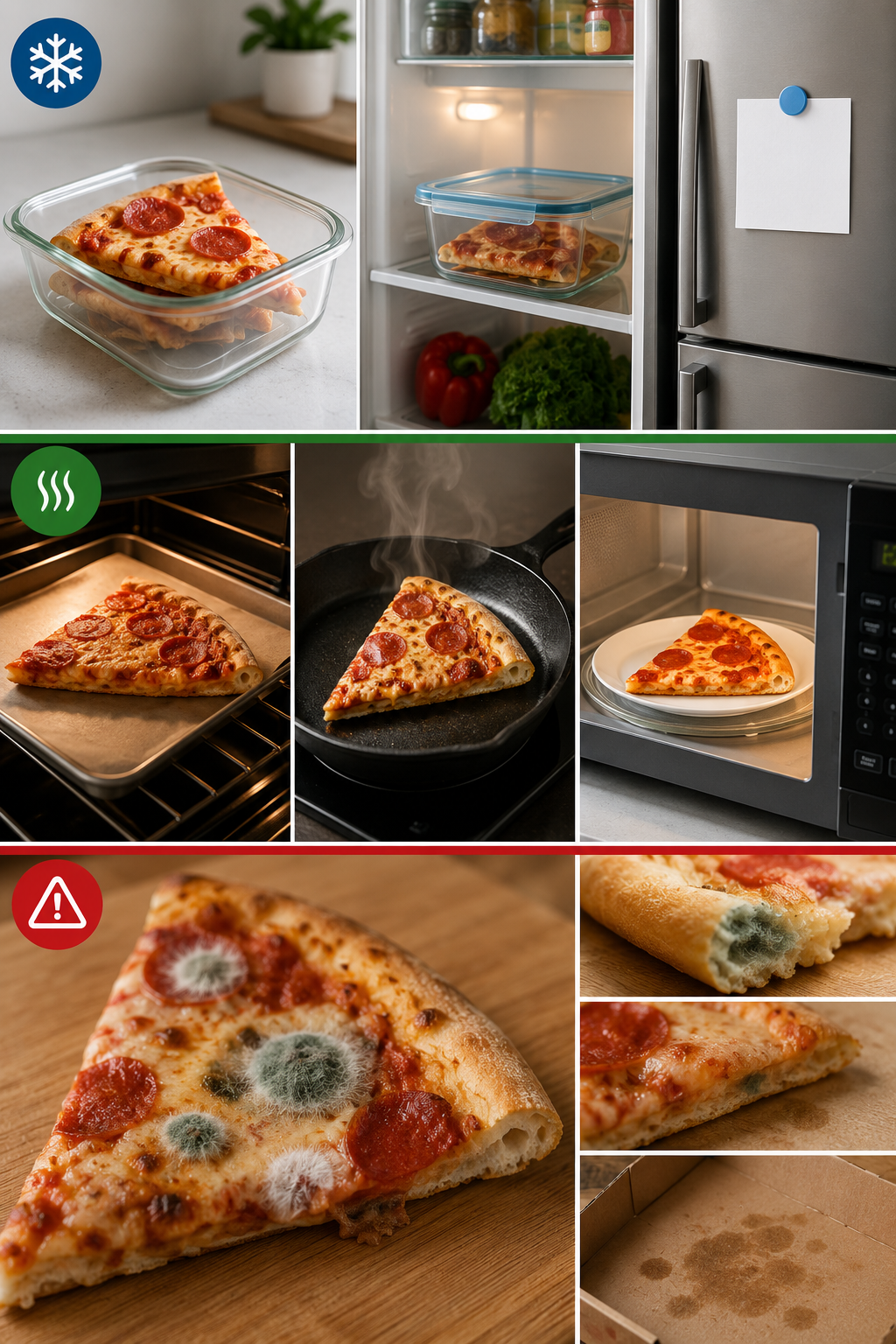

Learn how long leftover pizza lasts, when it must be refrigerated, how to reheat it safely, and which spoilage signs mean it should be discarded.
Suggested URL slug: how-long-is-leftover-pizza-safe
Leftover pizza is one of those foods people treat more casually than they probably should. A box may remain on the counter during a party, sit beside the television through an entire movie, or stay out overnight before someone decides it still looks good enough for breakfast.
Unfortunately, pizza is not shelf-stable simply because it has been baked. Cheese, meat, tomato sauce, cooked vegetables, and other moist toppings can support bacterial growth when they remain at room temperature. Even plain cheese pizza needs to be refrigerated promptly.
So, how long is leftover pizza actually safe?
Refrigerate pizza within two hours of cooking, delivery, or serving—or within one hour when the surrounding temperature is above 90°F (32°C). Properly refrigerated pizza should generally be eaten within three to four days. When reheating it, bring the center of the slice to 165°F (74°C). Pizza left out overnight should be discarded, even if it looks and smells normal.
Here is everything you need to know about storing, reheating, freezing, and safely disposing of leftover pizza.
How Long Can Pizza Sit Out at Room Temperature?
Pizza should not remain at room temperature for more than two hours. If the temperature is above 90°F, such as at an outdoor party, in a hot kitchen, or inside a parked car, that limit drops to one hour.
The FDA’s two-hour rule applies to foods that require refrigeration, including leftovers and takeout. Bacteria grow most rapidly in the temperature range between 40°F and 140°F (4°C and 60°C), often called the “danger zone.” (FDA food-storage guidance)
The clock is cumulative. If the pizza sits out for an hour during dinner, spends another 30 minutes in the car, and then remains on the counter for 45 minutes, it has exceeded the recommended limit.
Refrigerating the pizza afterward does not reset the clock or reverse bacterial growth that may already have occurred.
Is Pizza Left Out Overnight Safe to Eat?
No. Pizza that has been left at room temperature overnight should be thrown away.
It does not matter whether the pizza contains pepperoni, vegetables, or only cheese. All of these varieties contain moist, perishable ingredients. The crust may feel dry, but the cheese, sauce, and toppings can still support bacterial growth.
A common argument is that people have eaten overnight pizza before without becoming sick. That experience does not prove that the practice is safe. Foodborne illness depends on many factors, including the level and type of contamination, room temperature, time, and the health of the person eating the food.
Smelling the pizza is not an adequate safety test. Many disease-causing bacteria do not produce an obvious odor, flavor, or visible change. A slice can smell completely normal and still be unsafe.
Reheating is not a reliable way to rescue pizza that has been left out too long. Heat can kill many bacteria, but some microorganisms can produce toxins that may remain after ordinary reheating. When the time at room temperature is unknown or clearly exceeds two hours, the safest decision is to discard the pizza.
How Long Does Leftover Pizza Last in the Refrigerator?
Properly refrigerated pizza generally remains safe for three to four days when kept at 40°F (4°C) or below.
FoodSafety.gov specifically lists pizza with a refrigerated storage period of three to four days. Its freezer-quality recommendation is one to two months. (FoodSafety.gov cold-storage chart)
If pizza was refrigerated on Monday evening, plan to eat it by Thursday or Friday, depending on how you count the storage period. When there is any uncertainty, use the earlier date.
The three-to-four-day period assumes that the pizza:
- Was refrigerated within the two-hour limit
- Has remained at 40°F or colder
- Was protected from contamination
- Was not repeatedly taken out and returned to the refrigerator
- Did not already contain spoiled ingredients
Refrigeration slows bacterial growth, but it does not stop it completely. Do not keep leftover pizza for a week simply because it still looks acceptable.
Do Different Pizza Toppings Change the Storage Time?
The safest general rule is to treat all leftover pizza as a three-to-four-day refrigerated food. Certain toppings may lose quality sooner, but they do not justify extending the storage period.
Meat-topped pizza
Pepperoni, sausage, bacon, chicken, ham, and ground beef are perishable after cooking. Refrigerate meat-topped pizza within two hours and use it within three to four days.
Cheese pizza
Cheese pizza still requires refrigeration. Melted cheese and tomato sauce contain enough moisture to make the pizza perishable.
Vegetable pizza
Cooked mushrooms, spinach, peppers, onions, tomatoes, and other vegetables can release moisture during storage. Vegetable pizza may become soft or watery, but it should still follow the same safety limits.
Seafood pizza
Pizza topped with shrimp, clams, tuna, or other seafood can deteriorate quickly in quality. Refrigerate it promptly and consider eating it earlier within the recommended window.
White pizza
White pizza made with ricotta, Alfredo sauce, cream sauce, or other dairy-rich ingredients should be handled just as carefully as traditional tomato-based pizza.
Vegan pizza
A pizza without animal products is not automatically safe at room temperature. Cooked vegetables, plant-based cheese, sauce, and moist toppings may still support microbial growth.
The Best Way to Refrigerate Leftover Pizza
Leaving pizza in its original cardboard box is convenient, but it is not the best long-term storage method. Cardboard does not form an airtight barrier, and the pizza can dry out or absorb refrigerator odors.
Follow these steps instead:
- Wash your hands before handling the leftovers.
- Separate the pizza into individual slices.
- Place the slices in a shallow airtight container or wrap them tightly.
- Put parchment paper or wax paper between stacked slices.
- Refrigerate the pizza promptly at 40°F or below.
- Label the container with the storage date.
You do not need to wait until the pizza becomes completely cold before refrigerating it. In fact, leaving it on the counter to “cool down” for several hours creates a greater food-safety risk. Divide a large amount into smaller portions so it cools quickly in the refrigerator.
The FDA notes that placing hot food in the refrigerator does not damage the appliance and recommends dividing leftovers into smaller containers to speed cooling. (FDA refrigerator guidance)
Can You Freeze Leftover Pizza?
Yes. Pizza generally freezes well, and freezing is a useful option when you will not finish the leftovers within three to four days.
For the best quality, freeze pizza within the refrigerated storage window rather than waiting until the final day. Freezing does not make old or questionable pizza fresh again.
How to freeze pizza properly
- Make sure the pizza was originally refrigerated within two hours.
- Allow refrigerated slices to become cold before packaging for the freezer.
- Wrap each slice tightly in plastic wrap, foil, or freezer paper.
- Place the wrapped slices in a freezer bag or airtight container.
- Remove excess air from the package.
- Label it with the type of pizza and freezing date.
- Store it at 0°F (-18°C) or below.
Individually wrapped slices are easier to reheat because you can remove only what you need. Parchment paper between slices also prevents them from sticking together.
For the best taste and texture, use frozen pizza within one to two months. Frozen food kept continuously at 0°F may remain safe beyond that period, but the crust and toppings can gradually develop freezer burn or lose flavor.
How to Thaw Frozen Pizza Safely
You do not always have to thaw frozen pizza before reheating it. Most slices can go directly from the freezer into an oven, toaster oven, or air fryer. They will simply need additional heating time.
If you prefer to thaw the pizza first, place it in the refrigerator for several hours or overnight. Do not leave it on the counter to thaw.
Pizza thawed in the microwave should be heated and eaten immediately. Microwave thawing can make the crust soft, so it is often better to finish the slice in a skillet, toaster oven, or conventional oven.
How to Reheat Pizza Safely
Leftover pizza should be reheated to an internal temperature of 165°F (74°C). FoodSafety.gov recommends this temperature for all types of leftovers. (Safe minimum internal temperatures)
Insert a clean food thermometer into the thickest or coldest part of the slice. This is especially important for deep-dish pizza, heavily topped pizza, and slices containing large pieces of meat.
The cheese melting is not proof that the entire slice has reached a safe temperature. A thick center or cold topping can remain below 165°F even while the edges appear hot.
Reheating pizza in the oven
The oven is one of the best methods for restoring a crisp crust.
- Preheat the oven to approximately 375°F (190°C).
- Place the pizza on a baking sheet, oven-safe rack, or preheated tray.
- Heat for approximately 8 to 12 minutes.
- Add more time for thick or frozen slices.
- Check that the center reaches 165°F.
Covering the pizza loosely with foil for the first part of reheating can prevent the cheese from drying out. Remove the foil near the end to crisp the crust.
Reheating pizza in a skillet
A skillet works particularly well for one or two slices.
- Place the pizza in a dry skillet over low or medium-low heat.
- Cover the pan with a lid.
- Heat until the bottom becomes crisp and the toppings are hot.
- Add a few drops of water to the side of the pan—not directly on the pizza—if the cheese needs help melting.
- Continue heating until the slice reaches 165°F.
The lid traps steam, warming the toppings while the pan crisps the bottom.
Reheating pizza in an air fryer
An air fryer can quickly restore a crisp crust.
- Preheat it if required by the manufacturer.
- Arrange slices in a single layer.
- Heat at approximately 350°F (175°C).
- Check after three to five minutes.
- Continue heating until the center reaches 165°F.
Thick, refrigerated, or frozen slices may require additional time. Avoid overcrowding the basket because the pizza may heat unevenly.
Reheating pizza in the microwave
The microwave is the fastest option, although it can make the crust chewy or soft.
- Place one or two slices on a microwave-safe plate.
- Cover them loosely with a microwave-safe cover.
- Heat in short intervals.
- Rotate the plate or rearrange the slices between intervals.
- Allow a brief standing time.
- Check several areas for a temperature of 165°F.
FoodSafety.gov recommends covering and rotating food during microwave reheating because microwaves can create cold spots. (FoodSafety.gov leftovers guidance)
For a crisper result, transfer the microwaved slice to a hot skillet for a minute or two.
Can You Eat Leftover Pizza Cold?
Yes, refrigerated pizza can be eaten cold if it was stored safely and remains within the three-to-four-day period.
Reheating leftovers to 165°F provides an additional safety step, especially for people at greater risk of foodborne illness. However, properly handled ready-to-eat leftovers are often consumed cold.
Do not eat the pizza cold if it was left out too long before refrigeration, has exceeded its storage window, or shows signs of spoilage. Cold temperatures do not make previously mishandled food safe.
Pregnant people, young children, adults over 65, and people with weakened immune systems should be especially careful with storage times and reheating.
How Many Times Can You Reheat Pizza?
It is better to reheat only the number of slices you intend to eat. Repeated heating and cooling can reduce quality and increase the chances that the pizza spends too much time at unsafe temperatures.
If reheated pizza is not eaten, refrigerate it again within two hours. Reheat it thoroughly the next time. However, each cycle can make the crust tougher and the toppings drier.
Portioning the pizza before storage avoids this problem. Instead of reheating an entire box, take out one or two slices and leave the rest cold.
Signs That Leftover Pizza Should Be Discarded
Throw the pizza away if you notice:
- Visible mold
- A sour, rancid, or unusual odor
- Slimy cheese, meat, or vegetable toppings
- Unusual green, blue, black, or pink discoloration
- A leaking or swollen storage package
- Significant changes in texture accompanied by an off smell
- More than three to four days of refrigerated storage
- More than two hours at room temperature
- An unknown storage history
Freezer burn appears as pale, dry, or leathery patches. It is mainly a quality issue rather than proof of dangerous contamination, but heavily freezer-burned pizza may taste unpleasant.
Never taste questionable pizza to determine whether it is safe. When you cannot remember when it was purchased or how long it sat out, throwing it away is safer than gambling on a leftover slice.
Common Leftover-Pizza Mistakes
Leaving the box out overnight
This is the most important mistake to avoid. Refrigerating or reheating the pizza the next morning does not reliably make it safe.
Assuming meatless pizza is shelf-stable
Cheese, sauce, and cooked vegetables are still perishable.
Waiting for pizza to cool completely
It is better to refrigerate pizza promptly in small portions than to leave it out for several hours.
Storing pizza uncovered
Uncovered pizza dries out, absorbs odors, and can be contaminated by other refrigerator contents.
Keeping it for a full week
Three to four days—not seven—is the recommended refrigerated storage period.
Trusting smell alone
Spoilage may create unpleasant odors, but harmful bacteria are not always detectable through sight or smell.
Reheating only until the cheese melts
The thickest part of the slice should reach 165°F, particularly when it contains meat or dense toppings.
Frequently Asked Questions
Is five-day-old refrigerated pizza safe?
Five days exceeds the standard three-to-four-day recommendation. The safest choice is to discard it, even if it appears normal.
Can I put the pizza box directly in the refrigerator?
You can do so temporarily if necessary, but airtight containers or tightly wrapped slices preserve quality better and protect the pizza from contamination.
Is pizza safe after three hours at room temperature?
Under standard room conditions, three hours exceeds the two-hour limit. It should be discarded. If the temperature was above 90°F, the limit was only one hour.
Does microwaving kill all bacteria on old pizza?
Microwaving can kill many bacteria when food reaches 165°F throughout, but it may heat unevenly and cannot reliably neutralize every toxin that may have formed. Do not use reheating to rescue pizza stored unsafely.
Can delivery pizza go directly into the refrigerator?
Yes. Eat what you want and refrigerate the remaining slices promptly. There is no need to let the leftovers sit out until they become completely cold.
Final Thoughts
Leftover pizza can make an easy meal, but only when it has been handled correctly. Refrigerate it within two hours, store it at 40°F or below, eat it within three to four days, and reheat it to 165°F. If a pizza box spent the night on the counter, the safest destination is the trash—not the breakfast plate. How do you usually reheat leftover pizza: oven, skillet, air fryer, or microwave? Share your favorite method and best crispy-crust trick in the comments below.

Hi, I’m the creator and editor behind ZestyHabit. I research everyday safety, first aid, and practical wellness topics using official guidance and reliable public sources, then turn that information into clear, realistic steps for daily life.
My goal is to help readers make safer, better-informed choices at home and beyond.


